
Lieferung heute & morgen

Qualitätsgarantie

Willkommens-Angebote freischalten: KOSTENLOSE Lieferung | Bis zu 80 % RABATT | Kostenlose 30-Tage-JoyPlus-Testphase
App herunterladen
An LED bathroom mirror with lights combines a mirror and light source in one space-saving fitting. To make sure it’s a good long-term choice for your bathroom, you’ll need to consider more than just design and price. Key factors include the type of installation, lighting controls, IP rating and the area actually covered by the demisting function.
An LED bathroom mirror with a demisting function usually heats only a specific area. The function may also have a separate control or switch on at the same time as the lights. So it’s worth checking the stated demisting area before you buy.
For example, the heated area specified for the 50 × 70 cm EMKE model is 40 × 25 cm. This may be enough for the central viewing area, but it won’t cover the entire mirror.
A bathroom mirror with three light colours can switch between warm white, neutral white and cool white. But this doesn’t tell you whether you can adjust the brightness. Some models offer different colour temperatures only, while a dimmable bathroom mirror also lets you adjust the brightness continuously or in stages.
Adjustable brightness can be useful for applying make-up, shaving and everyday grooming. If you need this feature, look specifically for “dimmable” or a brightness range such as 10 to 100 per cent.
The IP44 rating describes protection against solid objects and splashing water from different directions. This doesn’t mean an IP44 bathroom mirror is automatically suitable for every position in the bathroom. You’ll also need to consider the specific installation area, distance from water sources and the instructions in the installation guide.
Models that are wired directly into the mains should be installed in line with current electrical regulations. If you’re not confident doing this, contact a qualified electrician.
First, measure the available wall width and the distance to the washbasin, taps and sockets. A 100 × 60 cm bathroom wall mirror is better suited to wider basins, while a 50 × 70 cm model may fit more easily in a compact bathroom.
A round 70 cm LED bathroom mirror creates a different look from a rectangular one. Also check whether it can be mounted horizontally and vertically. This may affect the position of the wall connections and the switch.
Check the following details:
A modern LED mirror often consists of a glass panel, an aluminium frame and a light box at the back. Check the glass thickness, edge finish and stated depth. Some models also need a specific gap between the wall and mirror to allow for the cable.
The package should include at least the mounting accessories and clear instructions. For products that need to be wired directly into the mains, check whether fixings are included or need to be bought separately.
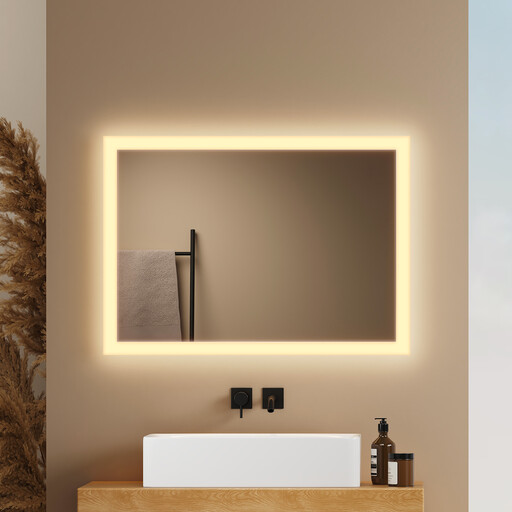
Why it’s a good fit: Its compact rectangular shape suits smaller bathrooms or rooms that are already furnished. Two light colours, a separate demisting button and side-switch controls cover the essentials.
The product details clearly state that the brightness isn’t dimmable, so you can get a realistic idea of what’s included before you buy.
50 × 70 cm, two light colours, separate demisting function, IP44 rating, and horizontal or vertical mounting.
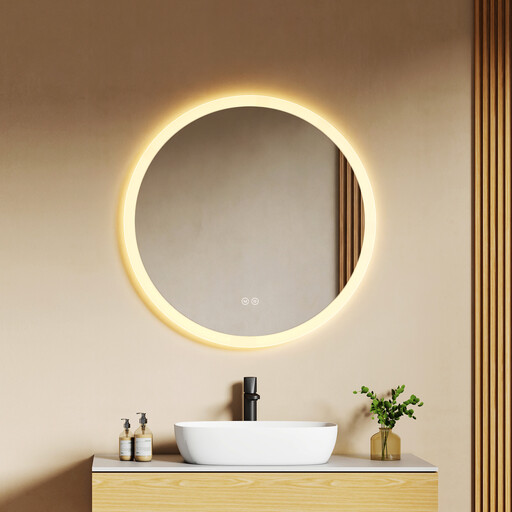
Why it’s a good fit: This round mirror combines three light colours with adjustable brightness and a memory function. It’s a good match for bathrooms where both style and flexible lighting controls matter.
The product details clearly distinguish between the three light colours and the additional brightness adjustment from 10 to 100 per cent.
Ø 70 cm, three light colours, dimmable lighting, touch switch, memory function and automatic shut-off after three hours, according to the product description.
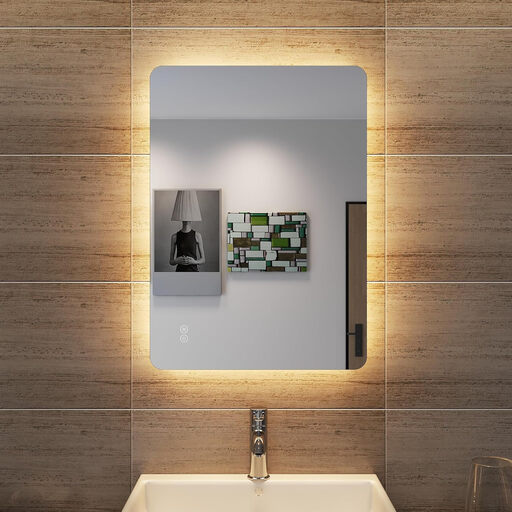
Why it’s a good fit: For households where the bathroom gets frequent use, this model offers several light colours, dimmability and controls that remember your settings, all in a compact design.
The product details list the IP44 rating, three light colours, dimmability and memory function separately. They also point out that the mirror isn’t intended to be the room’s only source of lighting.
Touch controls, three light colours, dimmable lighting, memory function, demisting function and a 4 mm-thick mirror, according to the product details.
We’ve put together a complete, regularly updated list of products that meet these strict selection criteria and fully comply with the safety regulations in force in the EU.
First, check the wall material, fixing points, mirror weight and cable routing. Depending on the model, you may be able to mount it horizontally or vertically. If it’s connected to the mains, switch off the power supply first. Follow the installation instructions and, if in doubt, hire a qualified electrician.
Lifespan depends on the LED module, power supply, usage and surroundings. Some product details, for example, state that the LED lamps can last up to 50,000 operating hours. This manufacturer’s estimate isn’t a guarantee of the actual overall lifespan of the mirror or power supply.
Energy use depends mainly on the power rating, how long you use it each day and the brightness setting. LED technology is generally designed to use relatively little energy, but you’ll need to check the wattage of the specific model for an accurate figure. An automatic shut-off function or switching the mirror off at the wall can help prevent unnecessary use.