
Lieferung heute & morgen

Qualitätsgarantie

Willkommens-Angebote freischalten: KOSTENLOSE Lieferung | Bis zu 80 % RABATT | Kostenlose 30-Tage-JoyPlus-Testphase
App herunterladen
An LED battery table lamp can provide extra light on a bedside table, dining table, balcony or campsite, without needing a power cable that reaches the nearest socket. Before you buy, though, it’s worth taking a closer look at the technical details. Product names such as ‘outdoor’, ‘waterproof’ or ‘long-lasting’ don’t always give you a clear idea of where a lamp can actually be used.
A figure such as 4,000 mAh tells you the battery’s capacity, but little else. How long a rechargeable table lamp will actually stay lit also depends on its brightness setting, LED power and controls. Runtime figures often refer to the lowest brightness setting. If you want to keep a lamp bright for long periods, look for runtime figures for several settings.
Replaceable batteries also mean ongoing costs. A USB-rechargeable lamp may be more practical if you use it regularly, but you’ll need to pause to recharge it and have a suitable power source.
An outdoor table lamp with an IP44 rating is protected against solid objects larger than 1 mm and splashes of water from different directions. This doesn’t mean it’s completely waterproof or suitable for immersion. Depending on where you place it, IP44 may be sufficient for a balcony, patio or garden party. Even so, you should protect the lamp in heavy rain.
Models without a stated IP rating, or with an IP20 rating, are generally not intended for damp outdoor areas. USB ports must also be kept away from water.
A decorative lamp doesn’t need to produce as much light as a task lamp. Lumens (lm) indicate how much visible light a lamp gives off. Between 100 and 200 lm may be enough for cosy table lighting, while reading or detailed tasks may call for brighter, more focused light.
Colour temperature is measured in kelvins (K):
A cordless table lamp can run on a built-in rechargeable battery, AA or AAA batteries, or USB power. Check whether a charging cable and mains adapter are included. Some USB models come with the cable only. You can then use a power bank, laptop or existing USB wall adapter as a power source.
If you’ll be moving the lamp around often, a handle, low weight and sturdy base are useful features. A portable LED lamp should also be designed so its switch isn’t accidentally turned on while you’re carrying it.
A dimmable table lamp with several brightness settings is easier to adjust to different situations. Touch controls are convenient, but may not respond reliably if the surface is wet or dirty. Rotary controls, push buttons and remote controls all differ in ease of use and energy consumption.
For an LED bedside lamp, a timer, memory function or low minimum brightness can be useful. A lamp with a motion sensor is better suited to a hallway, wardrobe or kitchen worktop, where you only need the light to come on when movement is detected.
Measure the available space before you buy. A compact lamp with a 90 mm diameter will fit on many bedside tables, while a taller model may spread light further but could be easier to knock over. Metal, ABS plastic, glass and silicone differ in weight, ease of cleaning and resistance to knocks.
For decorative LED lighting, check whether the light source can be replaced. Several of the models listed here have an integrated LED, which means the light source can’t be replaced separately.
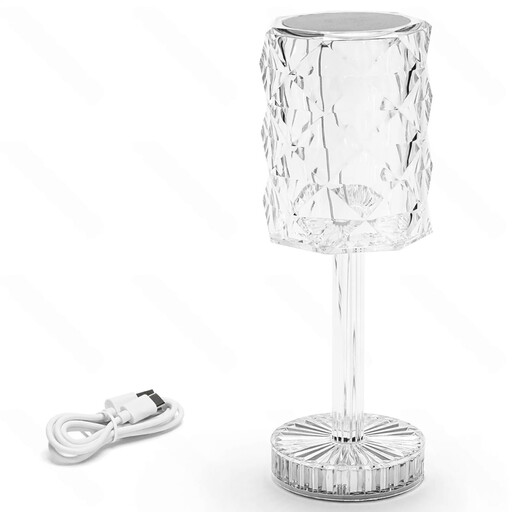
Why this product suits this profile: This compact lamp measures around 90 × 260 mm and provides 105 lm at 1 W. It can be powered via USB from a laptop, power bank or USB adapter.
The figures of 1 W, 105 lm and 2,700 to 6,500 K give you a clear idea of the expected light output and colour temperature. Note that it runs via USB rather than having a built-in battery.
Three adjustable light colours, an integrated LED and a compact footprint.
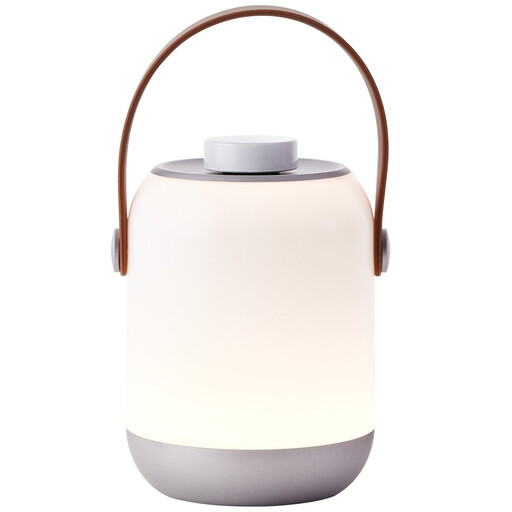
Why this product suits this profile: This battery-powered table lamp combines 200 lm of warm white light at 3,000 K with dimming, making it suitable for indoor use and sheltered outdoor areas.
The IP44 rating is clearly stated and can be correctly understood as protection against splashes. It isn’t designed to provide complete protection from the weather.
200 lm, 3,000 K, dimming and a rechargeable battery.

Why this product suits this profile: According to the product details, this model has a 4,000 mAh battery, four brightness settings, touch controls and an IP44 rating. It’s suited to portable use indoors, when camping or on a sheltered patio.
The runtime is stated as up to 80 hours on the lowest brightness setting. This qualification helps avoid assuming the same runtime applies at every setting.
Four dimming levels, USB charging, a carry handle and IP44 splash protection.

Why this product suits this profile: These two 300 × 38 × 10 mm lights have PIR sensors, three colour temperatures and 1,100 mAh batteries. They’re designed for cupboards, shelving, hallways and kitchen worktops.
The 3 to 5 m detection range and adhesive-strip mounting are clearly specified. Even so, the lights should be protected from moisture.
Motion detection, three light colours, USB charging and a two-pack.
We’ve put together a complete, regularly updated list of products that meet these strict selection criteria and fully comply with the safety regulations in force in the EU.
Runtime depends on battery capacity, brightness and operating mode. Manufacturer and product figures often refer to the lowest setting. For a realistic estimate, check whether runtime figures are also given for medium or high brightness.
With a USB-rechargeable lamp, the main cost is the electricity used for charging. Actual consumption depends on the battery, charging electronics and how often you recharge it. With a lamp that uses replaceable batteries, you’ll also need to factor in the cost of new batteries. You can only work out the exact running costs if you know how much energy it uses and how often it’s used.
It can be useful if you only need light briefly during the night. A motion-sensor lamp is less suitable for reading for long periods, as it may switch off after a set time. Also check the detection range, switch-off time and whether you can turn the sensor off.