
Lieferung heute & morgen

Qualitätsgarantie

Willkommens-Angebote freischalten: KOSTENLOSE Lieferung | Bis zu 80 % RABATT | Kostenlose 30-Tage-JoyPlus-Testphase
App herunterladen
An LED cabinet light with motion sensor should illuminate dark areas automatically, without you having to search for a light switch or install wiring. In practice, however, disappointing purchases are often caused not by the LED technology itself, but by unsuitable dimensions, inappropriate sensors or unclear information about the power supply.
A 60 cm LED strip can illuminate a wide wardrobe or shelving unit more evenly. For a narrow drawer or small kitchen cupboard, however, it may be too long. Before buying, measure the available space and check whether doors, shelves or hinges could obstruct installation.
Common options include an LED sensor light measuring 20 cm, 30 cm, 40 cm or 60 cm. Short models are more suitable for drawers and small compartments, while longer lights may be a better choice for under-cabinet installation and wide wardrobe rails.
Many products use a PIR sensor. PIR stands for “Passive Infrared” and detects changes in thermal radiation, for example when someone moves within the detection area. A PIR sensor does not necessarily keep the light on in response to every small movement. Position, distance and direction of movement all affect detection.
You should therefore look for a specific range. The 20 cm and 30 cm models described here specify a detection range of 3 to 5 metres. This is usually sufficient for a wardrobe. In a long hallway, the sensor should be positioned so that movement occurs not only directly towards the light, but also across its detection area.
Rechargeable cabinet lighting does not require a fixed power cable, but it does need to be charged regularly. Actual operating time depends on factors including how long the light stays on, brightness, room temperature and how often the sensor is triggered. A high mAh rating initially describes only the battery capacity, not the operating time.
Standardised USB connections are practical. According to the product details, the 20 cm and 30 cm models in the selection have an integrated battery rated at 800 mAh and 1100 mAh respectively, and are charged via DC 5 V at 0.5 A. This means they can be charged using a USB power adaptor, laptop or power bank, for example. Use only compatible power sources and follow the relevant instructions for use.
A cabinet light requiring no drilling is often attached using adhesive strips. This is practical for rented homes, shelving units and the inside of cupboards, but requires a dry, clean and preferably smooth surface. Adhesion may be reduced on dusty, greasy or heavily textured surfaces.
Before installation, you should:
ABS plastic and metal are used in many compact LED strips. However, the material alone says nothing about whether the light is suitable for damp areas. Moisture and splashing water should be avoided unless an appropriate IP rating is specified.
Several colour temperatures make it easier to adapt lighting throughout your home:
Colour temperature is measured in Kelvin. It describes the appearance of the light, not its brightness. When choosing an LED light for a kitchen or wardrobe, you should therefore also consider the number of LEDs, the design and the distance from the surface being illuminated. According to the product description, the 30 cm light in the selection has 41 LEDs, while the 20 cm model has 21 LEDs.
A 2-pack of cabinet lights can be useful if you want to equip several compartments or rooms. Nevertheless, check that both lights have the same functions and charging connections. A 4-pack may be more practical for several small drawers, while two longer strips can provide more even illumination beneath a kitchen cupboard.

Why this product suits this profile: Its compact design is suitable for small cupboards, drawers, shelves and narrow passageways. The two lights allow you to equip more than one location.
At 200 mm long, it is easy to compare the light with the available space before buying. PIR detection, USB charging and adhesive installation are all clearly specified.
21 LEDs, three colour temperatures, an integrated 800-mAh battery and adhesive, drill-free installation.
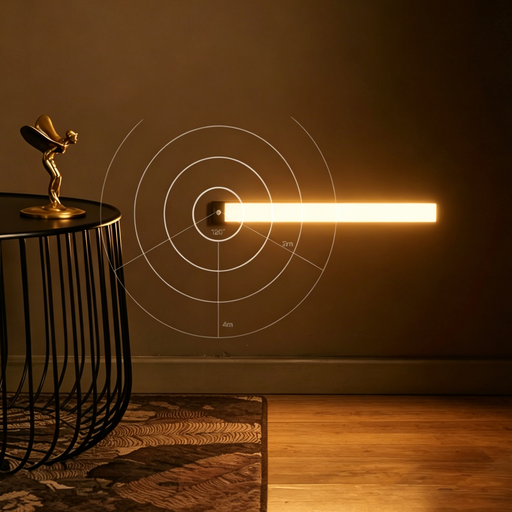
Why this product suits this profile: The 60 cm design is intended for longer cupboard fronts and wider storage areas, where a shorter strip might require several light sources.
The specified length makes planning before installation easier. Also check the complete details on the product page for the sensor, battery, charging connection and mounting method.
60 cm version and a slim design intended for cupboard areas, according to the product name.
Why this product suits this profile: The combination of two 30 cm lights is suitable for kitchens, bedrooms, wardrobes and hallways when several areas need to be equipped without wiring.
The specified dimensions of 300 × 38 × 10 mm prevent uncertainty when planning the size. The PIR range of 3 to 5 metres and USB charging are listed separately.
41 LEDs, a 1100-mAh battery, three colour temperatures and adhesive, drill-free installation.
With a wireless LED light, the sensor should not be obstructed by objects, the cupboard door or decorations. Install the light so that it illuminates the desired area and the charging cable remains accessible when needed.
Extra care is required in kitchens and bathrooms: an ordinary USB cabinet light is not automatically suitable for splashing water. Near a sink, hob or washbasin, the product’s stated suitability must match the surroundings. For the models described, care simply involves wiping them with a soft, dry cloth. Abrasive cleaning products and excessive moisture should be avoided.
It is worth carrying out this quick check before first use:
We have put together a complete, regularly updated list of products that fully meet these strict selection criteria and the safety regulations applicable in the EU.
Most wireless models are attached to a clean, dry surface using adhesive strips. No drilling is required for these versions. Before pressing the light firmly into place, check that the door closes fully and that the sensor is not obstructed.
This depends on the battery capacity, brightness, operating time and number of movements detected. A 1100-mAh battery has a higher capacity rating than an 800-mAh battery, but this alone cannot be used to determine a guaranteed operating time. Charge the light as soon as its brightness begins to drop, and use a compatible USB power source.
In standby mode when switched off, consumption is generally lower than when the light is left on continuously. With a USB cabinet light powered by a battery, the main electricity use in the home comes from charging cycles. If you want to compare power requirements, look at power consumption, battery capacity and the automatic switch-off time.