
Lieferung heute & morgen

Qualitätsgarantie

Willkommens-Angebote freischalten: KOSTENLOSE Lieferung | Bis zu 80 % RABATT | Kostenlose 30-Tage-JoyPlus-Testphase
App herunterladen
An LED cabinet light with motion sensor can automatically illuminate dark cupboard shelves, kitchen areas or hallways. To ensure your purchase works reliably in everyday use, however, buyers should not simply focus on the number of LEDs or bold brightness claims. What really matters are the installation method, sensor behaviour, power supply and suitability for the intended space.
The range of a PIR sensor is often stated without any further context. In practice, activation depends on the direction from which a person approaches, how the sensor is positioned, and whether sufficient darkness is detected. A figure such as 3 to 5 metres should therefore only be understood as a technical guideline.
For a wardrobe or a shelf, a short distance is usually sufficient. In a long hallway, however, a wide detection angle can be more important than a long range.
Many product descriptions list the number of LEDs but not the luminous flux in lumens. 41 LEDs do not automatically mean a certain brightness, because the design, light guide and LED power also play a role. For a cabinet LED light, a compact light strip is often sufficient. A small LED night light with motion sensor, on the other hand, is generally not designed to serve as general room lighting.
Adhesive tape is practical, but it only sticks reliably to clean, dry and smooth surfaces. Wallpaper, rough walls or damp tiles can be problematic. Furthermore, you should decide before buying whether a USB LED light with a rechargeable battery or a battery-operated light is better suited to the location.
A rechargeable LED light reduces the need for disposable batteries. However, it requires regular charging and a conveniently accessible USB power source. Battery models can be placed more flexibly, but incur ongoing costs from replacing the batteries.
Look out for these details:
With a USB light, battery capacity and charging specifications should be considered together. According to the product description, the 30 cm model in the two-pack has an integrated 1100 mAh battery and is charged via DC 5 V at 0.5 A. The 20 cm model uses an 800 mAh battery. Another night light works with a 500 mAh battery, USB charging at 5 V/1 A and a stated run time of up to 10 hours in sensor mode.
The actual operating time depends on the frequency of activation, brightness and charge level. For battery-operated products, you should check whether batteries are included. With the VARTA model, three AAA batteries are reportedly not included in the delivery.
Warm white and cool white light serve different purposes. Warm white in the range of approximately 2800 to 3200 Kelvin is suitable for bedrooms and night-time routes. More neutral or cooler light colours between approximately 4500 and 7000 Kelvin aid orientation in kitchens, cupboards and storage areas.
For a no-drill kitchen light solution, the dimensions are also important. A light measuring 300 × 38 × 10 mm fits into many narrow spaces. Nevertheless, you should check before buying whether doors, hinges and shelves leave enough room.

Why this product suits the profile: The two-pack can cover, for example, two cupboard shelves, a wardrobe and a section of hallway. The compact design is suitable for narrow installation spaces.
The product data states sensor range, battery capacity, charging method and dimensions. Installation is done with adhesive tape, no drilling required.
Two lights, 21 LEDs per unit, three colour temperatures and an integrated 800 mAh battery with USB charging.
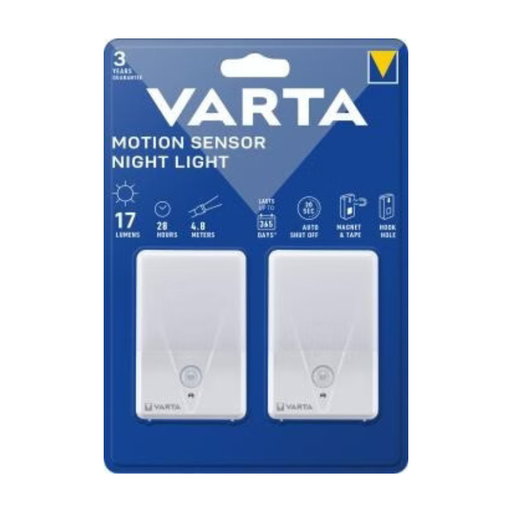
Why this product suits the profile: The battery-operated two-pack is intended for hallways, bedrooms, bathrooms or cupboards and offers several mounting options.
The specifications include 17 lumens, 3 metre range, 120 degree detection angle and automatic shut-off after 30 seconds.
Warm white light, mounting via screw, magnet or adhesive tape, and a stated three-year guarantee.

Why this product suits the profile: The combination of sensor operation, constant-on mode, dimming and three colour temperatures is designed for bedrooms, nurseries, hallways and shelves.
The description states five brightness levels, a sensor range of 3 to 5 metres and activation in low ambient light.
500 mAh battery, USB charging, 30 lumens, five dimming levels and colour temperatures from warm white to cool white.
We have put together a complete, regularly updated list of products that fully meet these strict selection criteria and the safety regulations in force in the EU.
Clean the mounting surface before attaching the light and allow it to dry completely. With adhesive tape, the light should be pressed firmly in place for some time. Afterwards, check that doors or drawers close without obstruction.
For bathrooms and other damp rooms, only use models whose product specifications permit the intended use. According to their descriptions, the lights mentioned should be protected from water and excessive moisture. Electronic lights must not be dismantled or operated with unsuitable chargers.
Depending on the model, installation is done with adhesive tape, magnet, hooks or screws. For an LED under-cabinet light with sensor without drilling, smooth, dry surfaces are required. On delicate surfaces, you should check beforehand whether the adhesive can be removed without leaving residue.
This depends on the battery capacity, brightness and number of daily activations. Product specifications such as 500, 800 or 1100 mAh allow a technical comparison, but do not guarantee a uniform run time. Sensor operation with a short shut-off time reduces energy consumption.
USB-rechargeable models require electricity for recharging, while battery-operated lights need regular new AAA batteries or other suitable batteries. The ongoing costs therefore depend on charging habits, usage duration and the respective electricity or battery price.