
Lieferung heute & morgen

Qualitätsgarantie

Willkommens-Angebote freischalten: KOSTENLOSE Lieferung | Bis zu 80 % RABATT | Kostenlose 30-Tage-JoyPlus-Testphase
App herunterladen
A LED cabinet light with motion sensor can brighten up dark cupboard areas, shelves or hallways without the need for additional wall installation. For rented flats in particular, wireless models with adhesive fixing and USB charging are especially practical. However, some marketing claims can quickly lead to a poor purchase.
"Long runtime" means very little without specific conditions. The actual usage time depends on factors such as brightness level, number of activations and room temperature. So check whether the battery capacity in mAh, the charging port and, where possible, the charging conditions are stated.
A PIR sensor detects changes in heat radiation, for example from a moving person. However, range and detection angle are crucial. The cabinet lights described here specify a range of 3 to 5 metres. This is usually sufficient for a small kitchen cupboard, whereas a long hallway may need several lights.
An LED strip for the kitchen doesn't need the same light colour as a night light in the bedroom. Cool white at around 6500 to 7000 Kelvin supports clear visibility, while warm light at around 2800 to 3200 Kelvin feels less clinical. A light with multiple colour temperatures is more flexible, provided the switching function is straightforward.
A USB-rechargeable LED lamp can be charged via a suitable USB power adapter, laptop or power bank. What matters is that the technical specifications are compatible. The cabinet lights selected here specify DC 5 V and 0.5 A. Only use compatible charging sources and follow the instruction manual.
Capacity alone doesn't guarantee a specific operating time. A battery with 1100 mAh generally stores more charge than a model with 800 mAh, but the number of LEDs and brightness level affect consumption. For a frequently used kitchen or hallway, the larger capacity can be worthwhile.
A 30 cm LED light strip is suitable for wider cupboard compartments, under-counter kitchen units or shelf boards. Shorter models at 20 cm are better suited to narrow compartments and small wardrobes. Check before you buy:
An ultra-flat design at around 10 mm height reduces the space required. With an LED under-cabinet light, the mounting surface should also be clean, dry and, ideally, grease-free so that the adhesive tape sticks properly.
Cabinet lighting without drilling is particularly appealing for rented flats. Adhesive fixings avoid tools and visible drill holes, but may be less reliable on delicate, rough or damp surfaces. Therefore, do not mount the light above delicate items and check the hold regularly.
For the kitchen, bathroom or outdoor areas, the IP rating is relevant. The cabinet lights recommended here are not intended for water or high humidity according to the product specifications. A table lamp with IP44 is not automatically suitable for installation in a wet area.

Why this product fits the profile: The 2-pack is ideal for small cupboards, shelves or a wardrobe, offering a compact solution for multiple areas.
The 20 cm length is easier to plan for tight spaces. PIR sensor, USB charging and adhesive fixing are all clearly specified.
Two lights, three colour temperatures, 21 LEDs per light and a built-in 800 mAh battery.
Why this product fits the profile: The longer design is intended for under-counter kitchen units, wide shelf boards and larger cupboard compartments, without needing a fixed power cable.
The product data specifies 300 × 38 × 10 mm, 41 LEDs, PIR detection from 3 to 5 metres and three selectable light colours.
1100 mAh battery, USB charging at DC 5 V/0.5 A and adhesive mounting without drilling.
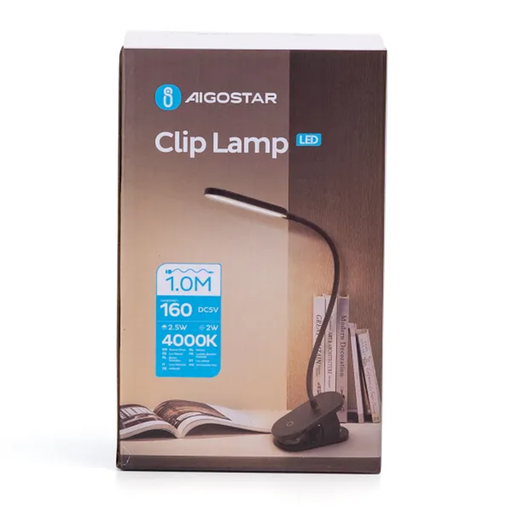
Why this product fits the profile: The clip mount is ideal for desks, shelf boards or bed frames when flexible positioning matters more than an automatic sensor.
The lamp is not advertised with a PIR sensor. This means no false expectation of automatic activation is created.
1200 mAh battery, three brightness levels, 160 lm and an adjustable gooseneck with clip function.
We've put together a complete, regularly updated list of products that fully meet these strict selection criteria and the safety regulations in force in the EU.
Many battery-powered models are attached with adhesive tape and require no drilling. The surface should be dry, clean and grease-free. Before final installation, a quick function test is recommended to ensure the sensor position and light coverage are correct.
A general answer isn't possible. Brightness, frequency of activation, sensor range and battery capacity all affect runtime. Models with 800 mAh or 1100 mAh are charged via USB; the specific operating time should be adjusted according to the respective product specifications and your usage.
The power consumption is usually lower than that of a permanently switched-on light, because the PIR sensor only activates the light when movement is detected. How much energy is actually needed depends on the LED power, brightness and activation time. An automatic shut-off can further limit battery consumption.