
Lieferung heute & morgen

Qualitätsgarantie

Willkommens-Angebote freischalten: KOSTENLOSE Lieferung | Bis zu 80 % RABATT | Kostenlose 30-Tage-JoyPlus-Testphase
App herunterladen
An LED cabinet light with a motion sensor can illuminate dark wardrobes, kitchen base cabinets, shelves or storage cupboards without the need for hardwiring. In rented properties, a drill-free installation is particularly handy. However, some product claims can lead to disappointing purchases: what really matters isn’t just the number of LEDs or a low price, but also the dimensions, sensor behaviour, battery and mounting surface.
A light that’s 60 cm long may be fine for a wide wardrobe, but it could overhang in a narrow kitchen compartment. Conversely, a 20 cm light might not spread illumination across the full width. Before you buy, measure the usable internal width and check whether doors, shelves or hinges restrict the mounting space.
The number of LEDs alone doesn’t tell you how bright an LED under-cabinet light will actually be. More meaningful are the specifications for luminous flux in lumens, light distribution and positioning. A light with even coverage can be more practical inside a cupboard than a spot of intense brightness. For decorative areas, less light is often sufficient compared with a kitchen worktop.
A PIR motion sensor light reacts to heat movement and needs a clear field of view. If the sensor is blocked by a cabinet edge, the automatic switch-on may be limited. What’s more, a USB rechargeable battery isn’t maintenance-free forever: the light needs regular charging, especially if you open and close the door frequently.
With a wireless cabinet light, you should therefore pay attention to the charging method, battery capacity, charging port and whether the mounting can be removed. A reliable statement about actual run time is only possible if the manufacturer specifies concrete operating conditions.
For narrow compartments, compact models around 20 cm are suitable. 30 to 42 cm cover medium-sized areas, while 60 cm can reach more space along a shelf or wardrobe. A height of around 10 mm can matter in tight gaps. Also check that the adhesive surface is clean, dry, grease-free and sufficiently load-bearing.
With kitchen lighting without drilling, adhesive strips or magnetic holders are often used. These avoid drill holes, but they don’t stick equally well to every surface. On rough, dusty or damp substrates, the fixing may weaken. Always follow the product’s installation instructions.
A PIR sensor detects movement within a certain range. For the 20 cm and 30 cm models listed here, a range of 3 to 5 metres is stated. For a cupboard, that’s usually more than enough, provided the sensor points towards the opening.
A sensor light for a cupboard can, depending on the model, also be operated manually or by gesture. This is useful if you want the light to stay on longer or to adjust the brightness. However, gesture control shouldn’t be confused with a PIR sensor: the two systems work on different principles.
A rechargeable cabinet light with a USB port can be charged from a suitable mains adapter, laptop or power bank. Check the stated battery capacity: 800 mAh and 1100 mAh are different values and don’t directly tell you the exact usage time, because LED power and switch-on duration also play a part.
For light colour, here are some practical guidelines:
Three selectable colour temperatures offer more flexibility. A fixed 4000 K light is straightforward if you don’t need to adjust it.

Why this product suits the profile: Two compact lights are ideal for smaller compartments, hallways or several spots around the home. The 20 cm design takes up very little space.
The dimensions and pack size are clearly stated. This lets you check before buying whether two short light sources can be better distributed than one overly long light.
21 LEDs per light, 800 mAh battery, USB charging, PIR sensor with a stated range of 3 to 5 metres and three colour temperatures.
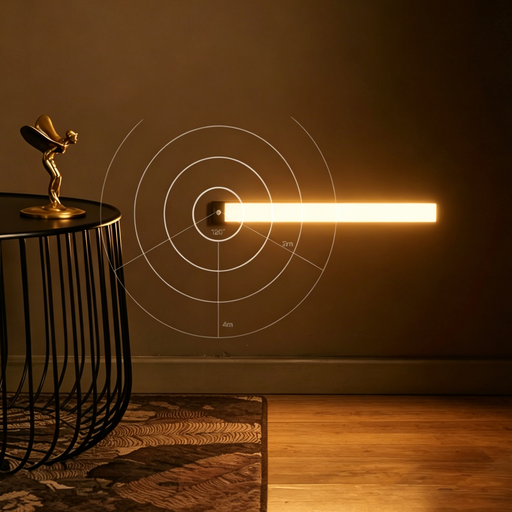
Why this product suits the profile: The long design is suitable for wider wardrobes, shelves or longer undersides, provided the measured mounting space allows 60 cm.
The specific length makes planning easier and reduces the risk of choosing a light that’s too short for a wide cupboard area.
60 cm format for larger mounting areas; the product line is also available in other lengths.
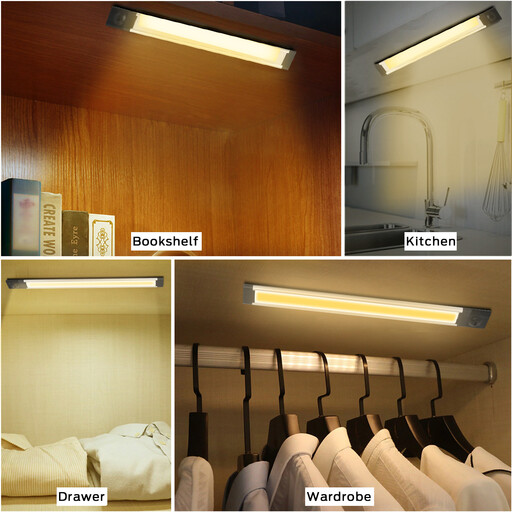
Why this product suits the profile: This light is aimed at users who need automatic lighting plus gesture control, dimming and flexible mounting in the bedroom, hallway, cellar or cupboard.
Operation isn’t limited to just a motion sensor. Gesture control, dimming and the chosen mounting method can be used depending on the situation.
36 SMD LEDs, stated luminous flux of 400 lumens, colour temperature range from 2800 to 6500 K, plus magnetic and hook fixing without drilling.
Clean the mounting surface with a suitable dry cloth before attaching the light, and let it dry completely. For adhesive fixings, press the light firmly in place according to the instructions. A magnetic holder makes it easier to remove the light for charging on some models.
Protect the light from water and high humidity unless it is explicitly designed for such conditions. For cleaning, a soft, dry cloth is sufficient. Damaged devices, swollen batteries or unusual heat should not be used further. Only use compatible USB power sources for charging.
We’ve put together a full, regularly updated list of products that fully meet these strict selection criteria and the safety regulations in force in the EU.
Depending on the model, it’s fixed with adhesive strips, magnets or hooks. The surface must be clean, dry and load-bearing. In rented properties, removable systems are practical, but you should check the adhesion regularly.
It’s not possible to give a reliable one-size-fits-all run time. It depends on battery capacity, LED power, switch-on duration and how often movement is detected. Figures like 800 mAh or 1100 mAh describe the battery capacity, not automatically the run time.
In automatic mode, the lamp only lights up when movement is detected and then switches off again. The actual energy consumption depends on the set brightness, the duration of use and daily usage. With a USB LED light strip that has a battery, there’s also the energy needed for regular charging.