
Lieferung heute & morgen

Qualitätsgarantie

Willkommens-Angebote freischalten: KOSTENLOSE Lieferung | Bis zu 80 % RABATT | Kostenlose 30-Tage-JoyPlus-Testphase
App herunterladen
LED cabinet lighting with a motion sensor can illuminate dark compartments, kitchen units and wardrobes without a fixed electrical installation. For tenants and households wishing to avoid drilling, cordless rechargeable models are particularly practical. However, sensors, light output, installation and battery capacity can vary considerably.
Anyone who focuses only on a high LED count or an especially slim housing can overlook important details. Three typical purchasing problems are particularly common with this product category:
First, measure the usable width of the compartment or underside. For small shelves and individual cabinet compartments, 20 cm may be sufficient. A 30 or 40 cm light distributes illumination over a larger area. For long kitchen wall units, a 60 cm model may be the better choice.
Also pay attention to the housing depth. Particularly slim versions with a height of around 10 mm can be installed discreetly beneath a shelf or inside a cabinet. For installation without drilling, adhesive tape, magnetic mounting or hooks may be suitable. The surface should be clean, dry and as free from grease as possible. Adhesion may deteriorate on porous or damp surfaces.
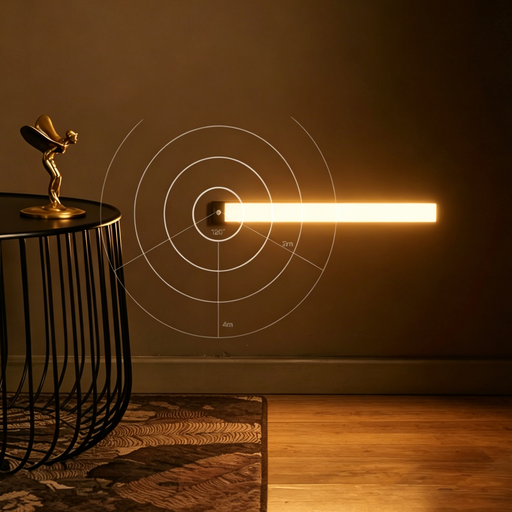
A PIR sensor detects changes in heat radiation caused by movement. According to the product information, the available models with PIR motion sensors are activated within a range of around 3 to 5 metres. This value depends on the installation situation and should not be treated as a guaranteed range in every room.
A sensor cabinet light is suitable for areas where the lighting should switch on automatically, such as when opening a cabinet or walking into a hallway. Gesture control works differently: with the Motion Sensor Night Light, switching on and off and dimming are controlled by hand movements. This can be useful when you do not want a sensor to be triggered by every movement.
For LED kitchen lighting, a neutral or cool light colour is often easier to work with. Depending on the version, the available models cover a range of approximately 2,800 to 7,000 Kelvin:
Not every LED under-cabinet light is dimmable. If you are looking for a dimmable night light for a bedroom or nursery, the dimming function should be explicitly stated in the product specifications. The Motion Sensor Night Light is specified with continuously adjustable brightness and a luminous flux of 400 lm.
With a rechargeable LED lamp, the charging connection and battery capacity are important points of comparison. The lights described are charged via USB or DC 5 V. A compatible power adapter, laptop or power bank can be used as a power source. Only use suitable USB power sources, and do not continue charging damaged or swollen batteries.

Why this product suits this profile: Two compact 20 cm lights are ideal for individual compartments, smaller cabinets and short shelves. They are designed for installation without drilling.
The length and PIR detection range of approximately 3–5 m are clearly stated. This makes it easier to assess in advance whether the lights are suitable for smaller installation locations.
2-pack, USB charging, 800-mAh battery, three colour temperatures and 200 × 38 × 10 mm per light.
Why this product suits this profile: The 60 cm design is well suited to longer cabinet areas or wide undersides where a short LED light bar would not provide sufficient coverage.
Before buying, compare the fixed length with the width of your cabinet. This helps prevent uneven illumination caused by a light that is too short.
60 cm length and cordless operation for cabinets, shelves and other longer installation surfaces.
Why this product suits this profile: Gesture control, dimming and flexible magnetic or hook mounting make it suitable for bedrooms, nurseries, hallways, workshops or storage rooms.
The operating method is specifically described as gesture control with a dimming function. This prevents it from being confused with a standard PIR sensor.
400 lm, 2,800–6,500 K, PMMA light guide, plus magnetic mounting and hooks without drilling.
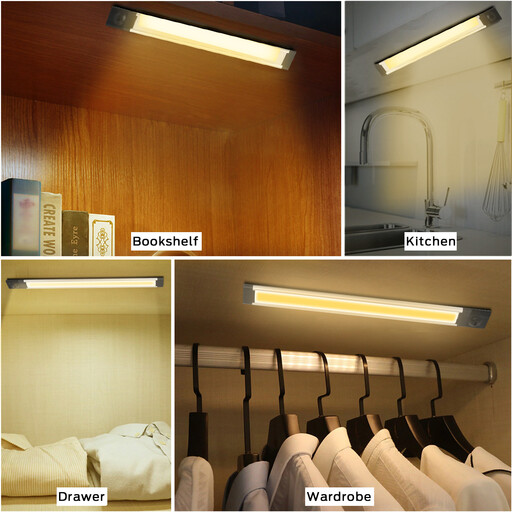
Why this product suits this profile: The 30 cm length and two lights offer a flexible solution for kitchen wall units, wardrobes and multiple shelf compartments.
The product specifications state the LED count, PIR range, battery capacity and dimensions. This allows you to plan lighting coverage and charging requirements more realistically.
41 LEDs, 1,100-mAh battery, three colour temperatures and 300 × 38 × 10 mm per light.
Before fitting the light, remove dust and grease from the installation surface. Adhesive fixings require firm pressure and should not be used directly above damp sinks or in areas with high humidity. Magnetic and hook solutions are generally easier to reposition in rented homes.
Wipe the light with a soft, dry cloth. Water, harsh cleaning products and opening the housing can damage the electronics and battery. With LED kitchen lighting, you should also keep a sufficient distance from direct steam and splashing water. The light must not be covered, and loose fixings should be corrected immediately.
We have put together a complete, regularly updated list of products that fully meet these strict selection criteria and the safety regulations applicable in the EU.
Depending on the model, installation is carried out using adhesive tape, magnets or hooks. Clean the surface, check the position and make sure that the sensor and light source are not covered. With adhesive tape, allow the light sufficient time to bond before putting it under any load.
It is not possible to give a reliable general runtime without information on how long the light is switched on, the brightness setting and activation frequency. You should therefore check the battery capacity, charging connection and the supplier’s instructions for the specific product. If the brightness drops noticeably, the battery should be recharged.
A PIR sensor switches the light on only when movement is detected, provided the model has an automatic switch-off function. This can reduce the time the light is on compared with a light that remains permanently switched on. However, actual energy consumption depends on the output, brightness and usage pattern.