
Lieferung heute & morgen

Qualitätsgarantie

Willkommens-Angebote freischalten: KOSTENLOSE Lieferung | Bis zu 80 % RABATT | Kostenlose 30-Tage-JoyPlus-Testphase
App herunterladen
LED cabinet lighting with a motion sensor can switch on as soon as movement is detected. This is practical for kitchen cabinets, wardrobes, drawers, shelving and hallways. However, unclear product details often lead to disappointing purchases: a light does not fit beneath the cabinet, the sensor responds too slowly or the battery needs charging far more often than expected.
Joybuy Product Recommendation Officer filters the most important product data and explains what households in Germany should look out for before buying.
A high lumen rating does not automatically mean that a light is suitable for every application. A short LED strip is usually sufficient for a drawer. Under a long kitchen wall cabinet, however, a larger illuminated area may be more practical. Alongside luminous flux, length, beam angle and mounting position are also crucial.
An LED light strip with sensor may use a PIR sensor to detect body heat and movement. Other models use contactless gesture control. These are not the same:
The exact range should therefore be stated in the technical specifications. Several rechargeable models in this selection specify a range of 3 to 5 metres.
Adhesive tape is useful in rented properties and on smooth furniture surfaces, but it can come loose because of dust, heat or uneven surfaces. Screws and clips are usually mechanically more secure when used with suitable materials, but they require an appropriate surface and possibly drilling.
The power supply must also suit the installation location. A rechargeable cabinet light works without a permanent mains cable, but requires regular USB charging. A 230-volt light is connected directly to the mains and should only be installed in accordance with the manufacturer’s instructions and applicable electrical safety regulations.
Check whether the light switches on automatically when movement is detected and whether it switches off again after a set period. With PIR sensors, the stated detection area should match the installation position. A short range is sufficient inside a narrow cabinet, while a larger area may be beneficial in a hallway.
Also check whether cabinet edges, doors or shelves obstruct the sensor. The sensor should have a clear view of the area where movement is expected.
For small cabinets or drawers, 20 cm is often sufficient. For wider base units, 30 or 40 cm may provide more even illumination. The selected models measuring 20, 30 and 40 cm also differ in the number of LED elements.
One example of a compact LED under-cabinet light is the 20-cm version with 21 LEDs. According to the product specifications, the 30-cm version has 41 LEDs and the 40-cm version has 61 LEDs. These figures describe the equipment, but do not replace an individual assessment of the actual light distribution.
3 colour temperatures provide greater flexibility:
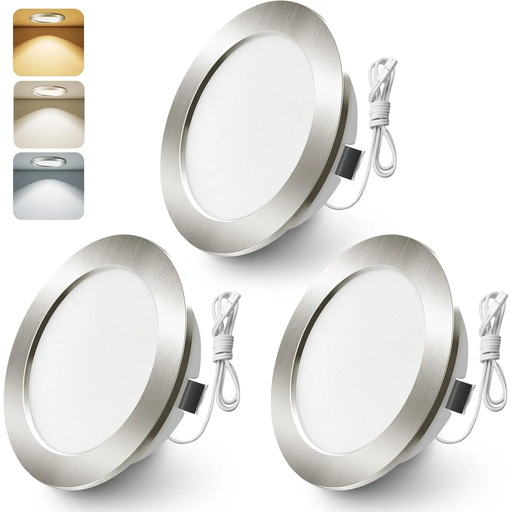
A dimmable LED recessed light often requires a compatible dimmer. This applies particularly to permanently installed 230-volt models. A mains-powered light must not be confused with a USB light. Similarly, a 230 V LED ceiling spotlight is a different product category from a cordless kitchen light for furniture.
In rooms exposed to moisture, the IP rating is important. The following recessed spotlight is specified as IP44. This rating must be assessed according to the intended installation and the specific environment; direct jets of water and prolonged exposure to moisture are not automatically covered.

Why this product suits the profile: Two 20-cm lights cover smaller cabinets, shelving units or hallways. According to the product specifications, they can be mounted with adhesive tape without drilling.
The 3–5 m PIR range and automatic switch-off reduce the need for manual operation. The adhesive surface should be cleaned before mounting.
2-pack, USB charging, 800-mAh battery and three selectable colour temperatures.
Why this product suits the profile: This light is designed for permanent installation beneath furniture and combines contactless control with adjustable colour temperature.
The technical specifications state 780 lm at 10 W, along with adjustment from 10 to 100 per cent. This gives a clearer description of brightness and operation than purely promotional claims.
3000, 4000 and 6500 K; mounting clips and screws; 230 V connection with 1.2 m cable.
Why this product suits the profile: The 40-cm design is suitable for longer furniture sections, kitchen base units or larger shelving, where a single short strip would not be sufficient.
The length and sensor range can be clearly checked before buying. This helps prevent choosing a light that is too short to illuminate the entire work surface.
2-pack, 61 LEDs per light, 1100-mAh battery, USB charging and three colour temperatures.
Before mounting, measure the length of the underside of the furniture and check whether doors or handles could obstruct the sensor. For adhesive mounting, the surface must be dry, clean and as smooth as possible. In the kitchen and bathroom, a cordless light must not come into contact with water or high humidity unless the manufacturer specifies an appropriate IP rating.
For a permanently connected 230-volt light, switch off the circuit, check the connection details and consult a qualified electrician if in doubt. A 10 W, 780 lm light and a 10 W, 1050 lm recessed spotlight each have their own installation requirements. These figures should not be applied to other models without checking first.
We have put together a complete, regularly updated list of products that fully meet these strict selection criteria and the safety regulations applicable in the EU.
Depending on the model, installation is carried out using adhesive tape, clips or screws. The surface must be suitable for the chosen fixing method. Before installation, check the sensor area, cable routing and access for charging.
It is not possible to determine the operating time from battery capacity alone. How often the light switches on, brightness, sensor delay and room temperature all affect power consumption. When the brightness starts to fall, the battery should be charged via a compatible USB connection.
If the light only switches on when movement is detected, it may operate for less time than a light that is permanently switched on. Actual consumption depends on power, operating time and usage. For a reliable assessment, the wattage and your daily usage pattern are the key factors.