
Lieferung heute & morgen

Qualitätsgarantie

Willkommens-Angebote freischalten: KOSTENLOSE Lieferung | Bis zu 80 % RABATT | Kostenlose 30-Tage-JoyPlus-Testphase
App herunterladen
LED cabinet lighting with a motion sensor can illuminate dark cupboard compartments, kitchen areas or passageways without the need for a switch. However, to ensure your purchase works well in everyday use, you should look beyond a high LED count or particularly low prices. Installation, sensor performance, power supply and the right colour temperature are what really matter.
The number of LEDs is only one part of the technical specification. The light’s length, the arrangement of the LEDs and the intended application are also important. A short LED light bar with many light points may be sufficient for a small compartment, while a long kitchen cupboard may need several lights or a longer model.
So, pay attention to the actual dimensions. A 20 cm light is suitable for narrow compartments and shelves. For wide wall cupboards, 30 or 40 cm may be a better choice.
A PIR sensor detects movement by registering changes in heat radiation within its detection area. This means it does not necessarily switch on a light with every movement, regardless of the ambient brightness. Some models also have a dusk sensor and only activate in the dark.
Before buying, check:
For the wireless lights described here, the stated PIR range is approximately 3 to 5 metres. This is generally sufficient for cupboards, shelves and short hallways, but it should still be suitable for the size of the room.
A rechargeable cabinet light requires regular USB charging. Battery life depends on how long it is used, the brightness setting and how often the sensor is activated. With a permanently installed light, there is no need to recharge it, but a socket or hard-wired connection is usually required.
For flexible applications, USB-rechargeable LED lights are practical. However, buyers should pay attention to the battery capacity and charging port. Depending on the version, the models featured here use an integrated 800 or 1100 mAh battery and are charged via DC 5 V at 0.5 A.
First, measure the available space. The light should not come into contact with doors, hinges or pull-out fittings. For installation without drilling, the surface must be clean, dry and as smooth as possible. Adhesive tape often adheres less effectively to dusty, greasy or heavily textured surfaces.
A slim design measuring approximately 10 mm in height is suitable for tight spaces. Also check whether mounting materials are included and whether the light can be removed again if required.
Colour temperature is measured in Kelvin:
A dimmable night light is particularly useful in children’s bedrooms, bedrooms and on staircases, provided that the brightness can be adjusted across several levels. For kitchen lighting, however, the light output should be appropriate for the worktop. For damp areas such as bathrooms, only use products whose IP rating and manufacturer’s specifications expressly confirm that they are suitable. The USB lights described here must be protected from moisture and water.
A rechargeable battery reduces the need for disposable batteries. With a 1100 mAh model, recharging may be needed less frequently depending on usage than with an 800 mAh version. However, it is not possible to make a reliable estimate of operating time without information about brightness and switching frequency.
Only use compatible USB chargers, and do not cover the sensor or LEDs. Damaged lights or swollen batteries should not be used. The devices are not designed to be dismantled and should be installed out of the reach of young children.

Why this product suits this profile: The compact 20 cm design is intended for small cupboards, shelves and short hallways. Two lights allow you to use them in separate areas.
The stated dimensions, 21 LEDs and PIR detection range of 3 to 5 metres make it easier to assess whether the light is suitable for your chosen location.
800 mAh battery, USB charging, three colour temperatures and adhesive, drill-free installation.
Why this product suits this profile: The 30 cm light combines a slim design with 41 LEDs, making it suitable for kitchen wall cupboards, wardrobes and medium-width shelving.
The three clearly stated colour temperatures and defined PIR range avoid vague claims about light performance and sensor capability.
1100 mAh battery, three light colours, 300 × 38 × 10 mm and two lights per pack.
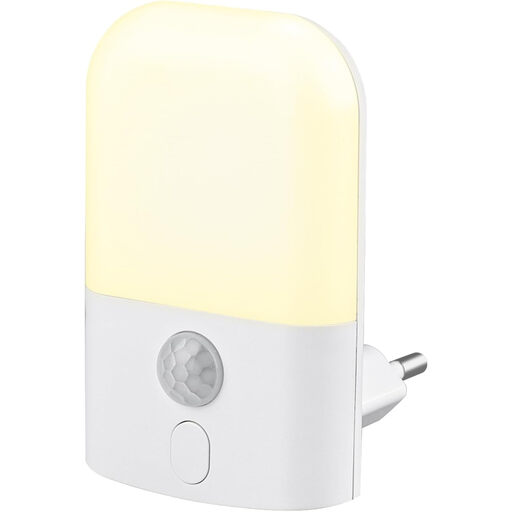
Why this product suits this profile: As a plug-in light, it is suitable for children’s bedrooms, staircases, hallways and bedrooms when a battery-powered light is not wanted.
The light combines motion and dusk sensors. According to the product specifications, it switches off after 60 seconds without movement and operates across five brightness levels.
2700 K warm white LED light, five brightness levels, 0.5 W power consumption and no batteries required.
Before installation, remove dust and grease from the surface. Position the sensor so that doors, cabinet frames or shelves do not obstruct detection. For wardrobe lighting, installation along the upper inside edge is recommended. In the kitchen, the light should not be installed directly above a sink or hob unless a suitable moisture-protection rating is specified.
Clean the surfaces with a soft, dry cloth. Water, harsh cleaning products and abrasive sponges can damage the casing or electronics. If the brightness starts to fade, recharge the battery. The light should not be covered or used if it shows visible damage.
We have put together a complete, regularly updated list of products that fully meet these strict selection criteria and the safety regulations applicable in the EU.
Most slim battery-powered lights are attached with adhesive tape. The surface must be clean, dry and strong enough to support the light. Before fixing it permanently, check that the sensor and light cover the desired area.
There is no single answer for operating time. It depends on battery capacity, brightness, the number of movements detected and how long the light stays on. Models with 1100 mAh offer a higher stated capacity than 800 mAh versions, but they also require regular USB charging.
LED lights generally have low power consumption. With a plug-in light rated at 0.5 W, actual consumption depends on how long and how often it is switched on. A motion sensor with automatic shut-off can reduce unnecessary operating time.