
Lieferung heute & morgen

Qualitätsgarantie

Willkommens-Angebote freischalten: KOSTENLOSE Lieferung | Bis zu 80 % RABATT | Kostenlose 30-Tage-JoyPlus-Testphase
App herunterladen
LED cabinet lighting with a motion sensor can brighten dark areas without a mains connection. Cordless models are particularly practical for rented homes, family households and flexible room layouts. However, sensor lights vary considerably in battery capacity, installation, light colour and controls.
The number of LEDs is just one part of the technical specifications. The design, light distribution and position of the light also matter. A slim light with 21 LEDs may be enough for a drawer or small cupboard, while a longer light with 41 or 61 LEDs may work better in a wide kitchen cupboard.
If a model doesn’t specify its light output, it’s difficult to compare its actual brightness. Figures such as 400 lm are therefore more useful than vague claims like ‘extra bright’.
A PIR sensor responds to detected movement or changes in heat radiation within its detection range. This switches the light on and off automatically. Gesture control works differently: you activate it with a hand movement, and it can let you adjust the brightness manually.
An automatic motion-sensor night light is often a good choice for a wardrobe or for finding your way around at night. Gesture control may be more convenient for a light by the bed, in a nursery or above a work surface, where you want to switch it on and off deliberately.
A rechargeable LED light needs to be charged regularly. If you only consider battery capacity, you may overlook the charging port or the power source you’ll need. For example, USB cabinet lights with DC 5 V can be charged using a laptop, power bank or suitable USB mains adaptor. Only rely on stated operating times if the seller provides specific figures.
The mounting surface matters too: adhesive strips stick better to clean, dry, grease-free surfaces. If you have delicate furniture, check in advance whether the strip can be removed without leaving residue.
For an LED under-cabinet light with a PIR sensor, the stated detection range should suit where you plan to install it. According to the product specifications, the PIR models featured here detect movement within a range of 3 to 5 metres. That’s enough for a small cupboard, but positioning can make all the difference in a long hallway.
Also check whether the light switches off automatically. This helps reduce unnecessary power consumption and means you won’t need to recharge the battery manually after every brief use.
Battery capacity is measured in mAh. However, you can’t compare the runtime of an 800 mAh model and a 1100 mAh model based on that figure alone, as the number of LEDs, brightness and sensor use also play a part.
A USB cabinet light with a 5 V charging input is a flexible choice for everyday use. Use only compatible USB power sources and charge the light according to the manufacturer’s instructions. Don’t continue using damaged or swollen batteries.
An ultra-thin LED light around 10 mm high is a good choice for narrow compartments. The models featured here range in length from 20 to 40 cm. Three colour temperatures can suit different tasks:
For magnetic cabinet lighting, check the fixing method and weight too. Magnetic mounts or hooks are handy for flexible installation, while adhesive strips let you attach a light to smooth interior surfaces without drilling.

Why this product suits these needs: The twin pack is suitable for smaller cupboards, shelves or a wardrobe. At 20 cm long, each light is a compact option for rented homes and individual storage areas.
PIR detection with a range of 3–5 m, three colour temperatures and USB charging make its features clear. It attaches with adhesive strips, so there’s no need to drill.
Two lights, 21 LEDs per light, an 800 mAh battery and a compact 200 × 38 × 10 mm design.
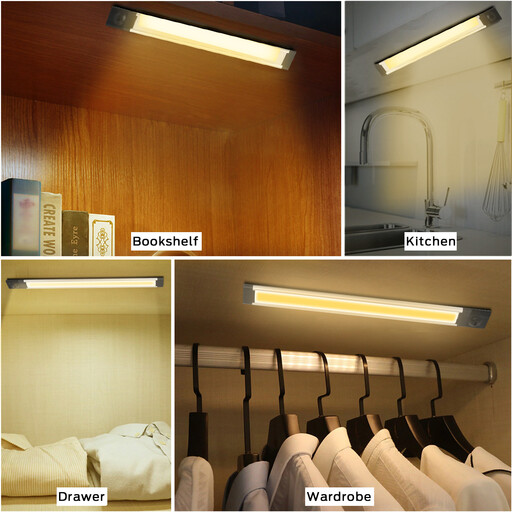
Why this product suits these needs: Alongside flexible installation, this light offers stepless dimming and a wide choice of colour temperatures.
It’s gesture-controlled rather than relying solely on a PIR sensor. The controls are clearly defined, and you can adjust the brightness.
36 Epistar 4014 SMD LEDs, 400 lm, 2800–6500 K, a PMMA light guide, magnetic fixing and hooks.
Why this product suits these needs: At 40 cm long, each light is suitable for longer kitchen units, wide wardrobes, shelves or dark storage areas, provided there’s enough room on the mounting surface.
The length and number of LEDs (61) are clearly specified. It also offers PIR detection, USB charging and three colour temperatures.
Two 400 × 38 × 10 mm lights, each with a 1100 mAh battery, and installation without drilling.
We’ve put together a complete, regularly updated list of products that meet these strict selection criteria and fully comply with the safety regulations in force in the EU.
Depending on the model, you can attach it using adhesive strips, magnets or hooks. Clean the surface before installation, let it dry completely and check that it’s suitable for the fixing method you’ve chosen. If you’re fitting it to rented furniture, it may be worth testing the adhesive on an inconspicuous area first.
You can’t work out the runtime from battery capacity alone. Brightness setting, how often the light switches on, sensor use and the number of LEDs all affect power consumption. Check the manufacturer’s specific runtime information and recharge the light when you notice the brightness dropping.
When running on batteries, power consumption mainly depends on how long the light stays on and its brightness. Automatic switch-off can reduce unnecessary lighting time. A USB-rechargeable LED sensor light also loses some power during charging; running costs depend on how often you use it and your electricity tariff.