
Lieferung heute & morgen

Qualitätsgarantie

Willkommens-Angebote freischalten: KOSTENLOSE Lieferung | Bis zu 80 % RABATT | Kostenlose 30-Tage-JoyPlus-Testphase
App herunterladen
LED cabinet lighting with a motion sensor can automatically illuminate dark compartments, worktops and passageways. However, not every sensor light is suitable for every application. A wardrobe light requires different features from a plug-in night light or permanently installed kitchen lighting.
If you focus only on a high number of LEDs or particularly low prices, you can easily overlook important details. The following points will help you avoid common purchasing mistakes and choose the right LED cabinet light for your home.
A PIR sensor responds to movement, while a dusk sensor measures the brightness of the surrounding area. A sensor under-cabinet light can therefore switch on with every movement, only in darkness, or through a combination of both sensor types.
A motion sensor is practical for a wardrobe because the light switches on when you open the door or reach inside. In a hallway, however, a sensor night light that responds to the ambient brightness may be more suitable. You should therefore check whether the product description explicitly mentions PIR, light sensor, dusk sensor or a combination of these.
A high lumen rating does not automatically mean suitable illumination. A small drawer needs less light than a 60-centimetre-wide kitchen worktop. Installation height, beam angle and the position of the LEDs also affect the result.
For subtle guidance lighting, for example, 18 to 40 lm is sufficient for plug-in night lights. A longer LED light bar with a motion sensor for a worktop should instead be assessed based on its total luminous flux and how evenly it distributes light. Descriptions such as ‘particularly bright’ are not very meaningful without specific lumen values.
A cordless LED lamp does not need a permanent power cable, but it must be charged regularly. If it is switched on frequently, a small battery can reach its limits more quickly. Check the stated capacity, charging port and whether a USB cable is included.
The installation surface is also crucial: adhesive strips do not adhere reliably to dusty, uneven or greasy surfaces. Magnetic mounts are flexible, but require a suitable metal surface or matching metal plate. With rechargeable cabinet lighting, you should also check whether the light can be easily removed for charging.
A PIR motion sensor detects changes in thermal radiation caused by moving people. The detection angle and range determine how reliably the automatic switching works. With a model offering a range of 3 to 5 metres, positioning may differ in a hallway compared with inside a wardrobe.
A dusk sensor is suitable for areas where the light should only become active when the ambient brightness is low. According to the product information, the Aigostar light with Twilight sensor switches on below 20 lux. A combined system, such as that used in certain night lights with PIR and Twilight sensors, can respond to movement and darkness together.
The lumen rating describes the total luminous flux. Moderate brightness is often sufficient for drawers and small compartments. For kitchen lighting or a deep wardrobe, a longer light bar with as even a coverage as possible is more practical.
Colour temperature is measured in Kelvin:
A CRI or Ra value of at least 80 is specified for several of the products mentioned. This value describes how naturally colours appear under the light. However, it does not replace checking the actual distribution of brightness.
Plug-in models generally work without a battery and are connected directly to 220–240 V. They are suitable for hallways, stairs and indoor areas, but require an available socket. Models with a USB connection or integrated battery can be installed more flexibly on wardrobes, shelves and beneath wall cabinets.
IP20 is often specified for dry indoor areas. This means that there is no special protection against water. For outdoor areas or damp locations, you should only use a light with a specifically suitable IP rating. The Brilliant Iseo, for example, is rated IP44 and features an integrated battery, USB charging and a motion sensor. For outdoor use, the manufacturer's relevant installation and safety instructions also apply.

Why this product suits this profile: The 2-pack is suitable for smaller wardrobes, shelves and hallways when several areas need to be lit without complicated wiring.
The PIR sensor, adhesive mounting and USB charging are clearly specified. The 20 cm design prevents a short light from being oversized for a small interior area.
2-pack, 800 mAh battery, three colour temperatures and dimensions of 200 × 38 × 10 mm.
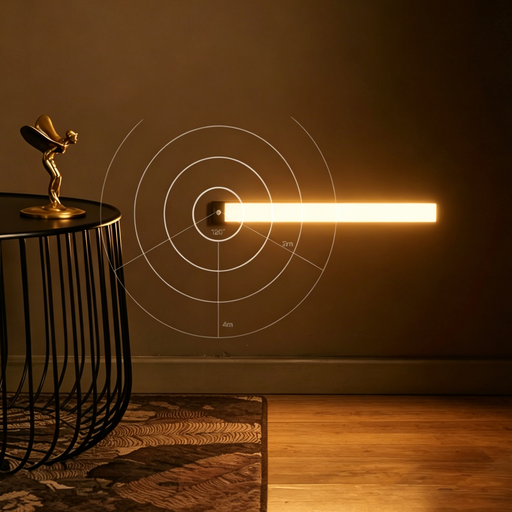
Why this product suits this profile: The 60 cm length is suitable for wide wardrobe areas, shelves or longer undersides where a shorter lamp would not cover the entire surface.
The clearly stated length makes it easier to compare the light with the available installation width. Before buying, check the sensor position, power supply and contents on the product page.
60 cm version for larger areas; black finish for discreet installation in dark furniture.
Why this product suits this profile: For kitchens, wardrobes and multiple shelf compartments, the set offers two longer lights with an adjustable light colour and rechargeable power supply.
The technical description specifies PIR detection, a 3–5 m range, USB charging and a 1,100 mAh battery. This provides clear information on the key purchase criteria.
30 cm housing, 41 LEDs, three colour temperature ranges and 2-pack with adhesive mounting.
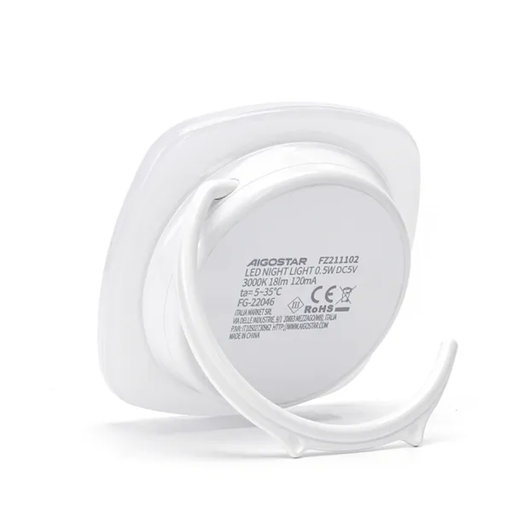
Why this product suits this profile: The compact light is designed for indoor areas such as hallways, bedrooms, wardrobes or beneath wall cabinets, and does not require permanent wiring.
The product specifications state 500 mAh, USB charging, a 3.5 m detection range and a light output of 18 lm. This makes it easier to assess its suitability as a guidance light realistically.
Warm white light at 3,000 K, PIR and dusk sensors, plus a USB-rechargeable battery.
We've put together a complete, regularly updated list of products that fully meet these strict selection criteria and the safety regulations applicable in the EU.
First, the surface should be free from dust, grease and moisture. For adhesive mounting, attach the light to a flat surface and press it firmly into place. Magnetic models are easier to remove, but require a suitable metal surface or metal plate. The sensor should not be blocked by side panels, clothing or decorations.
The operating time per charge depends on the battery, brightness, how often the sensor is triggered and the length of time the light remains on. A product specification such as 500 mAh or 1,100 mAh only describes the capacity; it does not automatically indicate the operating time. When the brightness decreases, charge the light via USB in accordance with the manufacturer's instructions. Swollen batteries, cracks or unusual heat are reasons to stop using the product.
Running costs depend on power consumption and operating time. The calculation is: Power in watts × operating hours ÷ 1,000 × electricity price per kilowatt-hour. As a sensor light is only active intermittently, consumption is usually lower with short activation intervals than with continuous lighting. For plug-in models, you should also take the stated power consumption into account.