
Lieferung heute & morgen

Qualitätsgarantie

Willkommens-Angebote freischalten: KOSTENLOSE Lieferung | Bis zu 80 % RABATT | Kostenlose 30-Tage-JoyPlus-Testphase
App herunterladen
An LED cabinet light with a motion sensor can illuminate dark compartments, worktops and passageways without a permanently installed power supply. No-drill cabinet lighting, a rechargeable battery and a choice of colour temperatures are particularly popular features. However, some product claims can lead to the wrong purchase: not every sensor light suits every installation, and not every cordless light is suitable for damp areas.
Claims such as “long runtime” are hard to assess without details of the battery capacity. When choosing a USB LED light, check whether the capacity is given in milliamp hours, which charging connection it uses and whether a USB cable is included. The actual runtime also depends on how often the PIR sensor is triggered and how long the light stays on.
A PIR motion sensor responds to changes in heat radiation within its detection area. Its performance is therefore affected by its range, orientation and mounting height. If the light is fitted too far inside a cabinet or the sensor is obscured by a panel, it may not switch on automatically. Look for clear information about the detection range and choose a mounting position with an unobstructed field of view.
A 20 cm light may be enough for a narrow compartment, while a 30 cm or 40 cm version may provide more even illumination in a wide kitchen wall unit. Bathrooms have additional requirements. A light with an IP44 rating should be considered differently from a model with no stated protection against splashes. A product described as an LED mirror cabinet with lighting is not automatically suitable for every wet zone either.
Measure the available space before placing your order. With an ultra-thin LED light, the housing height matters as well as the length and width. Models around 10 mm high can often be fitted beneath shelves or on the sides of cabinets.
For no-drill cabinet lighting, you can use adhesive strips or magnetic brackets. The surface must be clean, dry, grease-free and smooth enough. Adhesion may be poor on rough, dusty or damp surfaces. If you live in rented accommodation, easy removal without leaving marks may be an important factor.
A choice of colour temperatures makes these lights more versatile:
The number of LEDs alone does not tell you how bright the light will be. Also check whether the lumen output is stated, how the LEDs are arranged and whether the light shines from specific points or along its entire length.
A rechargeable LED light with a USB connection can be charged using a suitable mains adaptor, laptop or power bank. The models below include capacities of 800 mAh or 1,100 mAh. These figures make technical comparisons easier, but they do not guarantee a particular runtime.
Also check whether you can switch between continuous lighting, sensor mode and manual operation. Sensor mode is handy in a wardrobe; for cordless kitchen lighting, switching the light on manually may be more useful when you’re working for longer periods.

Why this product suits this type of buyer: Two 20 cm lights are ideal for narrow cabinets, shelves or a small hallway. The set offers three colour temperatures and USB charging.
The product specifications state a capacity of 800 mAh, a sensor range of 3–5 m and dimensions of 200 × 38 × 10 mm. This makes it easier to assess the battery, sensor and space requirements before you buy.
Pack of 2, PIR sensor, three colour temperatures, USB charging and adhesive, no-drill installation.
Why this product suits this type of buyer: With 41 LEDs, the 30 cm design is intended for longer shelves, kitchen wall units or wardrobe areas where you want to illuminate a larger area.
The dimensions of 300 × 38 × 10 mm, 1,100 mAh battery and stated sensor range of 3–5 m give you clear points of comparison.
41 LEDs, 30 cm design, pack of 2, three colour temperatures and USB charging.
Why this product suits this type of buyer: The 40 cm light is designed for wide cabinet fronts, long shelves and kitchen areas where a longer light source better suits the space.
Before buying, compare its 400 × 38 × 10 mm dimensions with the space available for installation. The specifications also state that it has 61 LEDs, a capacity of 1,100 mAh and a sensor range of 3–5 m.
61 LEDs, 40 cm length, pack of 2, PIR sensor, three colour temperatures and USB charging.
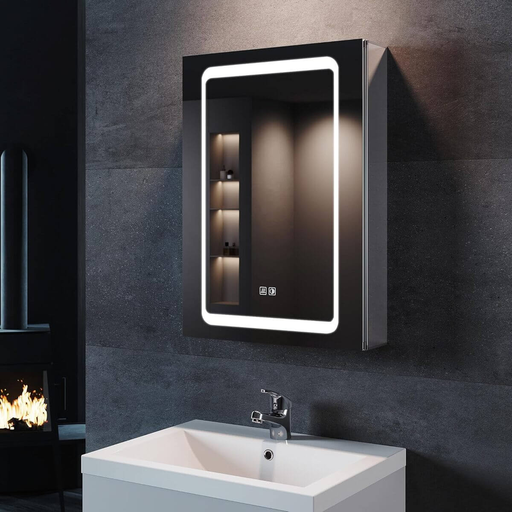
Why this product suits this type of buyer: This model combines a mirror, storage space and integrated lighting. It’s aimed at buyers looking for a complete mirror cabinet rather than an add-on under-cabinet light.
The product description lists aluminium profiles, an anti-fog function, a socket and an IP44 rating. Even so, check the local connection and installation requirements before fitting it.
LED lighting, anti-fog function, socket and stated IP44 rating.
We’ve put together a complete, regularly updated list of products that meet these strict selection criteria and fully comply with the safety regulations in force in the EU.
Clean the mounting surface and let it dry completely before applying the adhesive tape as instructed. Press the light firmly into place for long enough. First, check that the surface is smooth and sturdy enough to support it. For delicate surfaces, it’s a good idea to test a small, inconspicuous area first.
There’s no single answer. Runtime depends on the battery capacity, LED output, how often the sensor is triggered and how long the light stays on. Specifications such as 800 mAh or 1,100 mAh make it easier to compare models. Charge the battery using a compatible USB power source, and stop using the light if the battery is damaged or swollen.
In sensor mode, the light only comes on when it detects movement, so it may be on for less time than a light that stays on continuously. Actual power consumption depends on the model, brightness and how you use it. PIR operation can work especially well for cabinet compartments you don’t use often, while manual or continuous settings are more practical for longer tasks.