
Lieferung heute & morgen

Qualitätsgarantie

Willkommens-Angebote freischalten: KOSTENLOSE Lieferung | Bis zu 80 % RABATT | Kostenlose 30-Tage-JoyPlus-Testphase
App herunterladen
Choosing a new LED ceiling light can quickly become overwhelming. The market offers a vast array of models, all touting different technical specs and design features. But not every light delivers on its promises. Many buyers only realise after installation that the brightness is insufficient, the light colour is unpleasant, or the model is unsuitable for the intended room. To help you make an informed decision, we'll highlight the three most common pitfalls and show you which objective criteria truly matter.
Before you make a decision, you should be aware of common issues that often only become apparent after the purchase.
To avoid these mistakes, focus on three verifiable technical specifications. These will help you objectively assess a light's performance and suitability.
Forget wattage as a measure of brightness. The crucial value is the luminous flux, measured in lumens (lm). It indicates how much light a lamp actually emits. A higher lumen count means brighter illumination.
The colour temperature, measured in Kelvin (K), determines whether the light appears warm or cool. The choice depends on the room and the desired atmosphere.
Modern smart home ceiling lights often offer the ability to flexibly adjust the colour temperature via an app or remote control.
The IP (Ingress Protection) rating indicates how well a light is protected against the ingress of foreign objects (first digit) and water (second digit). For a bathroom ceiling light, an IP44 rating is the minimum standard.
This ensures the light is sufficiently protected against the typical moisture and water vapour found in a bathroom. For areas in the immediate vicinity of a shower or bathtub, higher IP ratings (e.g., IP65) are required.
Based on these objective criteria, we have selected a few models for different requirements and style preferences.

Why it's a great fit: Ideal for anyone who appreciates a warm, natural aesthetic. The combination of real wood and modern design blends seamlessly into living rooms or bedrooms, creating an inviting atmosphere.
At 3000 K, it provides a pleasant warm white light that doesn't feel sterile. The brightness of 2400 lm is clearly stated and sufficient for medium-sized rooms. The integrated 3-step dimmer offers the necessary flexibility.
The combination of a stylish wooden-style ceiling light and a practical dimming function with a memory effect (saves the last setting) offers a high level of comfort.

Why it's a great fit: Perfect for users who want full control and customisation. This smart home ceiling light can be controlled via app and voice (Google Assistant, Alexa) and offers a coloured backlight in addition to the main light.
The colour temperature is flexibly adjustable, eliminating the "wrong colour tone" mistake. Thanks to its IP54 certification, it is also dust and splash-proof, making it suitable for bathrooms or kitchens and bypassing the third pitfall.
The extremely slim design (approx. 2.5 cm) makes it an unobtrusive and modern low-profile ceiling light that sits flush against the ceiling. The RGB backlight allows for creative lighting accents.
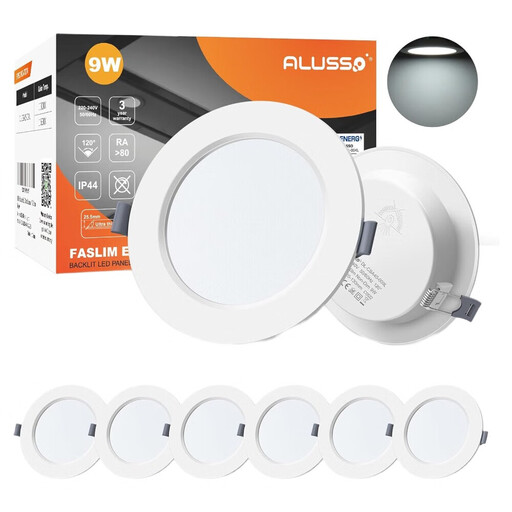
Why it's a great fit: A pragmatic solution for anyone needing uniform and safe lighting for functional spaces like bathrooms, kitchens, or hallways. The set allows for comprehensive, area-wide illumination.
With an IP44 rating, these spotlights are explicitly suitable for damp rooms, avoiding the safety risk. The colour temperature of 6500 K (Cool White) is intended for areas where bright, clear visibility is required and is not mistakenly marketed for living spaces.
The very shallow installation depth of only 25.5 mm makes installation possible even in suspended ceilings with limited space. The direct connection to 230 V without an additional transformer simplifies assembly.
We have compiled a complete, up-to-date list of products that fully meet these strict selection criteria and UK safety regulations.
For an average-sized living room (approx. 20 m?), a baseline brightness of around 2000 to 3000 lumens is recommended. Since the living room is used for various activities, a dimmable light is ideal. This allows you to increase the brightness for reading or reduce it for a relaxing evening.
The IP rating indicates the degree of protection against the ingress of foreign objects and water. For the bathroom, a minimum of IP44 is required. The first digit (4) stands for protection against solid objects (>1 mm), and the second digit (4) for protection against splashing water from all directions. This ensures safe operation in a humid environment.
No, not every LED light is dimmable. Pay close attention to the product description, which must explicitly state "dimmable." There are various dimming methods: via an external wall switch (leading-edge or trailing-edge dimmer), an included remote control, an integrated step-switch (often operated via the normal light switch), or via an app for smart home models. Using an incompatible dimmer can damage the light.