
Lieferung heute & morgen

Qualitätsgarantie

Willkommens-Angebote freischalten: KOSTENLOSE Lieferung | Bis zu 80 % RABATT | Kostenlose 30-Tage-JoyPlus-Testphase
App herunterladen
An LED ceiling light should illuminate a room evenly, complement your existing interior style and be easy to install without unexpected additional costs. In practice, unsuitable purchases are often not caused by the LED technology itself, but by incorrect dimensions, an unsuitable colour temperature or incorrectly assessed dimming and protection features.
Wattage describes power consumption, not brightness directly. For comparisons, luminous flux in lumens is more important. A light with 2,300 lm may be suitable for a medium-sized living room or hallway, while several recessed spotlights can distribute the brightness precisely across a larger area.
Room design also affects how light is perceived: dark walls and furniture absorb more light than light-coloured surfaces. The light should therefore not be selected solely according to its power consumption.
A warm white LED ceiling light of around 2,700 to 3,300 Kelvin is generally perceived as inviting and is suitable for bedrooms, living rooms or dining areas. Neutral white between around 3,300 and 5,300 Kelvin can be suitable for kitchens, work areas and hallways. Values of around 6,000 to 6,500 Kelvin appear noticeably cooler and may not be comfortable in every home.
A 3CCT light offers greater flexibility here. With a 3CCT LED recessed spotlight, for example, you can choose between 3,000, 4,000 and 6,000 or 6,500 Kelvin. Important: on many models, the colour temperature is set using a switch on the housing before installation.
Flat models are a sensible choice for low ceilings, suspended constructions or areas above furniture. With an LED recessed spotlight, at least the following dimensions must match:
A particularly slim model with an installation depth of 25.5 mm may be suitable for confined ceiling spaces. 12- to 24-volt lights, on the other hand, require a suitable transformer, which is not always included.
The luminous flux in lumens (lm) indicates how much visible light a light emits. With ceiling spotlights, you should also consider the beam angle. A wide angle distributes light over a large area, while a narrower angle creates more targeted accents.
A single flat light may be sufficient for a small hallway. In kitchens, bathrooms or open-plan living areas, several LED ceiling spotlights often provide more options for illuminating individual zones.
Not every LED light is dimmable. With a dimmable LED ceiling light, you must also check which type of dimmer is compatible. Some models require a suitable trailing-edge dimmer, while others are controlled exclusively via an app.
The product data sheet should clearly state:
A light with three-stage dimming is not the same as a continuously dimmable version.
The IP rating describes protection against solid foreign objects and water. An IP44 LED ceiling spotlight is protected against splashing water from different directions and may be suitable for certain areas in bathrooms or kitchens. IP65 provides a higher level of protection against dust and water jets.
The IP rating alone does not replace proper planning. Bathrooms have designated installation zones and safety clearances. In Germany, the electrical connection should be carried out by a suitably qualified person in accordance with the applicable regulations. IP20 lights, on the other hand, are generally intended only for dry indoor areas.
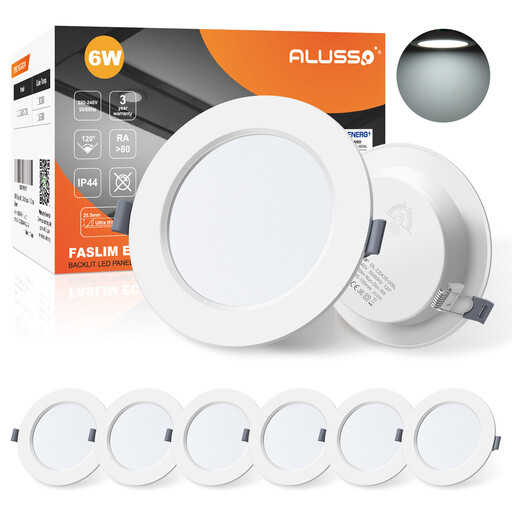
Why this product suits this profile: The set of six lights offers a practical solution for multiple installation points in bathrooms, kitchens, hallways or living areas. The stated installation depth of 25.5 mm is useful for shallow ceiling constructions.
The product specifications state the ceiling cut-out, installation depth, IP44 rating and direct 220–240-volt connection. This allows you to check the space required and connection type before buying.
Six lights, 430 lm per light, 6 W power consumption and IP44 protection rating according to the product description.
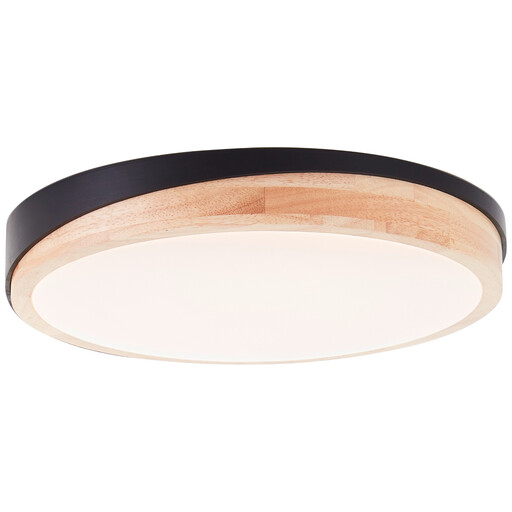
Why this product suits this profile: This light combines a wood-effect look with warm white illumination and integrated three-stage dimming. It is suitable for dry indoor spaces such as living rooms, bedrooms, kitchens or hallways.
The dimming function is described as an integrated three-stage control. This makes it clear that a standard external dimmer should not be assumed to be required.
2,400 lm, 3,000 K, 24 W, 35 cm diameter and memory function for the last brightness setting according to the product data.
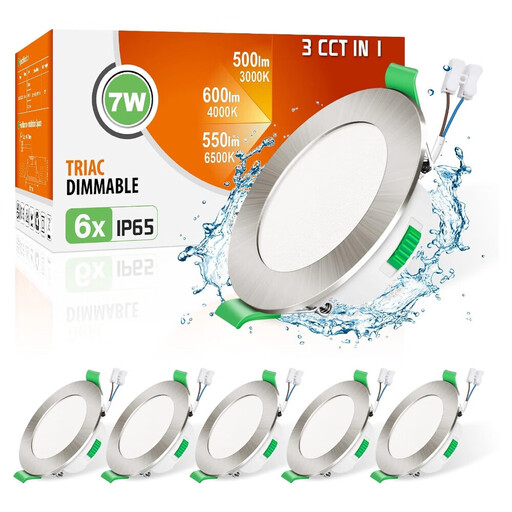
Why this product suits this profile: The combination of IP65, 3CCT selection and dimming is aimed at users who want to adjust their lighting precisely in kitchens, bathrooms or other humid indoor areas.
The specifications explicitly state the required 67–75 mm opening, 29 mm installation depth and use with a compatible trailing-edge dimmer.
3,000, 4,000 and 6,500 K, 10–100% dimming range, 500/550/600 lm and IP65 according to the product description.
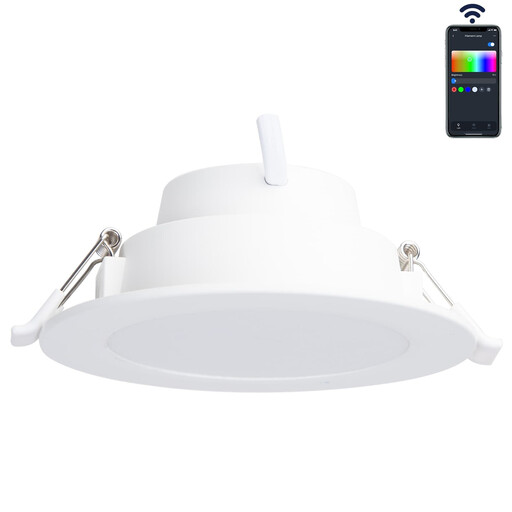
Why this product suits this profile: This smart LED recessed spotlight is designed for users who want to manage colour temperature, colours and brightness via an app or compatible voice control.
The product description states that dimming is carried out via the app and that an external wall dimmer should not be used. It also specifies IP20, which is suitable only for dry indoor areas.
780 lm, 2,700–6,500 K, RGB colours, Bluetooth Mesh and a stated cut-out of 120–130 mm.
We have put together a complete, regularly updated list of products that fully meet these strict selection criteria and the safety regulations applicable in the EU.
A light connected directly to 220–240 volts does not require a separate transformer. However, this does not mean that you should carry out the installation yourself. The circuit must be switched off before installation; the electrical connection should be handled by a qualified professional.
Power consumption is the key factor when calculating running costs. The simple formula is:
Wattage × operating hours ÷ 1,000 = kilowatt-hours
A 24 W light switched on for five hours a day uses 0.12 kWh per day in theory. The actual cost depends on your individual electricity tariff. The EU energy efficiency class should be considered as a comparison value, but not separately from lumens, power consumption and operating time.
This depends on the room size, wall colour, ceiling height and intended use. For general living areas, several thousand lumens from one central light or distributed across several spotlights may be suitable. With recessed spotlights, you should multiply the luminous flux per light by the number of lights.
For humid areas, the protection rating, installation zone and manufacturer’s specifications are crucial. An IP44 LED ceiling spotlight may be suitable for certain indoor areas; IP65 offers a higher level of protection. IP20 lights should not be used in areas exposed to moisture. The specific installation must comply with the applicable safety regulations.
The stated service life is a manufacturer’s figure and depends, among other things, on operating hours, heat dissipation and ambient temperature. Some of the products mentioned have an average service life of 30,000 hours. An integrated LED also cannot simply be replaced like a conventional bulb. Before buying, therefore, check the warranty, spare-parts and returns information.