
Lieferung heute & morgen

Qualitätsgarantie

Willkommens-Angebote freischalten: KOSTENLOSE Lieferung | Bis zu 80 % RABATT | Kostenlose 30-Tage-JoyPlus-Testphase
App herunterladen
An LED ceiling light should illuminate a room sufficiently, complement its interior style and work reliably in everyday use. However, many shoppers initially focus on design or wattage. This can lead to common buying mistakes: the light feels too cold, the fitting is too weak for the room or an advertised additional feature is incompatible with the existing electrical installation.
This buying guide explains which details really matter and which models suit different living situations.
Wattage describes energy consumption, not brightness directly. The lumen rating is more important when comparing light output. A 24 W ceiling light can vary in brightness depending on its design and light efficiency. Wattage and lumens should therefore always be considered together.
As a practical guide:
Light colour is measured in Kelvin. Warm white light of around 2,700 to 3,000 K usually creates a homely atmosphere and is suitable for bedrooms, living rooms and dining rooms. Neutral white light of around 4,000 K supports a more functional feel, while 6,500 K appears noticeably cool and similar to daylight.
A ceiling light with warm white light is therefore not automatically suitable for every room. Neutral white light may be more practical in a home office or kitchen. Warm white is often a better fit for a cosy living room or bedroom.
A dimmable ceiling light can adjust brightness to suit different situations. However, it is important to check how dimming works: via a wall switch, remote control or app. With an integrated 3-stage dimmer, you should also check whether the switch needs to be pressed repeatedly.
With a ceiling light featuring a motion and presence sensor, the detection range, overrun time and position of the fitting are important. This type of feature can be practical in hallways or utility areas, but it should not be chosen solely based on the product name. The specific technical details of each model remain decisive.
The luminous flux in lumens indicates how much visible light a fitting emits. Wattage describes its electrical power consumption. The EU energy label also provides information about the energy efficiency class. The class should be checked in the product data sheet, as a high lumen rating does not automatically mean a favourable energy efficiency class.
Example: A model rated at 20 W and 2,700 lumens may have a different efficiency rating from a 24 W fitting with 2,400 lumens. For running costs, daily usage time is also relevant in addition to power consumption.
Alongside Kelvin, the colour rendering index Ra is an important specification. A higher Ra value means that colours appear more natural under the light. This feature can be relevant when choosing energy-efficient ceiling lighting for living areas, kitchens and dining rooms.
Light distribution also matters: a flat acrylic cover usually spreads light over a wide area, while decorative elements can create visible accents. For a workspace, the fitting should provide as even an illumination as possible and avoid distracting reflections.
Before buying, measure the ceiling area and check the position of the power outlet. A fitting with a diameter or width of 35 to 41 cm may be suitable for small and medium-sized rooms, but could look too compact in very large rooms.
IP20 is often specified for dry indoor areas. This protection rating is not intended for damp rooms or direct outdoor use. Installation and electrical connection must only be carried out by a suitably qualified professional. Before installation, also check the ceiling’s load-bearing capacity, the fixing materials and the manufacturer’s instructions.
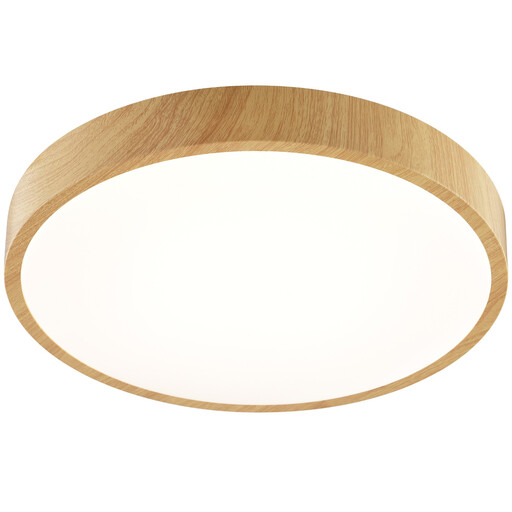
Why this product suits this profile: This light combines 24 W, 2,300 lumens and warm white light at 3,000 K. It is designed to provide even general lighting in living rooms, bedrooms, hallways or dining areas.
The specifications for power, luminous flux, colour temperature and dimming are clearly stated. This makes it clear that the model is not dimmable and is intended for consistent lighting.
38.5 cm diameter, integrated LED technology, 2,300 lumens and a plastic wood-effect finish.
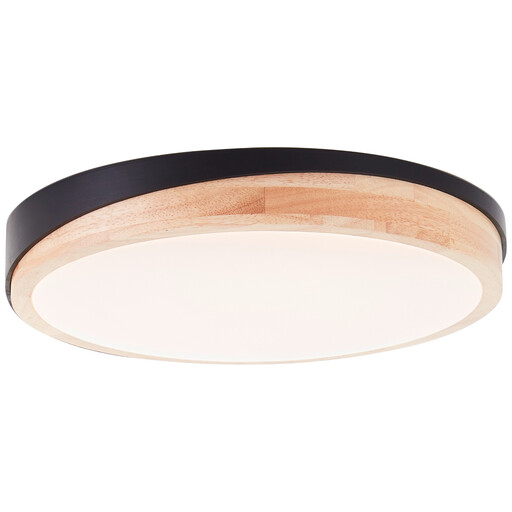
Why this product suits this profile: This wooden ceiling light combines a natural look with 2,400 lumens and warm white light. It is a good choice for shoppers who want to combine the look of natural materials with straightforward brightness adjustment.
The 3-stage dimming and memory function are clearly specified. This makes it easier to compare the feature with your preferred level of operating convenience than a general claim that a product is dimmable.
24 W, 2,400 lumens, 3,000 K, 35 cm diameter and integrated 3-stage dimmer.
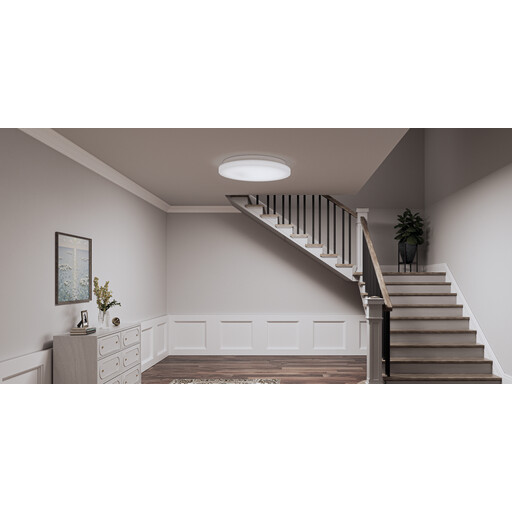
Why this product suits this profile: The model name indicates presence detection. This could be useful in hallways, entrance areas or frequently used utility rooms, provided the detection range and controls suit your living situation.
The sensor feature is not presented as a blanket guarantee of energy savings. Before buying, check the range, overrun time, installation height and the switching logic you require.
Presence detection according to the product name, making it suitable for areas where automatic lighting control is preferred.
We have put together a complete, regularly updated list of products that fully meet these strict selection criteria and the safety regulations applicable in the EU.
For a living room ceiling light, warm white light of 2,700 to 3,000 K and even light distribution are often a good fit. In the bedroom, the fitting should not be too glaring; an LED ceiling light for bedrooms with a dimming function allows you to adjust the brightness more flexibly.
In the kitchen and home office, 4,000 K and a higher lumen output are often practical. A more compact fitting or a sensor-equipped model may be suitable for a hallway. With wood-effect finishes, check whether real wood or simply a plastic décor has been used. The material specification should therefore be checked in the data sheet.
This depends on the size and use of the room, as well as any additional lights already in place. Around 1,500 to 2,400 lumens may be sufficient for smaller rooms. Living areas with higher lighting requirements may need 2,700 to 4,000 lumens. A general recommendation cannot replace an assessment of the room size and light distribution.
The service life stated by the manufacturer is a guideline and depends, among other things, on operating time, heat dissipation and the quality of the electronics. With integrated LEDs, the light source usually cannot be replaced in the same way as a conventional bulb. Check the warranty, spare parts and service information before buying.
You can estimate the cost using this formula: Power in kW × operating hours × electricity price. A 24 W light uses 24 kWh over 1,000 hours of operation. The actual amount depends on your electricity tariff and how long the light is used.