
Lieferung heute & morgen

Qualitätsgarantie

Willkommens-Angebote freischalten: KOSTENLOSE Lieferung | Bis zu 80 % RABATT | Kostenlose 30-Tage-JoyPlus-Testphase
App herunterladen
An LED ceiling light can illuminate a room evenly, save space and, thanks to integrated LEDs, reduce the need for bulb changes. However, not every modern LED ceiling light automatically delivers the right result. All too often, brightness, colour temperature or installation requirements are only checked after purchase.
Three typical pitfalls occur particularly frequently:
Luminous flux is given in lumens. A single LED ceiling light with 2,300 to 2,700 lumens can be suitable for a living room, bedroom or hallway, depending on the room shape, ceiling height, wall colour and desired lighting effect. For large or irregularly shaped rooms, a combination of ceiling lighting, floor lamps and wall lights may be more practical.
Also pay attention to the beam angle. A wide angle distributes light over a large area, while a spotlight highlights specific zones. For an LED recessed spotlight used in cabinets, kitchen units or alcoves, it's not just the wattage that matters, but also the position of the light cone.
The Kelvin value describes the colour temperature:
The CRI or Ra value describes colour rendering. A value of Ra ≥ 80 is common for many domestic lights. For the kitchen, dressing room or areas where colours should appear as natural as possible, it's worth checking this value.
A dimmable ceiling light offers extra flexibility. However, check how the dimming works: via a wall switch, remote control, app or an integrated step dimmer. An LED ceiling light with a remote control is not automatically compatible with every external dimmer.
Before buying, measure the installation location. For recessed lights, the cut-out diameter, installation depth and connection voltage are particularly important. The 12–24 V model from ALUSSO, for example, requires a separate transformer and must not be connected directly to the 220–240 V mains supply.
For bathrooms, kitchens or other areas with moisture, the IP rating must be considered. IP44 offers protection against splashing water from certain directions, while IP20 is intended only for dry indoor areas. Any electrical installation at the ceiling should be carried out by a qualified electrician in accordance with local regulations.
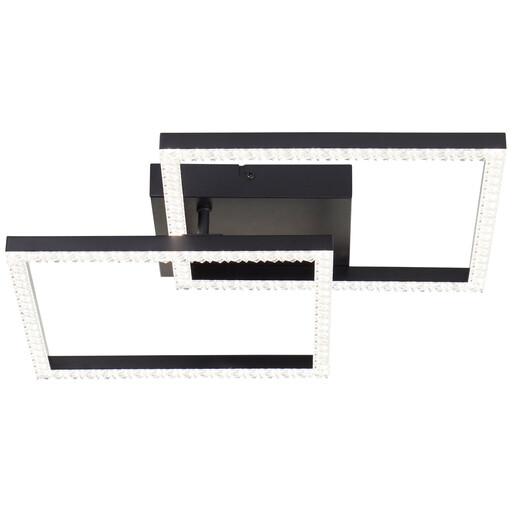
Why this product suits the profile: The fixed integrated LED with 20 W and 2,700 lm provides a clearly defined basic level of lighting for the living room, bedroom, dining area or hallway. The black finish complements modern interior design schemes.
The product details clearly state the luminous flux, colour temperature, dimensions and IP20 rating. This means you can check before purchase whether 4,000 K and use in dry indoor spaces match your needs.
2,700 lm at 20 W; black housing; one swivelling frame element and compact dimensions of 41 × 41 cm.

Why this product suits the profile: The combination of a wood-effect finish, 3,000 K and three-step dimming makes it ideal for households looking for a homely ceiling light for the living room, bedroom, kitchen or hallway.
The dimming function works in three steps and, according to the product details, includes a memory function. It's important to note: this is not a stepless external dimmer solution.
2,400 lm, 24 W, 3,000 K, integrated LED and three brightness levels; diameter 35 cm; wood material as per the product description.
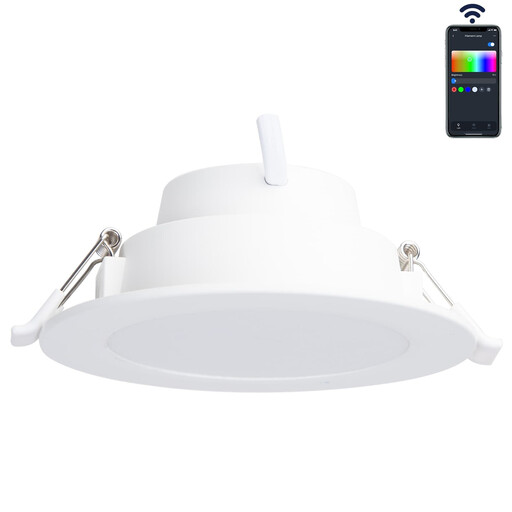
Why this product suits the profile: This smart LED ceiling spotlight is aimed at users who want to control colour temperature, dimming and RGB colours via an app. Bluetooth Mesh and optional voice control make it suitable for multiple networked lights indoors.
The product data explicitly states the cut-out size of 120–130 mm, IP20 and app control. According to the details, an external wall dimmer is not intended.
9 W, 780 lm, RGB plus 2,700–6,500 K, Bluetooth Mesh, dimmable and designed for flush mounting in dry indoor areas.
We've put together a complete, regularly updated list of products that fully meet these strict selection criteria and the safety regulations in force in the EU.
A black ceiling light creates a visible accent, but in small rooms it can stand out more than a white or wood-coloured version. A light with a wood-effect finish offers a natural look, but you should check the material, care requirements and colour tone to ensure it matches your existing décor.
For kitchens and bathrooms, recessed lights with IP44 are worth considering, provided the specific installation position is suitable. The ALUSSO model offers three selectable colour temperatures of 3,000, 4,000 and 6,000 Kelvin, but requires a 12–24 V transformer. According to the product details, the transformer is not included.
When choosing energy-efficient ceiling lighting, you should consider the consumption per 1,000 hours, the energy efficiency class and the luminous flux together. A low wattage alone does not automatically mean suitable lighting.
That depends on the room size, ceiling height, wall colour and desired brightness. As a rough guide, 2,000 to 3,000 lumens can be suitable for many medium-sized living spaces. For larger rooms or multiple lighting zones, a combination of several lights may be more appropriate.
The lifespan depends on factors including the LED module, heat dissipation, switching frequency and operating time. Check the manufacturer's stated lifespan and note whether the LED module is replaceable. With integrated LEDs, the entire light is often replaced when the module fails.
The running costs can be estimated using this formula: Wattage ÷ 1,000 × operating hours × electricity price per kilowatt-hour. A 24 W light uses 24 kWh over 1,000 operating hours. The actual amount depends on your individual electricity tariff and usage duration.