
Lieferung heute & morgen

Qualitätsgarantie

Willkommens-Angebote freischalten: KOSTENLOSE Lieferung | Bis zu 80 % RABATT | Kostenlose 30-Tage-JoyPlus-Testphase
App herunterladen
An LED ceiling light should illuminate the room sufficiently, complement your décor and be easy to use without unnecessary maintenance. However, many buyers initially focus on appearance or a high wattage. As a result, important factors such as luminous flux, colour temperature, room size and IP rating are overlooked.
Three buying pitfalls are particularly common:
Wattage describes energy consumption, not brightness directly. When choosing energy-efficient ceiling lighting, the luminous flux in lumens is therefore more informative.
The following figures can serve as a general guide:
An LED lamp rated at 20W, 24W or 32W can produce different levels of brightness depending on its design and luminous efficacy. Wattage and lumens should therefore always be considered together.
Colour temperature is measured in Kelvin:
A 3000K ceiling light creates a warmer atmosphere than a model with 4000 K. If you want to keep your options flexible, choose a light with selectable colour temperatures. A dimmable LED ceiling light also lets you adjust the brightness to suit the time of day and the activity. Check whether dimming is controlled via the wall switch, a remote control or a separate control unit.
A flat light mounted directly on the ceiling saves space and is suitable for rooms with low ceilings. Before buying, measure the diameter or width, as well as the position of the existing ceiling outlet.
Other relevant factors include:
A black ceiling light can create a striking contrast in minimalist or industrial interiors. With a modern ceiling lamp featuring decorative elements, you should also check whether the light is distributed evenly enough for the intended room.
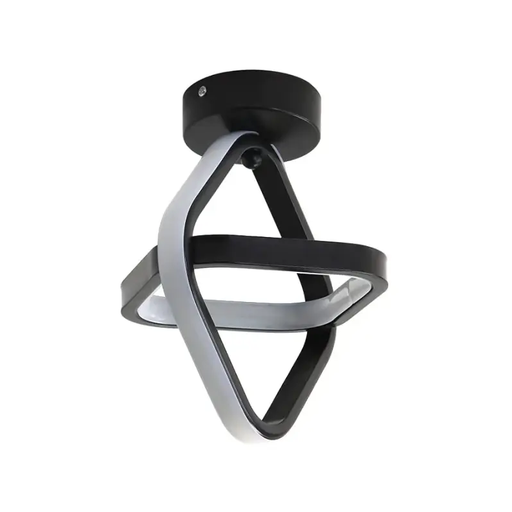
Why this product suits this profile: According to the product specifications, this compact model, with a diameter of 22 cm, 24 W and 2700 lm, is suitable for hallways, entrance areas, stairwells and smaller rooms of approximately 5 to 15 m².
The specifications state both the wattage and luminous flux, as well as the colour temperature. This makes it easier to compare the light objectively with other models.
3000 K warm white, integrated LED chip, black metal finish and space-saving ceiling installation.
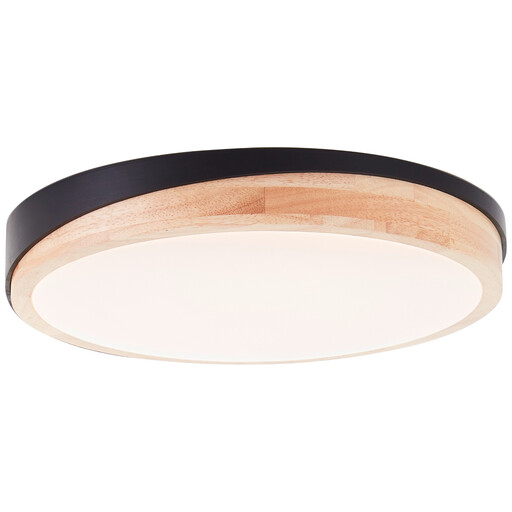
Why this product suits this profile: The combination of wood, plastic and metal complements living rooms and bedrooms. Three brightness levels with a memory function make adjustment simple.
The product data clearly specifies the three-stage dimming, 3000 K and 2400 lm. The lighting effect therefore does not have to be inferred from the design alone.
Integrated LED technology, 24 W, 2400 lm, 3000 K and three-stage dimming with memory function.
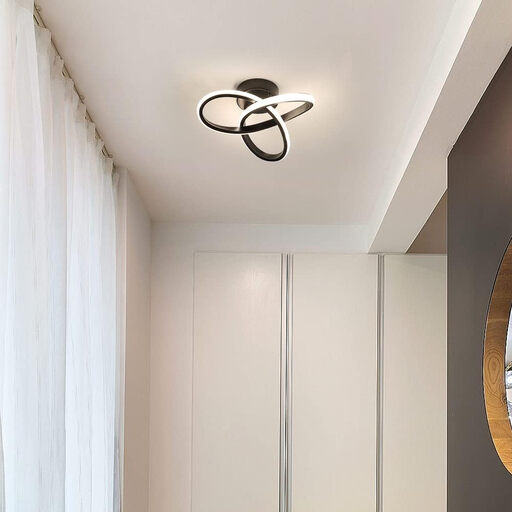
Why this product suits this profile: For hallways, balconies or stairwells with changing requirements, this model offers three colour temperatures and approximately 2400 lm at 22 W.
The three selectable colour temperatures reduce the risk of choosing a light with an unsuitable colour temperature for the room.
3000, 4000 and 6500 K via the wall switch, aluminium housing and low-profile surface mounting.
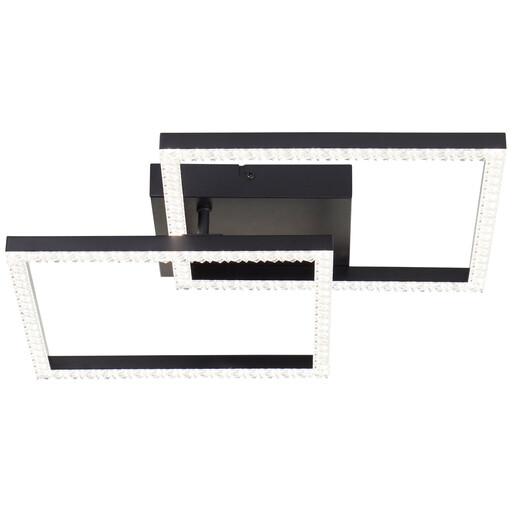
Why this product suits this profile: The square design, black finish and crystal-like elements are intended for living rooms, bedrooms, dining rooms and hallways.
The dimensions of 41 × 41 cm and the luminous flux of 2700 lm are clearly stated. This allows you to check in advance whether the size and brightness suit the room.
20 W, 2700 lm, 4000 K, integrated LED and a swivelling element for individual positioning.
We have put together a complete, regularly updated list of products that fully meet these strict selection criteria and the safety regulations applicable in the EU.
Before installation, switch off the power supply and secure it against being switched back on. When fitting lights that connect to existing ceiling cables, involve a qualified electrician. This is particularly important if the wires, earth connection or terminal blocks cannot be clearly identified.
The following points are relevant during everyday use:
Around 1,500 to 2,700 lm may be sufficient for a small hallway. In living or working areas, the requirement also depends on room size, wall colour, ceiling height and the desired light distribution. The lumen rating should therefore always be assessed together with the dimensions and intended area of use.
A warm white ceiling light with 3000 K is often chosen for bedrooms, living rooms and hallways. It creates a warmer lighting effect than neutral or cool white models. Whether it suits you personally depends on the décor, available daylight and individual preference.
Running costs depend on the wattage, daily usage time and electricity tariff. A 20 W light used for five hours a day consumes 0.1 kWh per day in theoretical terms; at 24 W, consumption is 0.12 kWh. For an exact calculation, you need the actual consumption and the current unit price of your tariff.