
Lieferung heute & morgen

Qualitätsgarantie

Willkommens-Angebote freischalten: KOSTENLOSE Lieferung | Bis zu 80 % RABATT | Kostenlose 30-Tage-JoyPlus-Testphase
App herunterladen
An LED ceiling light should illuminate a room evenly, complement your interior style and work reliably in everyday use. However, buying one often raises problems: the light looks larger in product images than it does on the ceiling, the colour temperature is unsuitable for the room or the stated wattage is confused with actual brightness.
If you are looking for a round LED ceiling light, a slim LED ceiling light or a modern ceiling lamp, you should therefore consider more than just the design. Technical specifications, installation requirements and the intended location are all crucial.
Wattage initially describes power consumption, not brightness directly. For comparison, luminous flux in lumens (lm) is more meaningful. Depending on the LED technology used, one 24 W light can appear noticeably different from another 24 W model from a different supplier.
As a general guide:
Claims such as “suitable for 15–20 m²” should be treated as a guide. Ceiling height, wall colour, furniture and existing supplementary lighting all affect the result.
Colour temperature is measured in Kelvin (K). Warm white light of around 3,000 K often creates a subtle atmosphere in living rooms and bedrooms. Neutral white light of around 4,000 to 4,500 K is better suited to kitchens, hallways and work areas. Cool white light at around 6,500 K may be intended for concentrated work or areas where clear visibility is important, but it may feel unsuitable in a bedroom.
A ceiling lamp with adjustable colour temperature or a dimmable LED ceiling light with an adjustable white tone offers greater flexibility. It is important to check that the product description actually confirms both brightness adjustment and colour temperature control.
For bathrooms, kitchens and other areas exposed to moisture, the IP rating is relevant. A light without a stated suitability for damp or wet rooms should not be installed there. Some of the product information provided expressly states that use in damp areas is not intended without an appropriate rating.
Installation requirements should also be assessed realistically:
In addition to lumens, the beam angle is important. A wide angle distributes light over a larger area, while more directional lighting can highlight specific zones. A CRI value above 80 is often given as a useful guide to natural colour rendering for many residential lights. Higher values may be worthwhile for specialist work areas.
Also look for information about glare and light distribution. A cover made from acrylic or polycarbonate can distribute the LEDs more evenly visually. However, this alone does not prove a particular level of light quality.
A slim LED ceiling light is particularly suitable for rooms with low ceilings. Round models often have a neutral appearance and can be integrated into bedrooms, hallways or living rooms. Geometric lights with rings or overlapping shapes, on the other hand, create a stronger design statement.
Before buying, you should measure:
A smart ceiling light can be controlled via an app, schedule or voice control. Before buying, check whether the light is compatible with your own system. According to the product information, the Yeelight C300 supports Alexa, Google Home, SmartThings and Mijia, among others. However, the exact setup may depend on the app version, Wi-Fi network and region.
A conventional dimmable LED ceiling light, by contrast, does not necessarily require a smart home system. Check whether it is dimmed using a remote control, wall switch or app. With permanently integrated LEDs, you should also bear in mind that the entire light often needs to be replaced if it develops a fault.
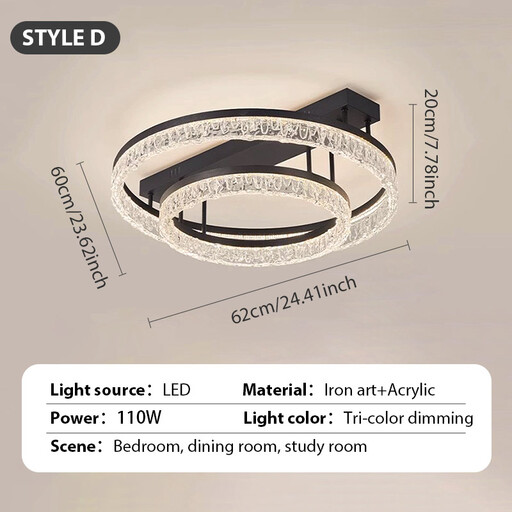
Why this product suits this profile: The round design works well in bedrooms, living rooms and hallways. Choosing from three colour temperatures offers more flexibility than a light with just one fixed white tone.
The stated choice of three light colours reduces the risk of being stuck with an unsuitable colour temperature. You should also check the lumen rating and dimensions before buying.
Round metal design and three selectable colour temperatures according to the product name.
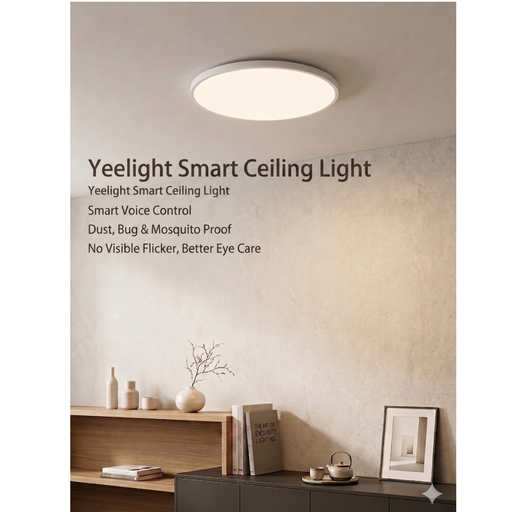
Why this product suits this profile: This model combines dimming, adjustable colour temperature and app control. It is suitable for anyone who wants to integrate living room or bedroom lighting into existing smart home routines.
Compatibility with several platforms is stated explicitly. Before ordering, check the Wi-Fi requirements, app functions and preferred voice control system.
Dimmable, adjustable colour temperature, app remote control and, according to the product information, support for Alexa, Google Home and SmartThings.
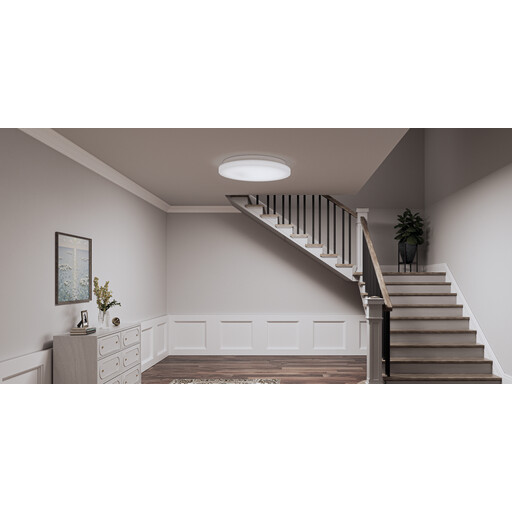
Why this product suits this profile: The product name indicates presence detection. This may be useful for hallways, entrance areas or rooms where automatic lighting control is desired.
A sensor should not automatically be assumed to provide every type of automation you want. Check the range, detection angle, delay time and app support in the product details before installation.
For a ceiling light with a motion or presence sensor, presence detection is specified as a product feature.
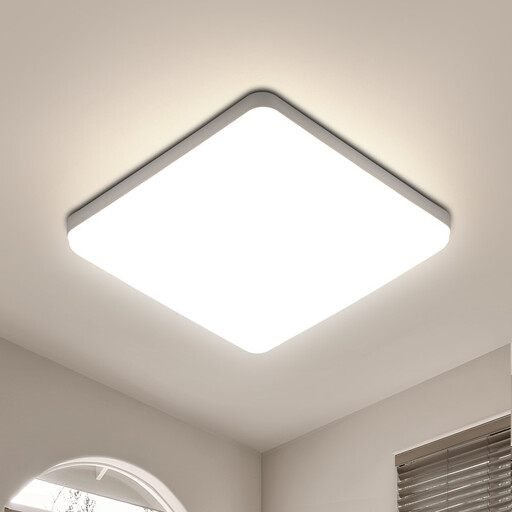
Why this product suits this profile: The stated installation height of around 3.5 cm and the square shape are relevant for hallways, kitchens, bedrooms or living rooms with limited ceiling height.
The slim design reduces the risk of the light becoming visually or practically intrusive in low-ceilinged rooms. According to the product information, a suitable IP rating is required for bathroom use, but none is specified here.
36 W, 3,300 lm, 4,500 K and an installation height of around 3.5 cm according to the product information.
We have put together a complete, regularly updated list of products that fully meet these strict selection criteria and the safety regulations applicable in the EU.
This depends on the room size, ceiling height and intended use. A smaller amount of light may be sufficient for a small bedroom than for a kitchen or study. Use the lumen rating as a comparison value and also take the room’s existing lighting into account.
The supplier gives the lifespan in operating hours, for example 30,000 or 50,000 hours. This is a product specification, not a guarantee of identical operating conditions in every household. Heat, switching cycles, power quality and usage all affect the actual lifespan.
An energy-efficient ceiling lamp can reduce electricity consumption compared with a light with a higher power draw. For a fair assessment, compare wattage, daily usage time and electricity price. Greater brightness may also mean higher consumption. The key is therefore the right combination of luminous flux and power, not just a marketing claim.