
Lieferung heute & morgen

Qualitätsgarantie

Willkommens-Angebote freischalten: KOSTENLOSE Lieferung | Bis zu 80 % RABATT | Kostenlose 30-Tage-JoyPlus-Testphase
App herunterladen
An LED ceiling light should illuminate a room sufficiently, complement its interior style and work reliably in everyday use. However, there are clear differences between a classic LED ceiling lamp, a dimmable ceiling light and a smart ceiling light. Terms such as “bright”, “energy-saving” or “smart home” are of limited value without the relevant technical specifications.
Before buying, you should therefore avoid three common pitfalls:
Luminous flux in lumens (lm) indicates how much visible light a light fitting produces. A 24-watt LED can vary in brightness depending on its design and efficiency. For comparison:
A compact light may be sufficient for a small bedroom or hallway. In a large living room, kitchen or home office, you should consider luminous flux, beam angle and room size together. A wide light distribution of, for example, 120 degrees can help provide more even illumination.
Colour temperature is measured in kelvin (K):
A warm-white ceiling light with 3000 K, such as the Brilliant Baarlo or Teranon, feels less clinical in a living area. A light with 6500 K, on the other hand, may be suitable for concentrated work or specific functional areas. With a CCT ceiling light, you can adjust the colour temperature within the specified range.
Not every dimmable ceiling light is controlled in the same way. The Baarlo light has an integrated three-stage dimmer with a memory function. This is different from continuously variable dimming via an app or remote control.
With smart models, you should check the type of connection:
IP20 is commonly specified for dry indoor areas. In a kitchen, bathroom or cellar, a higher IP rating such as IP54 may be more suitable. IP54 means limited protection against dust and protection against splashing water; the light must not be submerged.
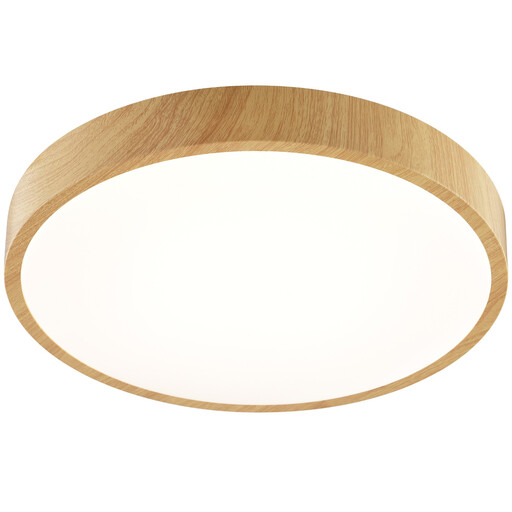
Why this product suits this profile: Measuring 38.5 cm, this light combines a wood-effect finish with warm-white light, making it suitable for living rooms, bedrooms, hallways or dining areas.
The product specifications state 2300 lm, 24 W and 3000 K. This makes it easier to assess brightness and light colour objectively. The light is not dimmable, which must be taken into account before buying.
2300 lm, 3000 K, 24 W, integrated LED and a decorative plastic wood-effect finish.

Why this product suits this profile: The combination of real wood, 2400 lm and three-stage dimming is ideal for buyers who consider materials, lighting comfort and ease of use together.
The fixed 3000 K light colour removes any uncertainty when choosing the colour temperature. At the same time, the dimming function is clearly described as a three-stage dimmer rather than as continuously variable adjustment.
Real wood, 2400 lm, memory function, three brightness levels and a diameter of 35 cm.
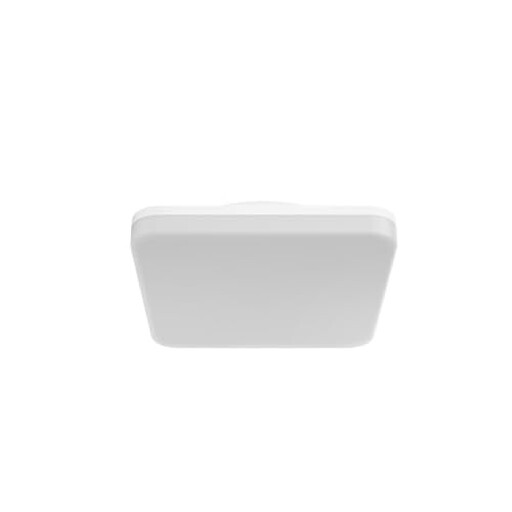
Why this product suits this profile: This model is designed for users who need app and voice control, RGBW colour selection, schedules and integration with an existing smart home system.
Matter, Wi-Fi, RGBW and IP54 are specified as concrete features. According to the product details, the light requires a 2.4 GHz Wi-Fi network and professional installation.
18 W, up to 1800 lm, 2700–6500 K, continuously variable dimming, RGBW, Matter and IP54.
We have put together a complete, regularly updated list of products that fully meet these strict selection criteria and the safety regulations applicable in the EU.
A ceiling light with a motion sensor can be practical in a hallway, cellar or entrance area. Check whether the product is actually a ceiling light or merely supplementary lighting. For example, the OSRAM FLEX MOTION SENSOR is a battery-powered LED strip with a motion sensor, not a conventional ceiling lamp.
The white acrylic light with 4000 lm and 6500 K is designed to provide particularly bright, cool-white light. It may be suitable for a home office or work areas, but it should not be chosen solely on the basis of its advertised service life. Specifications such as 50,000 hours are provided by the manufacturer and depend, among other things, on operating time, heat dissipation and ambient conditions.
The Aigostar Smart LED Ceiling Light, with 3960 lm, 3000–6500 K and Bluetooth Mesh, also offers adjustable light colours. Before ordering, however, check whether the intended control method works with your smartphone and existing smart home components.
The electrical connection of a permanently installed LED ceiling light must only be carried out by a suitably qualified professional. The power supply must be switched off before cleaning or maintenance. IP20 models are intended for dry indoor areas and are not suitable for direct exposure to moisture.
You can estimate running electricity costs as follows:
Power in kW × operating hours × electricity price per kWh = electricity costs
A 24-watt light uses 24 kWh over 1000 operating hours in theory. For a fair assessment, you should also consider the actual brightness, usage duration and energy efficiency class. If there are several lights in the room, suitable light distribution may be more important than choosing the highest possible wattage.
This depends on the room size, wall colour, intended use and desired brightness. Around 1500 to 2500 lm may be sufficient for smaller rooms. In larger living spaces or work areas, 3000 lm or more may be appropriate. However, more lumens do not automatically mean more comfortable lighting.
A colour temperature of around 2700 to 3000 K is commonly described as warm white and is often well suited to bedrooms and living spaces. If you prefer more neutral lighting in the morning or when working, a CCT or smart ceiling light with an adjustable colour temperature may offer greater flexibility.
The manufacturer states the service life in operating hours. This is a guide rather than a guarantee of a specific period of use in every household. You should also ensure sufficient ventilation, use the light in the intended room environment and avoid operating it outside its specified IP rating.