
Lieferung heute & morgen

Qualitätsgarantie

Willkommens-Angebote freischalten: KOSTENLOSE Lieferung | Bis zu 80 % RABATT | Kostenlose 30-Tage-JoyPlus-Testphase
App herunterladen
An LED ceiling light should illuminate a room evenly, complement your interior style and perform reliably day after day. However, product descriptions such as “extra bright”, “modern” or “energy-saving” do not automatically lead to the right choice. Measurable specifications are what matter: luminous flux in lumens, power consumption in watts, colour temperature in Kelvin and suitability for the room in question.
That is why it is worth taking a close look at the technical specifications before buying. This helps you avoid common purchasing mistakes, such as light that is too cool for the bedroom, insufficient brightness in a home office or complicated ceiling installation.
Wattage initially describes power consumption, not brightness itself. An LED ceiling light 36 W can produce different amounts of light depending on its construction and efficiency. For comparisons, luminous flux in lumens is more informative.
Example: a light with 36 W and 4,000 lm provides a much clearer indication than the description “particularly bright”. For living rooms, work areas and larger spaces, you should therefore compare the stated lumen value with the size of the room.
A 6500 K ceiling light produces cool white light. It appears clear and high-contrast, making it suitable for work areas, utility rooms or certain hallways. In a bedroom or a cosy living room, warm white light of around 2700 to 3300 K is often considered more suitable.
A ceiling light with 3 colour temperatures offers greater flexibility. It is important to check how the selection is made: via a wall switch, remote control or app. This information should be included in the product description before you buy.
A modern ceiling light with a geometric shape or wood-effect finish can complement your interior beautifully. However, if details such as luminous flux, colour temperature, dimming function or installation are missing, it is difficult to assess how practical the light will be in everyday use.
The description “long-lasting” should not be considered in isolation either. A stated LED lifespan, the warranty terms and whether the LED module can be replaced are more meaningful indicators.
Luminous flux in lumens (lm) describes the total amount of light emitted. Power consumption in watts (W) shows how much electrical power the light requires. Energy-efficient ceiling lighting provides sufficient light for the intended area while keeping power consumption at a reasonable level.
As a practical guide:
The actual effect also depends on ceiling height, wall colour, the shape of the light and how the light is distributed.
Colour temperature is stated in Kelvin (K). Warm white light is generally up to around 3300 K, while neutral white light is approximately between 3300 and 5300 K. Values above this appear cool white.
The colour rendering index Ra or CRI is also relevant. The higher the stated value, the more naturally colours are likely to appear. This information is useful in rooms where you want clothing, furniture or decorations to be seen in their true colours.
Before placing your order, check the dimensions of the light and the connections already available. Professionally installed fitting may be required for permanently wired lights. The installation instructions should provide information about mounting, connections and the type of ceiling the light can be fitted to.
The IP rating is also important for bathrooms, cellars or covered outdoor areas. A light without a suitable IP rating is not automatically suitable for damp rooms. You should also look for the relevant EU conformity and manufacturer information. These do not replace an assessment of the specific installation situation.
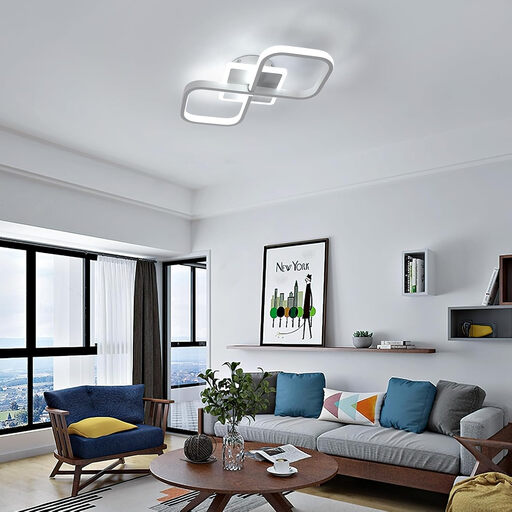
Why this product suits this profile: The stated figures of 36 W, 4,000 lm and 6,500 K make comparisons easier. According to the product description, this model is suitable for areas where clear, bright illumination is required.
Brightness is not promoted solely through the wattage; it is also supported by a specific lumen value. The colour temperature is clearly stated as cool white at 6,500 K.
4,000 lm, acrylic shade and a stated LED lifespan of 50,000 hours.
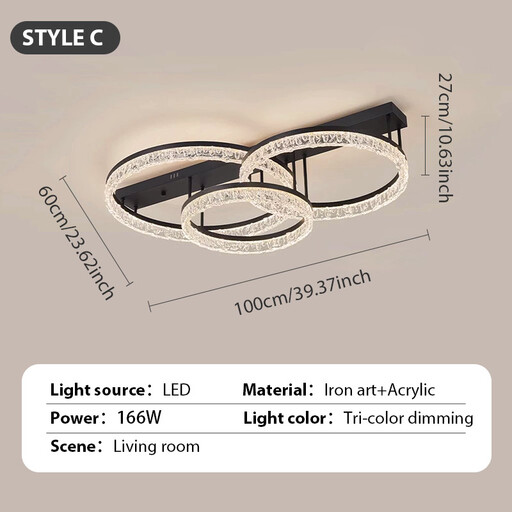
Why this product suits this profile: The round shape works well in bedrooms, living rooms and hallways with a range of interior styles. The choice of three colour temperatures appeals to buyers who want to adjust their lighting according to the room or time of day.
The product name explicitly mentions three colour temperatures. Nevertheless, check how switching between them works and whether a dimming function is included before buying.
Round metal design and three selectable colour temperatures, according to the product name.
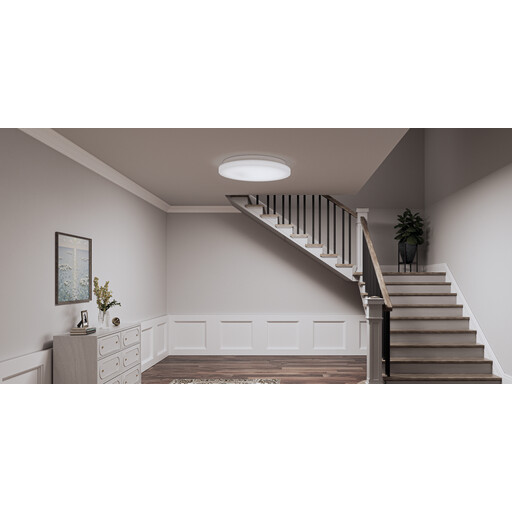
Why this product suits this profile: The integrated presence detection is useful in hallways, entrance areas or rooms where you do not want to switch the light on manually every time you enter.
Presence detection is listed as a specific function. Before installation, check the detection area, switching behaviour and power connection against the manufacturer’s information.
Yeelight C300 model with stated presence detection.
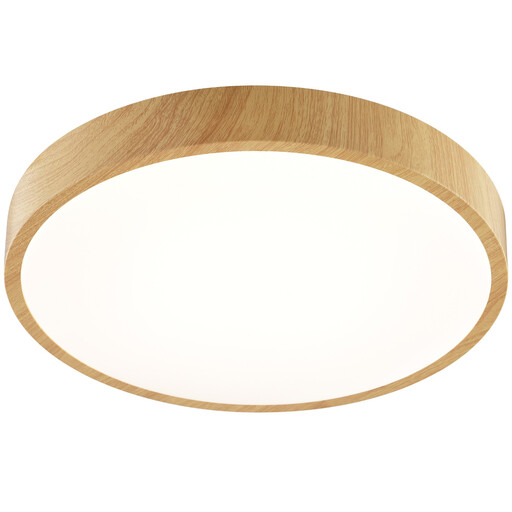
Why this product suits this profile: This wood-effect ceiling light combines a round shape with warm white light at 3,000 K. It suits living rooms, bedrooms and dining rooms with a natural interior style.
The product specifications state the luminous flux, colour temperature, power consumption and dimensions. They also explicitly state that the light is not dimmable.
24 W, 2,300 lm, 3,000 K, diameter 38.5 cm and plastic with a wood-effect finish, according to the product description.
We have put together a complete, regularly updated list of products that fully meet these strict selection criteria and the safety regulations applicable in the EU.
Before installation, switch off the relevant circuit breaker and check the type of connection already in place. For permanently wired ceiling lights, installation by a qualified electrician is advisable or required if you are unsure.
To reduce power consumption:
You can estimate the actual electricity cost using this formula: Wattage ÷ 1,000 × operating hours × electricity price. For example, a 24 W light uses 0.24 kWh after ten hours of operation. You will need the current tariff for an exact calculation.
This depends on the size of the room, how it is used and whether there is additional lighting. Moderate brightness may be sufficient for a bedroom, while a home office or larger living area needs more light. The lumen value should always be considered together with the light distribution and floor area.
Manufacturers usually state the lifespan in hours. The acrylic model described above is specified as lasting 50,000 hours. This is a product specification and depends, among other things, on operating time, heat dissipation and environmental conditions. It does not guarantee a specific actual service life.
A ceiling light with a presence sensor can be practical in hallways, entrance areas or occasionally used ancillary rooms. In a living room or bedroom, automatic switching may be unwanted depending on the detection area and settings. Before buying, check the sensor range, run-on time and whether manual override is possible.