
Lieferung heute & morgen

Qualitätsgarantie

Willkommens-Angebote freischalten: KOSTENLOSE Lieferung | Bis zu 80 % RABATT | Kostenlose 30-Tage-JoyPlus-Testphase
App herunterladen
An LED ceiling light should illuminate a room evenly, complement your décor and be straightforward to use every day. However, product descriptions can often lead to disappointing purchases: a high lumen rating alone says little about how the light is distributed, a dimming function is not always convenient to operate, and an attractive wood effect does not necessarily mean the light is made from real wood.
This buying guide explains which details matter before you buy and which models suit different living situations.
Wattage describes power consumption, not brightness directly. For comparisons, the luminous flux in lumens is more informative. A ceiling light with 2400 lumens may be suitable for a medium-sized living room or bedroom. However, room size, ceiling height, wall colours and whether the light is the only source of illumination are also important factors.
Light colour is measured in Kelvin. A ceiling light with 3000 Kelvin produces warm white light, which is often suitable for living rooms and bedrooms. 4000 Kelvin appears more neutral and creates a more functional atmosphere. 6500 Kelvin corresponds to a noticeably cooler white and may be suitable for work areas or rooms where clear visibility is essential. For a cosy ceiling light with warm white illumination, always check the Kelvin rating carefully.
“Dimmable” does not automatically mean that every light can be adjusted continuously or controlled with an existing wall dimmer. With integrated LEDs, for example, the brightness may be changed between three settings using an integrated switch. Before buying, check the following:
Luminous flux is measured in lumens (lm). A ceiling light with 2300 to 2400 lumens can provide practical general lighting for small to medium-sized rooms. Larger living rooms, open-plan living areas or rooms with dark surfaces may benefit from a higher luminous flux. However, more lumens do not automatically create more comfortable lighting if the cover distributes the light poorly or causes glare.
Also consider the design of the light. Flat lights with an evenly translucent cover often distribute light differently from models with directional openings or decorative elements.
Colour temperature is measured in Kelvin (K):
An LED ceiling light for the bedroom should not be chosen based on design alone. The desired ambience and how easy it is to operate in the evening are also important. In a living room, a modern LED ceiling lamp with a warm white colour temperature and dimming function may offer greater flexibility than a permanently very bright, cool white light.
Power consumption is measured in watts. The energy label may also state an energy efficiency class. For the products mentioned here, the ratings range from Class D to F. You can use the following simple calculation to estimate running costs:
Wattage × operating hours ÷ 1000 = kilowatt-hours
To calculate your individual costs, multiply the result by your electricity tariff. The stated service life and whether the light source can be replaced may also be relevant when choosing energy-efficient ceiling lighting. With integrated LEDs, replacement at a later date is generally not intended in the same way as with a light fitting using a standard socket.
A light measuring 34 to 41 centimetres in diameter or width will suit many rooms, but it should be proportionate to the space and furniture. Check the following before ordering:
Electrical connections for permanently installed ceiling lights must only be carried out by suitably qualified professionals. An IP20 light is generally intended for dry indoor areas and is not suitable for damp rooms or outdoor use.
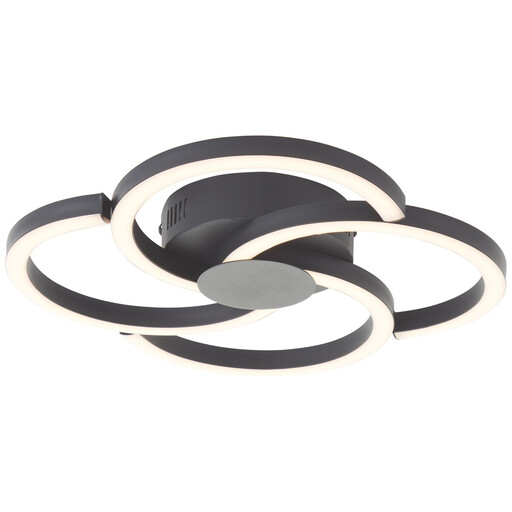
Why this product suits this profile: According to the product details, this compact light combines 22 watts with 2300 lumens and is suitable for living rooms, bedrooms, kitchens and hallways.
The stated 3000 Kelvin and 2300 lumens make the light colour and brightness easy to understand. This means you do not have to choose based on the black design alone.
34 cm diameter, integrated LED, 22 watts, 2300 lumens and energy efficiency class E.
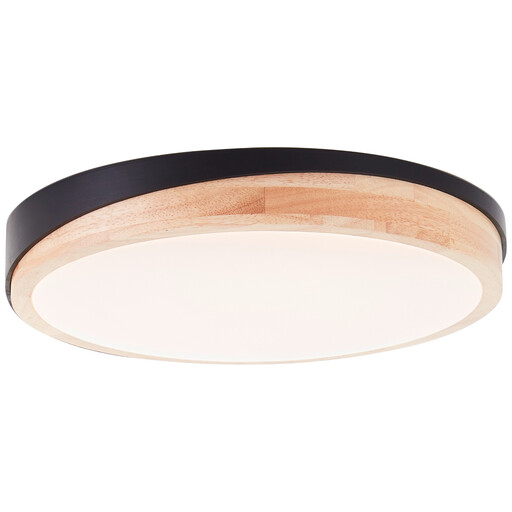
Why this product suits this profile: This model combines real wood, FSC certification, warm white light and integrated dimming for living rooms and bedrooms.
The product details explicitly state 3000 Kelvin, 2400 lumens and a three-stage dimmer with a memory function. The wood specification refers to real wood, not just a decorative surface.
Real wood, 35 cm diameter, 2400 lumens, 3000 Kelvin and three-stage dimming with a memory function.
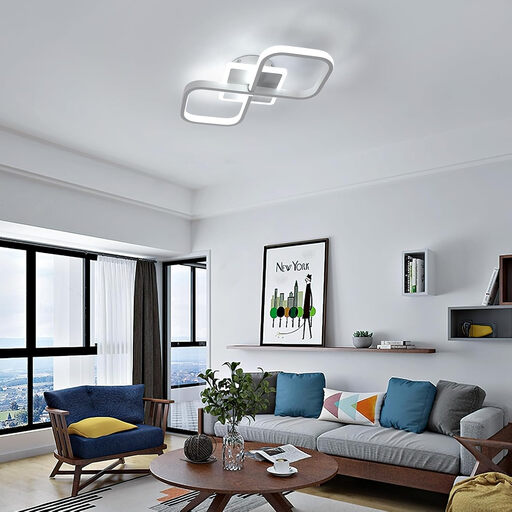
Why this product suits this profile: This light is designed for households looking for very clear, cool illumination for larger rooms, work areas, reading spaces or home office settings.
The high brightness is clearly stated alongside 36 watts and 4000 lumens. The colour temperature of 6500 Kelvin prevents cool light from being confused with warm white light.
4000 lumens, 6500 Kelvin, integrated LED technology and an acrylic cover with even light distribution according to the product details.
We have put together a complete, regularly updated list of products that fully meet these strict selection criteria and the safety regulations applicable in the EU.
A ceiling light should be installed centrally or positioned according to the main area of use. In a living room, a central position may be a sensible choice, while in a dining room, positioning the light above the table is more important. For a ceiling lamp for the living room, warm white 3000 Kelvin is often a suitable guideline. In kitchens and hallways, more neutral colour temperatures may be more practical.
Before installation, check that the wall plugs and screws are suitable for the ceiling material. With concrete ceilings, suspended ceilings or unclear wiring, consult a qualified professional. Lights with IP20 are intended for dry indoor areas. For bathrooms, utility rooms or outdoor areas, the relevant ingress protection requirements must be observed.
This depends on the room size, ceiling height, furnishings and any additional lights already in place. For small to medium-sized rooms, 2300 to 2400 lumens can serve as a useful guide. Larger or darker rooms may need more light or a combination of ceiling and supplementary lighting.
For an LED ceiling light for the bedroom, warm white light of around 2700 to 3000 Kelvin is often chosen. 3000 Kelvin creates a warm white effect. Whether this colour temperature is right for you depends on how you use the room and the rest of the lighting.
The service life must be taken from the relevant manufacturer’s specifications. The acrylic model mentioned above is rated for 50,000 hours. This figure is a technical specification provided by the manufacturer and is not a guarantee for every usage scenario. Switching cycles, operating time, heat generation and environmental conditions can affect the actual service life.