
Lieferung heute & morgen

Qualitätsgarantie

Willkommens-Angebote freischalten: KOSTENLOSE Lieferung | Bis zu 80 % RABATT | Kostenlose 30-Tage-JoyPlus-Testphase
App herunterladen
An LED ceiling light should illuminate a room evenly, complement your interior style and require as little day-to-day effort as possible. However, choosing the right one involves more than just wattage and appearance. Unclear lighting specifications, unsuitable dimensions or underestimated installation work often lead to disappointing purchases.
These are the three most common purchasing pitfalls:
When planning a ceiling light for a living room, bedroom or home office, the stated luminous flux in lumens (lm) is crucial. Depending on its design and light output, a 24W LED lamp can produce a different level of brightness from a 36W LED lamp.
As a general guide, consider not only the size of the room but also the colour of the walls, the furnishings and how you intend to use the space. A living room usually needs balanced ambient lighting, while a home office may benefit from higher brightness and the most even light distribution possible. Product specifications should therefore state at least watts, lumens and colour temperature.
Colour temperature is measured in kelvin (K):
Also check whether the light is dimmable. The term ‘LED’ does not automatically mean that the brightness can be adjusted.
Before buying, measure the available ceiling area and take the ceiling height into account. A large light can look out of proportion in a small hallway. With a ceiling light featuring a wood-effect finish, you should also distinguish between real wood and a decorative wood effect. The material affects cleaning, weight and the overall visual impression.
The following points are relevant when it comes to installation:
A battery-operated pendant light or cordless hanging light can be a flexible alternative when no power connection is available. For balconies and patios, pay close attention to the information regarding moisture. A light without a stated protection rating should not be exposed to rain or persistent damp without protection.
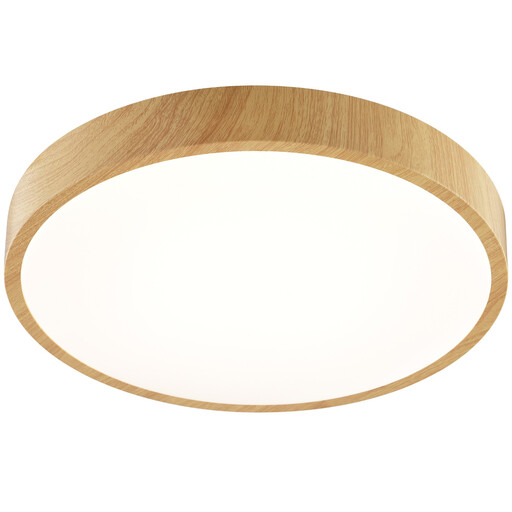
Why this product suits this profile: This 24W light combines 2300 lumens with a warm-white colour temperature of 3000 K. Its compact 38.5 cm diameter makes it suitable for living rooms, bedrooms, hallways or dining areas.
Luminous flux, power consumption and colour temperature are clearly stated. This makes it easier to compare the light with other models, rather than looking at wattage alone.
2300 lm, warm-white light at 3000 K and a decorative wood-effect finish. The light is not dimmable, so this should be taken into account before buying.
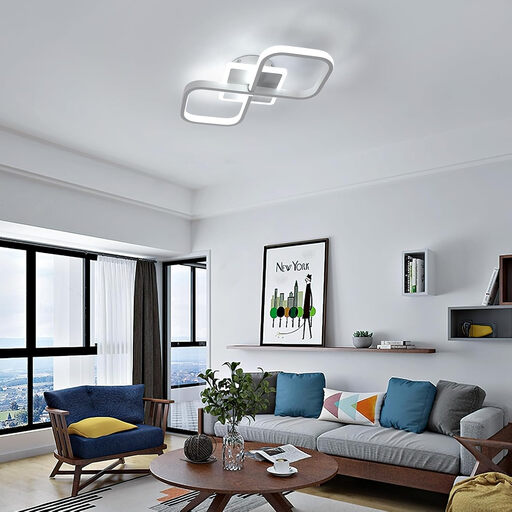
Why this product suits this profile: Its geometric shape suits modern interior schemes. With 36W power consumption, 4000 lumens and 6500 K, this light provides bright, crisp illumination for bedrooms, living rooms, hallways or home offices.
The combination of 4000 lm and 6500 K makes the intended lighting effect easy to understand. Buyers can deliberately assess the bright, cool-white orientation in relation to their room and how they plan to use it.
Integrated LED technology, 4000 lm and a stated service life of 50,000 hours. The acrylic cover is designed to distribute light evenly; the colour temperature is cool white.
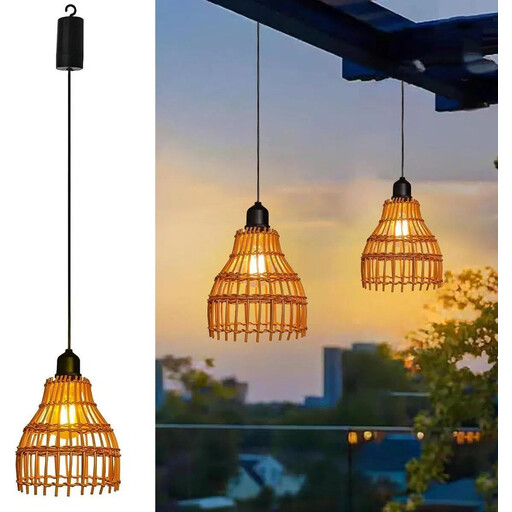
Why this product suits this profile: This battery-operated pendant light does not require a wall connection and can be hung flexibly using the hook. Its boho rattan look is suitable for decorative lighting indoors and in sheltered outdoor areas.
The power supply via 4 AA batteries and the 6/18-hour timer are clearly specified. Batteries are not included; operation in water or heavy moisture is not permitted.
No fixed installation required, a 100 cm lead and a timer function. The lampshade is made from acrylic and is not removable; the included A60 Edison bulb creates a warm, decorative lighting effect.
We have put together a complete, regularly updated list of products that fully meet these strict selection criteria and the safety regulations applicable in the EU.
Energy-efficient lighting does not depend solely on the LED symbol. Compare power consumption, luminous flux and daily operating time. A 36W light uses more electricity than a 24W light when operated for the same length of time, but it may provide a higher luminous flux.
Annual costs can be estimated using the following formula:
Watts ÷ 1000 × operating hours per year × electricity price per kilowatt-hour
For battery-operated models, you also need to factor in the cost of batteries and the effort involved in replacing them. A timer, such as the one on the cordless hanging light, can help avoid unnecessary operating time. Before buying, also check whether the bulbs can be replaced or whether the LED technology is permanently integrated. With integrated LEDs, the entire light usually needs to be considered if repairs are required.
This depends on the size of the room, the wall colour and how you intend to use it. For an initial selection, the stated lumens are more important than the wattage. A 2300-lumen model may provide sufficient ambient lighting for a medium-sized room, while larger or particularly bright rooms may require more light. Several light sources allow for a more flexible arrangement.
For many bedrooms, warm white between approximately 2700 and 3300 K creates a calmer, cosier feel. Cool-white light at around 6500 K is clearer and may be suitable for reading, working or situations where high visibility is needed. Personal preference, the function of the room and whether the light is dimmable are all important factors.
The service life depends on the LED module, electronics, heat dissipation and length of use. Manufacturers may state a service life of 50,000 hours, for example, but this is not a guarantee for every application. Also check the warranty terms, whether the bulb can be replaced and whether the light is installed correctly.