
Lieferung heute & morgen

Qualitätsgarantie

Willkommens-Angebote freischalten: KOSTENLOSE Lieferung | Bis zu 80 % RABATT | Kostenlose 30-Tage-JoyPlus-Testphase
App herunterladen
An LED ceiling light should illuminate the room sufficiently, use little energy and be compatible with the existing connection. In practice, however, poor purchases are often caused not by the design but by overlooked technical details. A higher wattage, for example, does not automatically mean the right level of brightness. Likewise, a smart LED ceiling light can become impractical if the app, gateway and desired voice control do not work together.
This buying guide explains which specifications are important before you buy and which models may suit different living situations.
Wattage describes energy consumption, not the amount of light directly. For comparisons, the luminous flux in lumens is the key specification. A 9 W, 780 lm light is suitable for different tasks from a 24 W, 2,400 lm model. Also consider the size of the room, the ceiling height and the lighting effect you want to achieve.
With an LED recessed spotlight, LED downlight or recessed ceiling light, the ceiling cut-out must match the product. The visible outer dimensions alone are not enough. Depending on the model, openings of 100 to 110 mm, 120 to 130 mm, 150 to 160 mm or 200 to 210 mm may be required. An existing cut-out cannot always be adapted without additional ceiling work.
Bluetooth Mesh, Wi-Fi, app control and voice commands are not automatically compatible with one another. Check the following before buying:
With several smart lights, Bluetooth Mesh lighting can offer advantages for group control. For individual rooms, however, simpler operation may be sufficient.
The luminous flux in lumens (lm) indicates how much light a fitting emits. A wide beam angle distributes light more evenly, while a narrower angle is better suited to focused accent lighting. Many of the LED downlights in this selection have a beam angle of 120°.
The CRI or Ra value describes colour rendering. A value of Ra ≥ 80 is specified for several of the models listed here and provides a common benchmark for living and working areas. Colour-critical tasks may require different specifications.
A CCT LED ceiling light allows you to choose between warm and cooler white light. Typical ranges are 2700 K to 6500 K or 3000 K to 6500 K. Warm white usually creates a more subdued atmosphere in living rooms and bedrooms, while neutral or cooler settings can be used in kitchens, hallways or offices.
A dimmable ceiling light should be checked for its dimming method. Some smart Aigostar models can only be dimmed via the app and are not designed for use with an external wall dimmer. A Brilliant light with an integrated 3-stage dimmer, on the other hand, is operated directly using the light switch.
The IP20 rating indicates that a light is suitable for use in dry indoor areas. Bathrooms, damp rooms and sheltered outdoor areas require a different IP rating. Installation work on 220–240 V connections should be carried out by a qualified electrician in accordance with local regulations.
Recessed lights also require sufficient space for heat dissipation. The light must not be covered with insulation material or other objects if this is prohibited in the safety instructions.
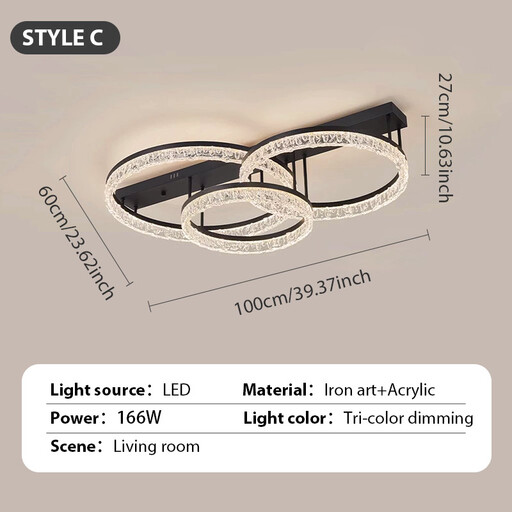
Why this product suits this profile: This round ceiling light is designed for bedrooms, living rooms and hallways, and offers three colour temperatures for easy adjustment to suit the room.
The three selectable colour temperatures reduce the risk of choosing a light colour that is permanently unsuitable for the room.
Round metal housing; three colour temperatures; suitable for several typical living areas.

Why this product suits this profile: This model combines 2400 lm with warm white 3000 K light, a 3-stage dimmer and a memory function for living rooms, bedrooms, kitchens or hallways.
The stated lumens, colour temperature and dimming levels make the expected lighting effect easier to assess before buying.
2400 lm; 3000 K; integrated 3-stage dimmer with memory function; FSC specification.
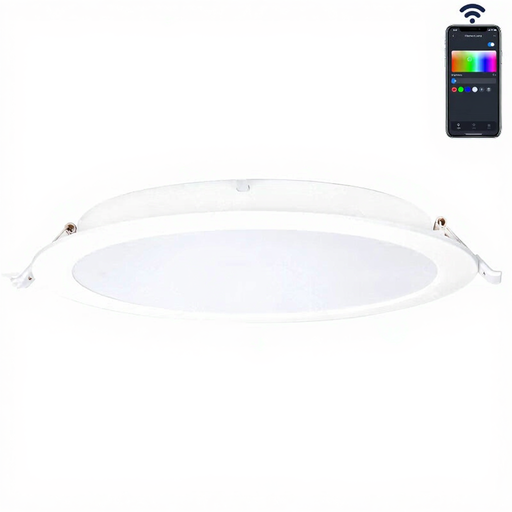
Why this product suits this profile: This RGB+CCT ceiling light offers 1760 lm, dimmable settings, colour selection and Bluetooth Mesh for controlling multiple lights as a group.
The required opening of 200 to 220 mm and the IP20 classification make it clear whether this model is suitable for the planned dry indoor area.
1760 lm; RGB plus 2700–6500 K; Bluetooth Mesh; app and voice control; 120° beam angle.
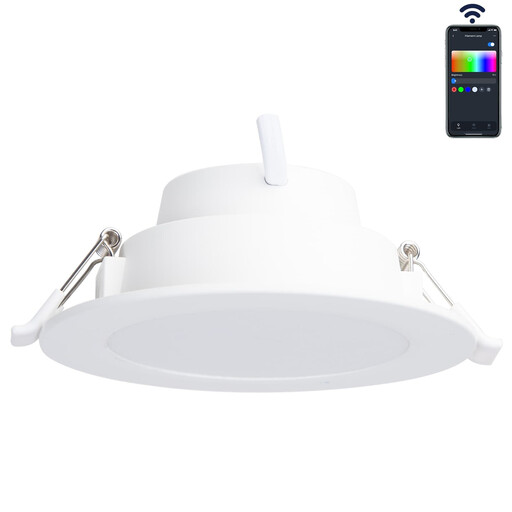
Why this product suits this profile: This more compact version is aimed at buyers who want to combine CCT, RGB, dimming and voice features in a recessed light.
The product data specifies 780 lm, 9 W and a ceiling cut-out of 120 to 130 mm, making room and installation planning easier.
9 W; 780 lm; RGB plus 2700–6500 K; Bluetooth Mesh; 120° beam angle; stated service life of 30,000 hours.
We have put together a complete, regularly updated list of products that fully meet these strict selection criteria and the safety regulations applicable in the EU.
This depends on the size of the room, ceiling height, wall colour and the lighting effect you want. Start by comparing the stated luminous flux in lumens. A bedroom may only need more subdued lighting, while a living room, kitchen or office often requires a higher light output or several light sources.
No. Some models can only be dimmed via the app and are not designed for external wall dimmers. You should therefore check the installation instructions. With a light featuring an integrated 3-stage dimmer, brightness is selected using the designated switch.
The stated service life is a manufacturer’s figure and depends, among other things, on operating time, heat dissipation and ambient conditions. The product data for some Aigostar downlights specifies 30,000 hours, while the white acrylic ceiling light is rated at 50,000 hours. These figures do not guarantee a specific service life in an individual household.
For a rough calculation, multiply the power in kilowatts by the operating hours and your individual electricity price. For example, a 9 W light uses 0.09 kWh when operated for ten hours. Actual annual costs depend on how often the light is used and your electricity tariff.