
Lieferung heute & morgen

Qualitätsgarantie

Willkommens-Angebote freischalten: KOSTENLOSE Lieferung | Bis zu 80 % RABATT | Kostenlose 30-Tage-JoyPlus-Testphase
App herunterladen
An LED ceiling light should illuminate the room sufficiently, complement your interior style and work reliably every day. Yet some purchasing decisions can quickly lead to disappointment: a light may look larger in product photos than it does on the ceiling, the colour temperature may not suit the way you use the room, or installation may prove more complicated than expected.
This buying guide explains which details are crucial before purchasing a modern ceiling light, and which models suit different living spaces.
Wattage mainly describes power consumption, not actual brightness. For comparisons, the luminous flux in lumens is more important. For example, a light with 2,300 lumens produces considerably more light than a 1,000-lumen model, regardless of its design.
A higher luminous flux can be useful in a living room or kitchen. In a bedroom or hallway, a lower brightness is often sufficient, depending on the size of the room. Ceiling height, wall colour and the number of other light sources also affect the overall result.
A warm white LED ceiling light with around 2,700 to 3,000 Kelvin creates a cosier atmosphere and is often suitable for living rooms, bedrooms or dining rooms. Neutral white light at around 4,000 Kelvin feels more functional and supports clear illumination in hallways, kitchens or work areas.
However, the description “modern” says nothing about the colour temperature. If you are looking for one light to use in several rooms, consider a model with switchable colour temperatures.
A round ceiling light with a diameter of 35 or 40 centimetres may be just right for a small hallway, yet look visually understated in a large living room. Before buying, you should therefore compare the diameter, height and weight with the existing connection and the size of the room.
With permanently integrated LEDs, it is also important to check whether the light source can be replaced or whether the entire light fitting will need to be replaced. In Germany, electrical connections may only be installed by a suitably qualified person.
Luminous flux in lumens indicates how much visible light a fitting produces. The kWh/1000 h figure on the energy label makes it easier to estimate consumption. The energy efficiency class should also be taken into account, although the classification depends on the specific product and the current EU labelling system.
An energy-efficient ceiling light with an integrated LED can be a practical solution if you want even general illumination without having to change bulbs frequently.
A dimmable ceiling light offers additional adjustment options. Check whether the dimming is controlled directly via an integrated switch, a remote control or an external dimmer.
For dry indoor spaces, IP20 is common for many ceiling lights. This rating is not intended for damp rooms or outdoor use. Bathrooms, balconies and covered outdoor areas have different requirements.
When installing the light, you need a stable ceiling surface, suitable fixings and a safely accessible power connection. Read the relevant manufacturer’s instructions before installation.
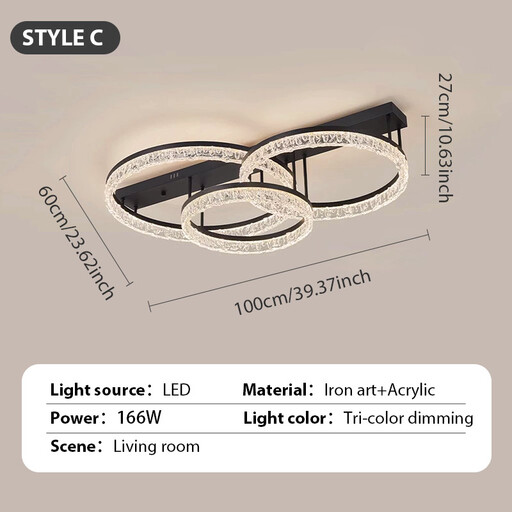
Why this product suits this profile: The round design and three adjustable colour temperatures make this an interesting choice for shoppers looking for a versatile ceiling light for several indoor spaces.
The three colour temperatures reduce the risk of being stuck with a light colour that does not suit the room.
Round metal construction; three selectable colour temperatures according to the product description.
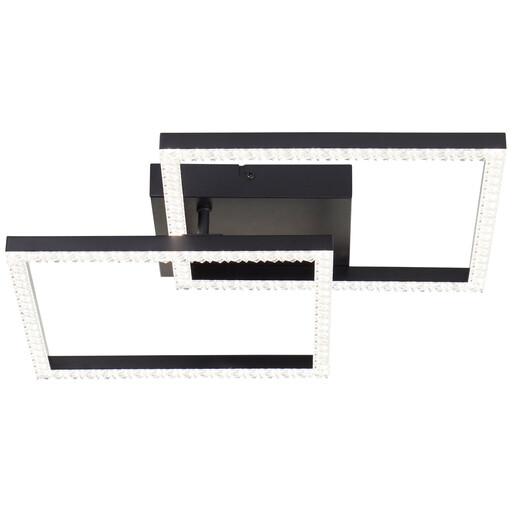
Why this product suits this profile: This model combines a stated luminous flux of 2,700 lumens with neutral white light and a black rectangular frame.
The specific details of 20 W, 2,700 lumens, 4,000 K, 41 × 41 cm and IP20 make it easier to compare the product objectively before buying.
2,700 lumens; swivelling element; integrated LED and energy efficiency class D according to the product data.

Why this product suits this profile: Suitable for living rooms, bedrooms, kitchens or hallways, this wood-effect ceiling light provides warm white illumination and integrated three-stage dimming.
Details of the luminous flux, colour temperature and dimming levels make the light easier to plan around than a purely design-focused description.
2,400 lumens; 3,000 Kelvin; integrated three-stage dimmer with memory function; diameter 35 cm.
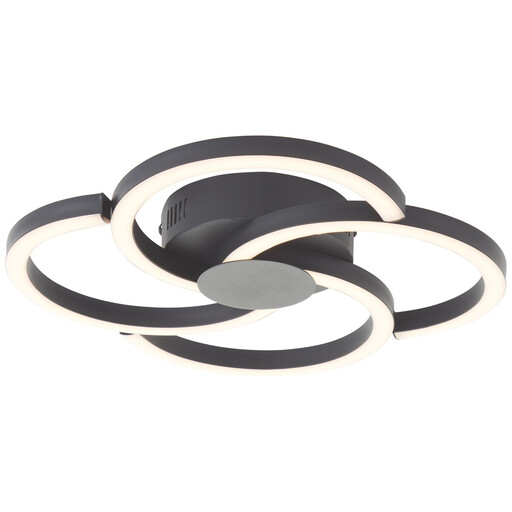
Why this product suits this profile: With its black finish and curved arms, this ceiling light suits modern interiors when you want a compact design with warm white general illumination.
The stated dimensions and lighting data prevent you from choosing the light based solely on its appearance.
2,300 lumens; 3,000 Kelvin; 22 W; diameter 34 cm; IP20 according to the product data.
We have put together a complete, regularly updated list of products that fully meet these strict selection criteria and the safety regulations applicable in the EU.
The required brightness depends on the size of the room, ceiling height and any additional lights already in place. A lower luminous flux may be sufficient for small hallways, while living rooms and kitchens often need more general illumination. Lumens provide a more meaningful comparison than wattage alone.
The actual service life depends on factors including operating hours, heat dissipation, electronics and ambient temperature. Always check the manufacturer’s stated lifespan directly in the product details. With an integrated LED, the light source cannot be replaced like an E27 or E14 bulb.
For a rough calculation, use: power in kilowatts × operating hours × electricity price. A 24 W light uses 24 kWh over 1,000 operating hours. The actual cost depends on your individual electricity tariff and how long the light is used.