
Lieferung heute & morgen

Qualitätsgarantie
App herunterladen
Kategorien
Selecting an LED ceiling light involves an analysis of technical parameters that extend beyond mere aesthetics. Key metrics such as luminous flux, colour temperature, and the Colour Rendering Index are crucial for a light's functionality and suitability. These factors determine how a room is perceived and how well it is illuminated for specific activities. Modern LED technology offers high energy efficiency and a long lifespan, significantly reducing operating costs compared to traditional light sources.
The decision to purchase an LED ceiling lamp should be based on an objective assessment of the following specifications.
Luminous flux, measured in lumens (lm), describes the total amount of light emitted by a source. The required brightness depends on the room's size and its intended use. As a guideline for living areas like the living room or bedroom, a range of 100 to 150 lumens per square metre (lm/m²) is recommended. For workspaces such as the kitchen or a home office, 250 to 300 lm/m² is advisable to ensure sufficient illumination for detail-oriented tasks.
Colour temperature, measured in Kelvin (K), defines the colour of the light. It is primarily categorised into three ranges:
Models with an adjustable colour temperature offer maximum flexibility to adapt the lighting to the time of day and activity.
The Colour Rendering Index (CRI) indicates how true-to-life colours appear under an artificial light source. The value is rated on a scale up to 100, where 100 corresponds to natural sunlight. For living spaces, a CRI value above 80 (CRI > 80) is the standard. A value of CRI > 90 ensures exceptionally authentic colour perception, which is particularly advantageous in kitchens for assessing food or in dressing areas.
A dimmable LED ceiling light allows for seamless adjustment of brightness. This enhances comfort and enables situational adaptation of the light intensity. Many modern lights are supplied as a ceiling light with a remote control.
A smart home ceiling light takes it a step further. It can be controlled via an app or voice commands (e.g., through Alexa, Google Home). Features such as scheduling, adjusting colour temperature and brightness, or integration into automated scenes (e.g., "Movie Night") are possible.
The design should integrate functionally into the space. A low-profile ceiling light is particularly suitable for rooms with low ceilings, as it has a minimal visual profile. Models in black create clean, modern accents. The dominant materials are metal (aluminium, steel) for the structure and acrylic or polycarbonate for the diffuser, which ensures even, glare-free light distribution.
The following products have been selected based on their technical specifications and functional design.
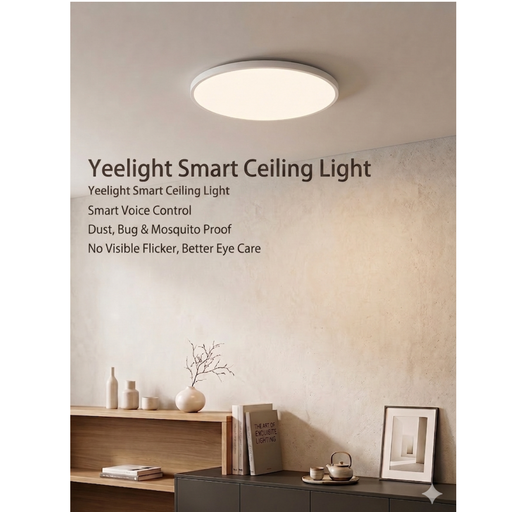
Why we recommend this product: This model combines comprehensive smart home compatibility with precise adjustment options for brightness and colour temperature. Its fully sealed design prevents the ingress of dust and insects, which minimises maintenance and ensures longevity in various environments, including kitchens. The RG0 certification for eye safety is a relevant factor for daily use.
Pros:
Ideal for: Users seeking a fully integrable smart home ceiling light with maximum flexibility in lighting settings and low maintenance requirements.
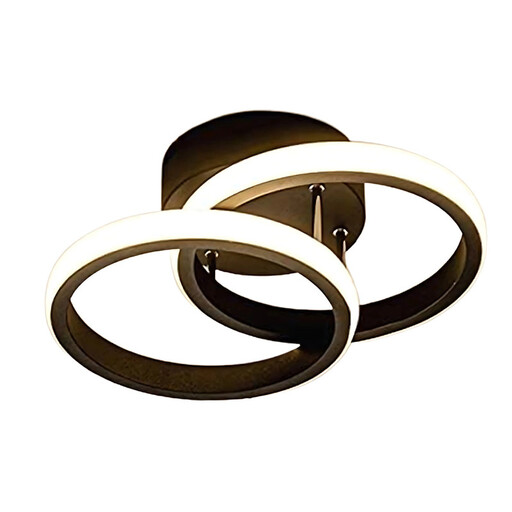
Why we recommend this product: This light focuses on making a clear design statement. The two acrylic rings and the chrome-plated metal frame create a modern aesthetic. With a fixed colour temperature of 3000 K (Warm White), it provides pleasant ambient lighting for living areas where a cosy atmosphere is the priority.
Pros:
Ideal for: Users looking for a stylish and modern ceiling lamp with a warm white light colour for the living room or dining area, who do not require smart features or dimmability.
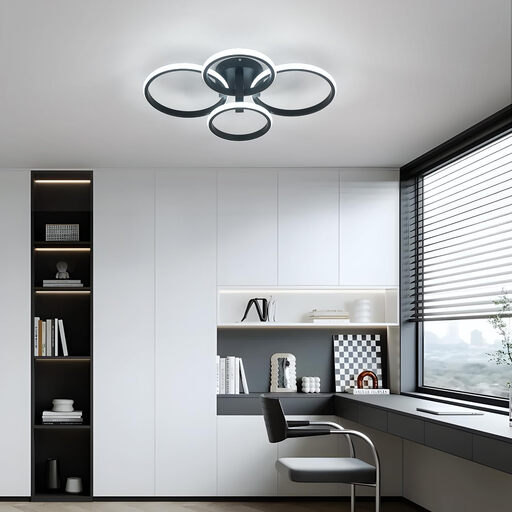
Why we recommend this product: With 48 watts of power and a colour temperature of 6500 K (Daylight White), this model is designed for high brightness and clear, concentration-enhancing illumination. The design, featuring four stacked rings in black, creates a striking three-dimensional look. Its aluminium and acrylic construction is engineered for durability and even light distribution.
Pros:
Ideal for: Individuals who need powerful lighting for larger rooms (15–20 m²) or workspaces and prefer a bold, modern design in black.
The models presented here cover common requirement profiles. If you are looking for specific designs, such as ring-shaped lights, you can find a wider selection in our LED Ring Light category.
1. How many lumens does an LED ceiling light need for a 20 m² living room? For a living room, a brightness of 100 to 150 lumens per square metre is recommended. For an area of 20 m², this results in a requirement of 2,000 to 3,000 lumens. A dimmable light offers the advantage of being able to adjust the brightness as needed.
2. Can I install an LED ceiling light myself? Installing a ceiling light involves working with the household electrical system (230 V). For safety reasons and to ensure correct functionality, it is recommended to have the installation performed by a qualified electrician. Before starting any work, the power supply must be disconnected at the circuit breaker.
3. What is the difference between warm white and cool white light? Warm white light (under 3,300 K) has a higher proportion of red and yellow tones, creating a cosy, relaxing effect similar to the light of an incandescent bulb. Cool white light (over 5,300 K) has a high blue component, has a stimulating effect, and resembles daylight. It is well-suited for areas where concentration and clear visibility are required.