
Lieferung heute & morgen

Qualitätsgarantie

Willkommens-Angebote freischalten: KOSTENLOSE Lieferung | Bis zu 80 % RABATT | Kostenlose 30-Tage-JoyPlus-Testphase
App herunterladen
An LED ceiling light can illuminate a room evenly and, compared with older light sources, operate with lower energy consumption. However, not every model suits every room. Unclear specifications often lead to poor purchases: a high lumen count alone tells you little about the actual light distribution, a modern look doesn't replace the correct IP rating, and an integrated LED isn't automatically dimmable.
Wattage mainly describes the electrical power consumption. For brightness, the luminous flux in lumens is what matters. Two LED lights with the same wattage can therefore appear to have different brightness levels. In addition, the beam angle, diffuser and room size all affect light distribution.
As a rough guide, buyers should consider the stated room area, the luminous flux and the intended use together. A light with 2,300 lumens may be sufficient for a bedroom, whereas in a larger kitchen or work area, a higher light output or multiple light sources could be more appropriate.
Colour temperature is given in Kelvin (K):
A warm white LED ceiling light is not automatically suitable for every task. In a kitchen, neutral white LED lighting can make the work surface appear clearer. For flexible use, lights with 3CCT selection are interesting, where you can switch between warm white, neutral white and cool white LED settings.
For bathrooms, kitchen areas with high humidity or covered outdoor spaces, the IP rating is relevant. IP44 offers protection against splashing water, while IP65 provides higher protection against water from various directions. The specific installation zone and the manufacturer's instructions must still be observed.
A flat LED ceiling light can be practical for low ceilings. However, before buying, you should check the connection type, existing drill holes, ceiling material and dimensions. For a 230-volt connection, installation should be carried out by a qualified electrician. Always disconnect the power supply before installation or cleaning.
First, check the stated luminous flux in lumens and the recommended area. A model with 3,300 to 4,000 lumens may, depending on its design, be intended for medium-sized rooms. However, this figure does not guarantee even illumination.
For a living room, a central ceiling light can be supplemented with floor or wall lights. In a bedroom, a lower, warm white light effect is often more suitable. A ceiling light for the living room and a ceiling light for the bedroom should therefore not be chosen on design alone.
A dimmable LED ceiling light requires either an integrated dimmer, a remote control or a compatible external dimmer. For recessed spotlights, a trailing-edge dimmer is often specified. This information must match your existing switch and electrical installation.
Even with 3CCT lights, you need to distinguish between colour temperature selection and dimming function: a light can offer multiple colour temperatures without being dimmable.
For low rooms, flat surface-mounted lights are suitable. LED recessed spotlights, on the other hand, require a suitable ceiling cut-out. The dimensions of the cut-out must be checked carefully. A model with a 67 to 75 mm recessed diameter will not fit into a 90 to 100 mm opening.
For targeted accent lighting, ceiling spotlights can be useful. In the kitchen, an under-cabinet kitchen light or LED cabinet lighting can supplement the general lighting. Motion-activated models with PIR sensor LED light are suitable for hallways, cupboards or stair areas, but should not be confused with a full room light.
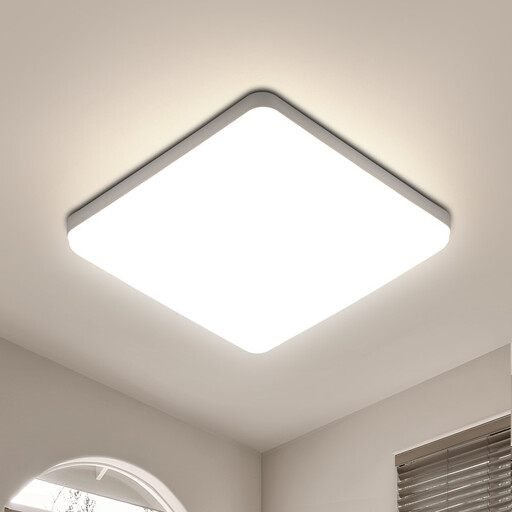
Why this product fits the profile: This square surface-mounted light combines 36 W, 3,300 lm and 4,500 K for neutral white general lighting in rooms of around 15–20 m².
Luminous flux, colour temperature and recommended area are all clearly stated. However, according to the product description, this light is not marked as waterproof.
Ultra-slim design with metal and acrylic components, 180° beam angle and integrated LED.

Why this product fits the profile: The spiral-shaped, black design is intended for bedrooms, living rooms, kitchens or hallways, combining a compact form with 3,000 K warm white light.
The product data lists diameter, height, luminous flux, colour temperature and a recommended area of 10–15 m².
36 W, 4,000 lm, integrated LED and, according to the supplier, includes mounting materials with instructions.
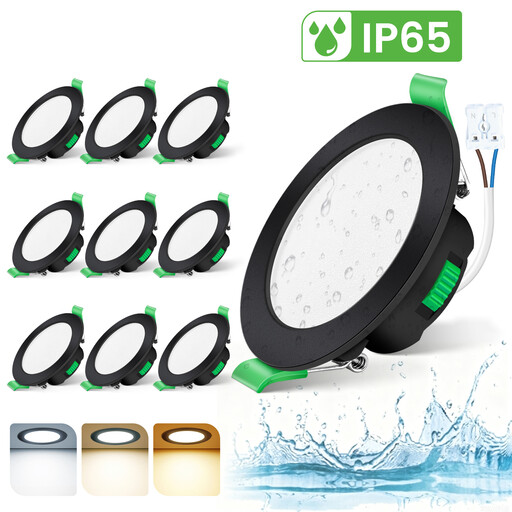
Why this product fits the profile: These recessed spotlights offer 3CCT, stated dimming of 10–100 %, 230-volt connection and a recessed cut-out of 67–75 mm.
Colour temperature, dimming range, recessed dimensions and IP65 are all clearly stated. The dimmer must be compatible; the power supply must be disconnected before installation.
7 W per spotlight, up to 600 lm per unit, 3,000/4,000/6,500 K and aluminium-polycarbonate housing.

Why this product fits the profile: These battery-powered lights can be attached with adhesive tape to cabinets, shelves or walls without drilling.
Battery capacity, USB charging, sensor range of 3–5 m and three colour temperatures are all specified. This model is not intended for damp areas.
41 LEDs, 1,100 mAh battery, PIR motion detection and 2-pack for kitchen, cupboard or hallway.
We have put together a complete, regularly updated list of products that fully meet these strict selection criteria and the safety regulations in force in the EU.
That depends on the room size, usage and any additional lights you have. What matters is the stated luminous flux in lumens, the light distribution and the ceiling height. For a kitchen or work area, an under-cabinet light can also be useful.
The lifespan is given by the manufacturer in operating hours, for example around 30,000 hours for several of the models mentioned. This figure is a technical specification and not a guarantee for every installation situation. Heat, voltage, switching cycles and the quality of the electronics can all affect the actual service life.
The running costs depend on the power, daily usage time and your electricity tariff. You can estimate the approximate running costs using the following formula:
Power in kW × operating hours × electricity price per kWh = running costs
A 36 W light, for example, consumes 0.036 kWh per operating hour. For an accurate estimate, you should use your actual usage and current tariff.