
Lieferung heute & morgen

Qualitätsgarantie

Willkommens-Angebote freischalten: KOSTENLOSE Lieferung | Bis zu 80 % RABATT | Kostenlose 30-Tage-JoyPlus-Testphase
App herunterladen
An LED ceiling light should provide sufficient illumination for the room, complement your interior style, and operate without unnecessary ongoing costs. In practice, however, the choice often fails not on design but on technical details: a light can look larger in product images than it actually is, the colour temperature may not suit the intended use, or installation may require connections that aren't available in your home.
The wattage describes energy consumption, not directly the brightness. For comparison, the luminous flux in lumens is what matters. A 24-watt light with 2,300 lumens can illuminate a room quite differently from a model with the same power consumption but a lower luminous flux.
The room size, ceiling height, and the colour of walls and furniture also affect the perceived brightness. For a living room, as even a light distribution as possible makes sense, whereas a hallway or a display cabinet can manage with directional spots.
A dimmable ceiling light can use different control methods. Some models are operated via an integrated step switch, others via a remote control or an app. This is not automatically compatible with an existing wall dimmer.
With the Aigostar Smart LED Recessed Spotlight, dimming is carried out via the app according to the product description; an external wall dimmer is not intended for this purpose. So if you want to install a dimmable LED lamp into an existing electrical installation, you should check the specified control method before purchasing.
A flat design says little about whether the light will fit into your existing ceiling opening. With an LED recessed spotlight, the cut-out dimensions, installation depth and connection type must all match. The 12-24 V model from our selection, for example, requires a separate transformer and must not be connected directly to the mains.
For damp rooms, the IP rating is also relevant. IP20 is intended for dry indoor spaces. IP44 offers higher protection against splashing water, but does not replace checking whether the specific installation position is suitable for a bathroom or kitchen.
Colour temperature is given in Kelvin:
A warm white ceiling light at 3,000 Kelvin can feel more pleasant in a living room or bedroom than a cool white variant. For colour rendering, the CRI or Ra value is relevant. With several of the products mentioned here, the stated value is at least or above Ra 80. This is a technical comparative value, but not a guarantee of identical colour perception in every room.
Lumens indicate the total luminous flux. You should also consider the beam angle. A wide beam angle distributes light over a large area; a spotlight sets targeted accents. For a central living room ceiling light, even light distribution and sufficient luminous flux are usually more important than a particularly small housing.
With recessed spotlights, several lights may be involved. In that case, you need to consider spacing, installation depth and heat dissipation. LED lights must not be covered with insulation material unless the manufacturer expressly permits it.
The power consumption in watts and the consumption in kWh per 1,000 hours provide a factual basis for assessing running costs. The energy efficiency class should be checked on the product data sheet. A lower wattage alone does not automatically mean a more suitable light if the luminous flux is insufficient for the room.
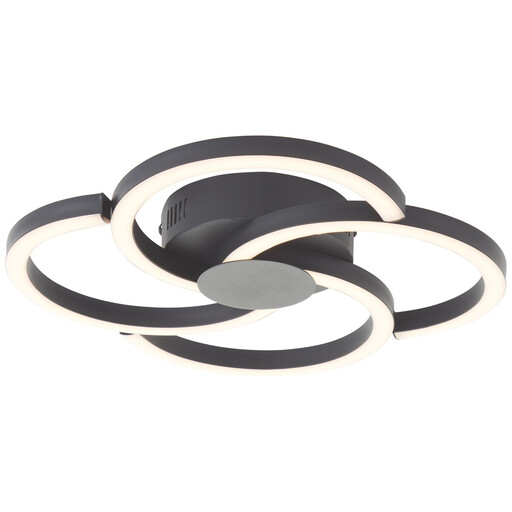
Why this product fits the profile: This compact, black light offers 22 W, 2,300 lumens and 3,000 Kelvin for dry indoor spaces such as hallways, bedrooms or living rooms.
The specifications for diameter, luminous flux, colour temperature and energy efficiency class E make comparison before purchase more transparent.
2,300 lumens, 3,000 Kelvin and a diameter of 34 cm; integrated LED technology.
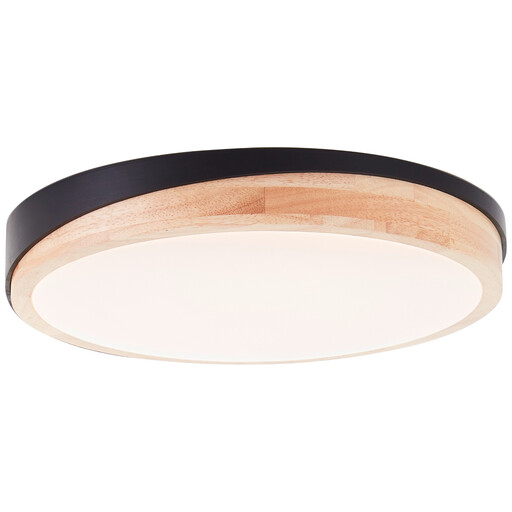
Why this product fits the profile: The combination of wood, metal and plastic, along with the integrated 3-step dimmer, suits living and sleeping areas with warm lighting design.
The dimming function is described as an internal three-step control, not just vaguely listed as "dimmable".
2,400 lumens, memory function and 3,000 Kelvin; diameter 35 cm.
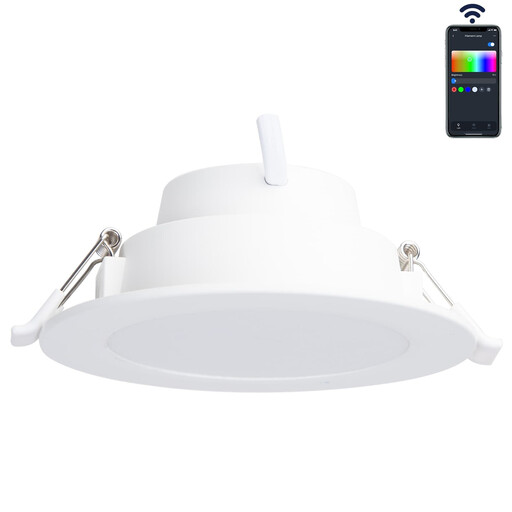
Why this product fits the profile: This smart LED spotlight supports RGB, 2,700 to 6,500 Kelvin, app control and Bluetooth Mesh for individually configurable indoor spaces.
The product data explicitly states the required ceiling opening of 120–130 mm, IP20 and the lack of compatibility with external wall dimmers.
780 lumens, 9 W, RGB+CCT and a stated lifespan of 30,000 hours.
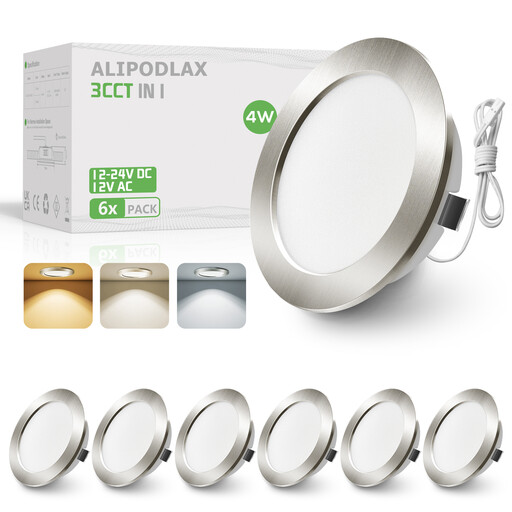
Why this product fits the profile: According to the product information, this flat LED recessed spotlight is suitable for cabinets, shelves, kitchen areas and damp indoor spaces with appropriate installation.
The cut-out dimensions, installation height, 12–24 V connection and the required transformer are all specifically stated. The transformer is not included.
270 lumens, three selectable light colours and IP44; installation height 14.5 mm.
We have compiled a complete, regularly updated list of products that fully meet these strict selection criteria and the safety regulations applicable in the EU.
For hardwired lights, installation should be carried out by a suitably qualified electrician. The power supply must be switched off before any work on the light. The following points are also important for your selection:
A ceiling light with a wood effect can add a natural accent, while a black ceiling light tends to harmonise with modern or high-contrast interiors. What remains crucial is that design, light output, room function and installation conditions all work together.
That depends on the room size, ceiling height and desired lighting effect. For central room lighting, several thousand lumens are often more sensible than a single weak spotlight. With multiple recessed lights, you should consider the total luminous flux.
The lifespan is usually given by the manufacturer in operating hours. With the Aigostar model, for example, 30,000 hours are stated. The actual service life depends on factors including heat dissipation, switching cycles, ambient temperature and correct installation.
LED technology can enable energy-efficient LED lighting with a suitable luminous flux. However, the specific wattage, daily usage time and electricity tariff are decisive for running costs. A comparison based on kWh per 1,000 hours provides a clear basis for this.