
Lieferung heute & morgen

Qualitätsgarantie

Willkommens-Angebote freischalten: KOSTENLOSE Lieferung | Bis zu 80 % RABATT | Kostenlose 30-Tage-JoyPlus-Testphase
App herunterladen
An LED ceiling light should illuminate a room evenly, suit your décor style and work reliably day to day. When choosing, many shoppers focus first on design or a high lumen figure. As a result, important details such as colour temperature, dimmability, dimensions and installation method are often overlooked.
Three typical buying problems crop up particularly often:
So before you buy, it’s worth looking at the technical specifications rather than relying solely on product images and marketing claims.
With an LED light, the wattage mainly describes the power consumption. For brightness, the luminous flux in lumens is the key figure. An LED ceiling light 24 W can, depending on its design, achieve 2,300 or 2,400 lumens, for example. These values are sufficient for many living areas, but they don’t replace individual planning for very large or particularly dark rooms.
As a rough guide:
The energy efficiency class should also be considered. For the Brilliant models mentioned here, for example, energy efficiency class F is stated. An integrated LED therefore doesn’t automatically mean a specific efficiency class.
Colour temperature is given in Kelvin:
A ceiling light with warm white light at 3,000 K is a practical choice if you want an even, more homely general light. Models with three colour temperatures offer more flexibility. Before buying, however, check how the switching works and whether the chosen setting is saved.
The diameter must suit the room size and the available ceiling area. A light with a diameter of 35 to 38.5 cm can work well for many standard rooms, while smaller models are more practical for hallways or confined spaces.
Also important are:
A ceiling light with spots provides directional light distribution. It’s useful when you want to illuminate specific areas such as pictures, furniture or a section of hallway. Decorative models with amber glass, on the other hand, focus more on a visible light effect and a homely design.
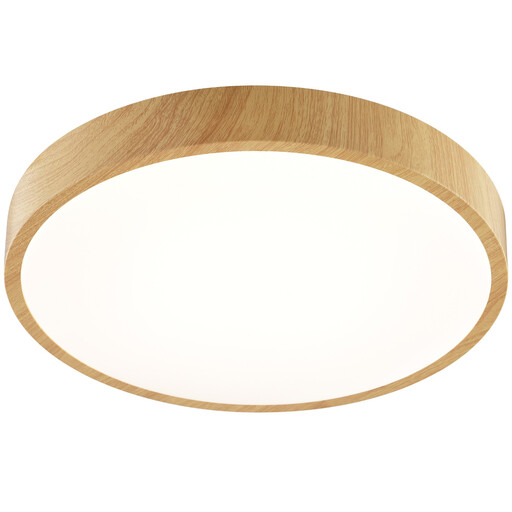
Why this product suits the profile: This light combines a clear round shape with a stated size of 38.5 cm and a wood effect. 24 W, 2,300 lm and 3,000 K are clearly specified.
The details on lumens, wattage and colour temperature help you avoid confusing design with actual light output. According to the product information, this light is not dimmable.
2,300 lm, 3,000 K, 24 W and a diameter of 38.5 cm; suitable according to the supplier for living room, bedroom, hallway and dining area.

Why this product suits the profile: This model combines wood with plastic and metal, a stated light output of 2,400 lm and a three-step internal dimming with memory function.
The dimming function is specifically described as three-step and internally dimmable. This makes it clear that no arbitrary external dimmer should be assumed.
35 cm diameter, 24 W, 2,400 lm, 3,000 K, FSC certification and memory function for the last selected brightness level.
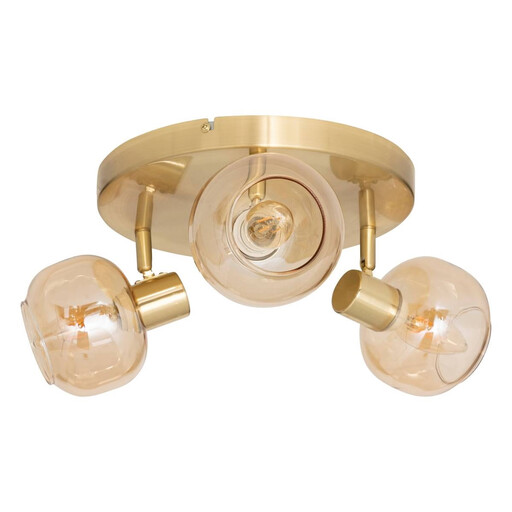
Why this product suits the profile: Three adjustable spots, amber glass and a diameter of 25 cm make this model interesting for directional accent lighting in the living room, bedroom or hallway.
The adjustable spots avoid a purely decorative light distribution when you need to illuminate specific areas. An IP rating is not stated according to the information provided.
Steel and glass construction, three adjustable spots, 25 cm diameter and CE marking according to the product information.
We’ve put together a full, regularly updated list of products that fully meet these strict selection criteria and the safety regulations in force in the EU.
For a living room, even general lighting is usually more important than a very narrow beam of light. A flat, round ceiling light with a warm white colour temperature can be suitable for this. In the bedroom, a low profile and a pleasant light colour are often more important than maximum brightness.
In a hallway, a compact light or a model with spots can be useful. For the kitchen and dining area, check whether the light distribution adequately reaches work surfaces. A decorative light with amber glass creates a visible light effect, but depending on its design, it may illuminate less evenly than a closed light cover.
That depends on room size, ceiling height, wall colours and the intended use. For an initial assessment, lumens, beam angle and light distribution should be considered together. A single lumen figure isn’t enough to predict the actual effect in every room.
Not every model is dimmable. Some lights have an internal three-step dimming, while others require a compatible wall dimmer. If the product description says “not dimmable”, no external dimmer should be connected.
The specific lifespan must be taken from the manufacturer’s details for the particular model. With integrated LEDs, a later bulb change is often not possible, unlike a light with a replaceable socket. That’s why product data, warranty and service information are especially relevant before you buy.