
Lieferung heute & morgen

Qualitätsgarantie

Willkommens-Angebote freischalten: KOSTENLOSE Lieferung | Bis zu 80 % RABATT | Kostenlose 30-Tage-JoyPlus-Testphase
App herunterladen
LED ceiling lighting can have a significant impact on energy consumption, light quality and the overall feel of a room. At the same time, many products in online shops look similar, even though they can differ considerably in brightness, installation depth, IP rating, dimmability and connection type. If you buy based only on wattage or design, you may not end up with the right solution for your living room, kitchen, bathroom or hallway.
Three common buying mistakes occur particularly often:
For choosing an LED ceiling light, the luminous flux in lumens is a key specification. Under comparable conditions, a light with 4,000 lumens produces considerably more light than a model with 1,000 lumens. The required brightness depends on the size of the room, ceiling height, wall colour and intended use.
Colour temperature is measured in kelvins:
A 3CCT LED ceiling spotlight solution offers several colour temperatures via a switch on the housing. This can be useful during renovations when the final room design has not yet been fully decided. You should also consider the colour rendering index, CRI or Ra. A value of Ra 80 is standard for many residential lights; higher values may be beneficial for tasks where accurate colour reproduction is important.
With LED recessed spotlights, the existing ceiling cut-out and installation depth must match the product specifications. Flat models are particularly practical for suspended ceilings or shallow cavities. Some products require an installation depth of only around 25.5 millimetres, while others need more space for cooling and connections.
You should also check:
An LED 230 V recessed spotlight can be connected directly to the mains, provided the installation is designed for this. A 12–24 V spotlight, on the other hand, requires a separate transformer. Confusing the two can lead to malfunctions and safety risks. In Germany, electrical installation work should be carried out by a suitably qualified person.
The IP rating consists of two digits. The first describes protection against solid foreign objects and dust, while the second indicates protection against water. An IP44 LED recessed spotlight is protected against solid foreign objects measuring 1 millimetre or more, as well as splashing water from various directions. IP65 LED recessed spotlights provide a higher level of protection against dust and water jets.
The IP rating must be suitable for the specific installation location. Bathrooms are also subject to the relevant installation zones and safety distances. A light described as “suitable for bathrooms” must therefore not automatically be installed in the immediate vicinity of a shower or bath.
For dimmable lights, the approved dimmer, dimming range and any notes regarding flickering or minimum load are all relevant. A model with a dimming range of 10–100 per cent must be used differently from a light that only works with a particular dimmer.
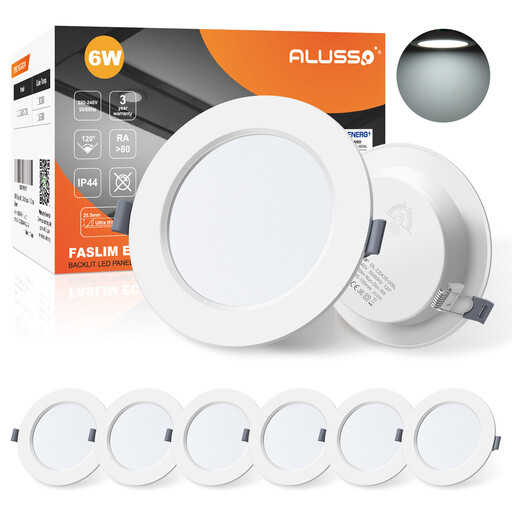
Why this product suits this profile: This six-piece set is suitable for buyers who need several flat recessed lights for the bathroom, kitchen or living space and prefer a direct 230 V connection.
The installation depth of 25.5 mm and the specified cut-out of 95–110 mm make it easy to check the available space before installation. The light is explicitly non-dimmable.
6 W, 430 lumens, 6,500 K, IP44, 230 V connection and a stated lifespan of more than 30,000 hours.
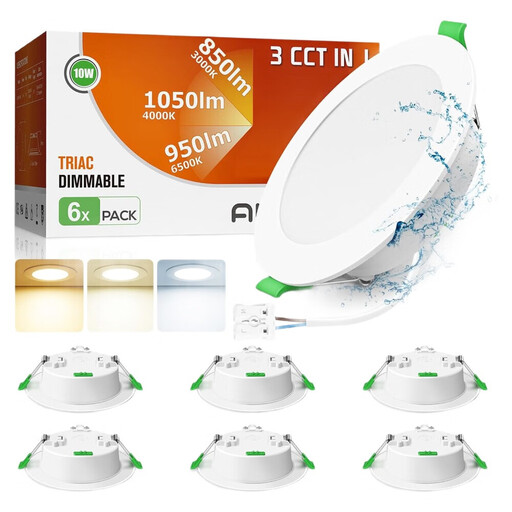
Why this product suits this profile: The combination of three colour temperatures and dimmable light offers flexibility for kitchens, bathrooms and living spaces.
The 3CCT selection and the required compatible trailing-edge dimmer are clearly specified. This makes it possible to plan the installation before buying.
10 W, 1,050 lumens, 3,000/4,000/6,500 K, dimmable from 10–100 per cent, 34 mm depth and IP44.
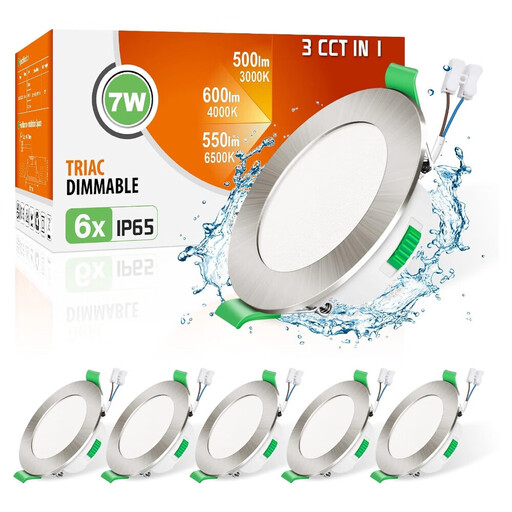
Why this product suits this profile: The higher IP rating is useful for damp rooms, kitchens or sheltered outdoor areas. The choice of three colour temperatures supports different usage scenarios.
IP65, a 29 mm installation depth and a required ceiling cut-out of 67–75 mm are clearly specified. Installation must be carried out by a qualified person.
500/550/600 lumens depending on colour temperature, 3,000/4,000/6,500 K, dimmable from 10–100 per cent and a six-piece pack.
A flat LED ceiling light is ideal when there is little space between the ceiling and the light, or when you want to avoid a visible recessed opening. For bedrooms and living rooms, a large light with even distribution may be more suitable than several individual LED ceiling spotlights. For example, a 36 W model with 4,000 lumens and 6,500 K is designed to provide bright, functional lighting.
For rooms with changing requirements, dimmable LED spotlights or 3CCT models may be worth considering. If you also want to improve air circulation, you could consider an LED ceiling fan with light combination such as the Brilliant Thore. According to the product specifications, it offers up to 4,500 lumens at 40 W, warm to cool white light and RGB lighting, as well as a remote control and reversible rotation. It is intended exclusively for dry indoor spaces and is not water-resistant.
An older 22 W ring fluorescent lamp with 1,200 lumens and energy efficiency class G may be relevant as a replacement part for existing round lights. However, if you are installing new energy-efficient LED lighting, you should check whether replacing the entire light would be more practical in the long term. According to the information provided, this particular product is currently unavailable.
We have put together a complete, regularly updated list of products that fully meet these strict selection criteria and the safety regulations applicable in the EU.
That depends on the size of the room, how it is used and the desired lighting effect. A small hallway generally needs less light than a kitchen or home office. You should therefore compare the specified lumen value and look for even distribution. Several LED recessed spotlights can reduce shadows more effectively than a single focused light source.
This depends on the specific IP rating and installation location. IP44 LED recessed spotlights are protected against splashing water, while IP65 models offer a higher level of protection against dust and water jets. The light must still be suitable for the bathroom’s installation zones and safety distances. If you are unsure, the electrical installation should be professionally planned.
Lifespan depends on component quality, heat dissipation, operating time and ambient temperature. Product specifications may, for example, state lifespans of 30,000 or 50,000 hours. This figure is not a guarantee of a specific service life in an individual household. Adequate ventilation and installation in accordance with the instructions help support the intended operation.