
Lieferung heute & morgen

Qualitätsgarantie

Willkommens-Angebote freischalten: KOSTENLOSE Lieferung | Bis zu 80 % RABATT | Kostenlose 30-Tage-JoyPlus-Testphase
App herunterladen
A new LED ceiling light should illuminate the room effectively, use little energy and suit the existing ceiling. In practice, however, unsuitable purchases are often caused not by the LED technology itself, but by unclear information about luminous flux, cut-out size or IP rating. Checking a few technical details before buying can help you avoid unsuitable lights for the living room, bedroom, hallway, kitchen or bathroom.
Power consumption in watts shows how much electrical power a light requires. On its own, however, it says little about how bright the room will actually be. That is determined by the luminous flux in lumens. A 24-watt light with 2,700 lumens may be sufficient for a small hallway or entrance area, while a larger living space may require several light sources.
An LED ceiling light in warm white with 3,000 kelvin produces a cosy light and is often used in bedrooms, living rooms or dining areas. Neutral white or cooler light can be practical in work areas, kitchens or utility rooms. The term ‘warm white’ should be accompanied by a specific kelvin value, such as 3000K LED ceiling light.
A light with IP44 is protected against splashing water from various directions, but it is not designed for direct jets of water or immersion. IP65 provides greater protection against dust and water jets and may be more suitable for damp areas, depending on the installation location. The IP rating does not replace an assessment of the installation zone and the local electrical installation.
Recessed lights also require the ceiling cut-out to be considered. A light designed for 145–160 millimetres will not automatically fit an existing cut-out of 68–75 millimetres. Before ordering, compare the cut-out size, installation depth and connection type.
At least the following details are relevant when choosing a light:
A single LED ceiling light for the living room can provide general lighting. This can be complemented by an LED wall light, floor lamp or directional spotlights. In hallways or small ancillary rooms, a compact, low-profile ceiling light is often sufficient.
An LED ceiling light with dimming can only be adjusted continuously or within a specific range when operated with a compatible dimmer. The products described specify compatibility with either leading-edge or trailing-edge dimming. Check the existing dimmer before installation, as not every combination operates without flickering or interference.
A switchable 3CCT light allows you to choose between 3000K, 4000K and 6500K. With the recessed lights mentioned, the setting is selected using a switch on the light housing. It must therefore be set before installation or changed with the power supply switched off.
When connecting directly to 230 volts, the power supply must be switched off at the circuit breaker. In Germany, installation should be carried out by a qualified electrician. This is particularly important for recessed spotlights, where the ceiling cut-out, connection terminals and heat dissipation must all be taken into account.
Material specifications help with assessing a product: aluminium can contribute to heat dissipation, while plastic housings keep weight low. The specific product details, installation depth, fixings and intended environment remain the decisive factors.
The following selection categorises various LED lights according to typical requirements in German households. The information is based on the respective product descriptions.
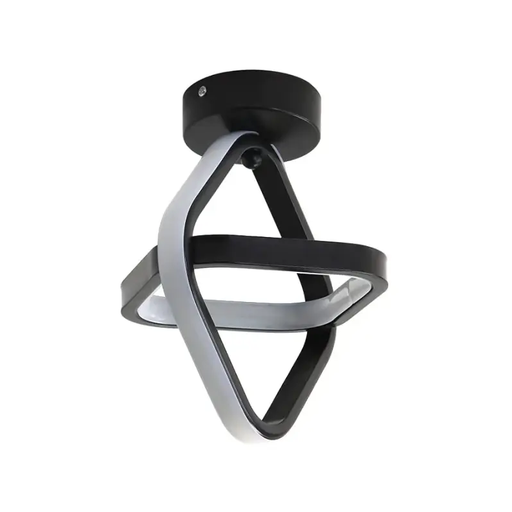
Why this product suits this profile: This compact surface-mounted light is designed for hallways, entrance areas, balconies or smaller rooms measuring approximately 5 to 15 m².
The product description specifies both 2,700 lumens and 3,000 kelvin. This makes it easier to assess brightness and colour temperature separately.
24 watts, 2,700 lumens, 3,000 kelvin and low-profile ceiling mounting with a black metal housing.
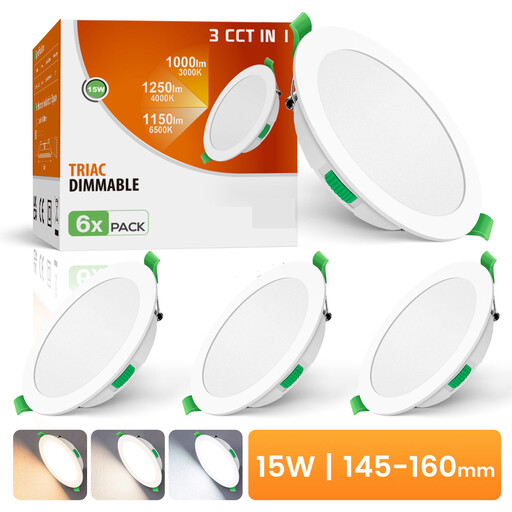
Why this product suits this profile: This 6-piece set is ideal for buyers who want to equip several installation points in living rooms or bedrooms with matching lights.
The product data specifies the cut-out size, installation height of 32 millimetres, 120-degree beam angle and IP44 rating.
1,200 lumens per light, dimmable from 10 to 100 per cent, with switchable colour temperatures of 3000K, 4000K and 6500K.
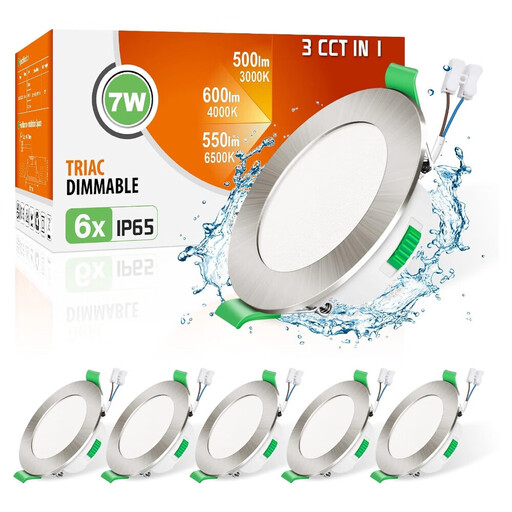
Why this product suits this profile: For bathrooms, kitchens or other damp indoor areas, the specified IP rating is a key selection criterion.
The product has an IP65 rating and specifies a ceiling cut-out of 68–75 millimetres. The suitability of the particular installation zone must also be checked.
Aluminium and polycarbonate construction, 29 millimetres installation depth, 7 watts and a dimmable 3CCT selection.
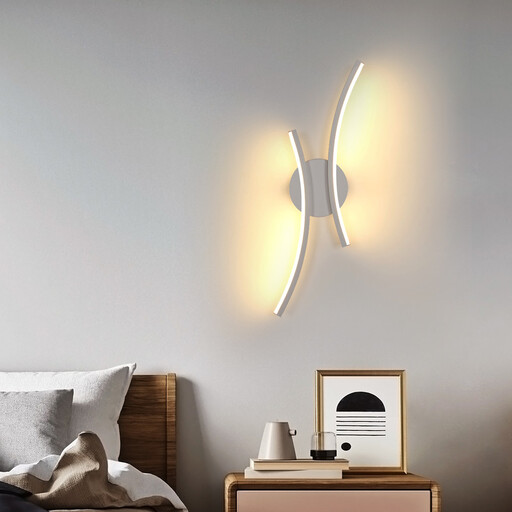
Why this product suits this profile: Its upward- and downward-facing design complements a ceiling light in the living room, bedroom, hallway or home office.
The product description specifies the material, a depth of 5 centimetres and the 3000K colour temperature. This makes it easier to coordinate with existing lighting.
Aluminium housing, 20 watts, warm white light at 3,000 kelvin and indirect or two-sided light emission.
We have put together a complete, regularly updated list of products that fully meet these strict selection criteria and the safety regulations applicable in the EU.
This depends on the IP rating, the installation zone and the manufacturer’s specifications. IP44 can protect against splashing water, while IP65 offers greater protection against dust and water jets. The requirements of the electrical installation also apply to the specific position in the bathroom. Installation should be carried out by a qualified electrician.
Lifespan is often specified in operating hours, such as 25,000 or 30,000 hours. This is a product specification and depends, among other things, on heat dissipation, ambient temperature and operating conditions. With permanently integrated LEDs, it is generally the entire light fitting rather than just a bulb that is considered.
LED technology can have lower power consumption for comparable light output. However, wattage, daily operating time and electricity tariff determine running costs. Therefore, do not compare only the design; also consider lumens per watt, usage profile and the stated energy efficiency class.