
Lieferung heute & morgen

Qualitätsgarantie

Willkommens-Angebote freischalten: KOSTENLOSE Lieferung | Bis zu 80 % RABATT | Kostenlose 30-Tage-JoyPlus-Testphase
App herunterladen
A new ceiling light should illuminate a room reliably, complement your décor and be easy to operate day to day. However, some common marketing claims about LED ceiling lights can lead to unsuitable purchases. A high wattage, for example, does not automatically mean better illumination. An integrated dimming function can also be impractical if only a few brightness levels are available or the controls are incompatible with your existing wall switch.
Wattage describes energy consumption, not the amount of light directly. For brightness, the key factor is luminous flux in lumens. A modern LED ceiling light can achieve a high lumen output with comparatively low power consumption. So pay attention to both values: watts for consumption and lumens for light output.
A warm white ceiling light of around 2,700 to 3,300 kelvin is generally pleasant in living rooms, bedrooms and dining rooms. For work areas, kitchen worktops or utility rooms, neutral white light of around 4,000 kelvin may be more practical. Very cool white light at around 6,500 kelvin is not suitable for every living situation and can feel overly clinical in bedrooms or living areas.
For permanently installed LED ceiling lights, the electrical connection in Germany must be carried out by a suitably qualified professional. You should also check the dimensions of the connection point, the weight and the condition of the ceiling before buying. A ceiling light with remote control offers additional settings, but requires batteries and a suitable place to store the remote. For models controlled by a wall switch, check how the light colour is changed.
As a general guide, smaller rooms such as hallways or storage areas can manage with a lower lumen output. Living rooms, kitchens and offices often need more light, depending on the room size, ceiling height and furnishings. The product information on the recommended coverage area is useful, but does not replace an individual assessment.
A model with 24 watts and 2,400 lumens, such as the Baarlo light, needs to be assessed differently from a 22-watt light with 2,300 lumens. So do not compare power consumption alone; also consider the luminous flux and design. A wide, flat light panel distributes light differently from three adjustable spotlights.
A dimmable ceiling light can be useful when a room serves several purposes. Stepless dimming allows more precise adjustment than a three-stage dimmer. Also check whether the colour temperature can be changed. Some models switch between warm white, neutral white and cool white, while others are fixed at 3,000 kelvin.
On suitable models, a memory function saves the last setting used. This is practical in everyday use, but it should be explicitly stated in the relevant product description.
The size of the light must suit the room and the existing ceiling position. Models with a diameter of around 20 to 35 centimetres may be suitable for compact hallways, while larger rooms require a larger light panel or several light sources.
The IP20 rating is intended for dry indoor areas. Wet rooms have different requirements. For lights with E27 sockets, bulbs must be purchased separately; check the permitted maximum wattage. Integrated LEDs do not require bulb replacement, but if they fail, they cannot be replaced like a standard bulb.
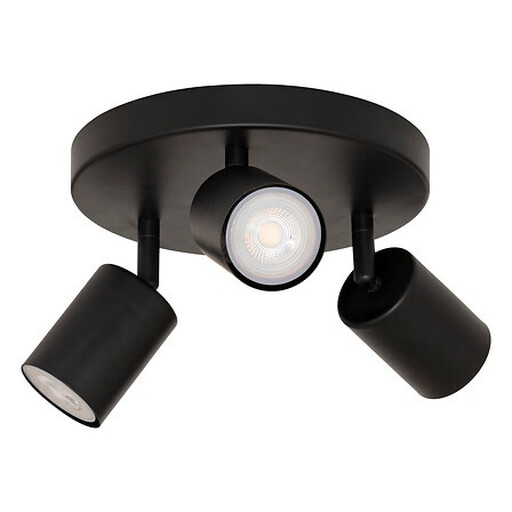
Why this product suits the profile: With a diameter of 20 cm and three adjustable spotlights, this compact ceiling light is suitable for smaller rooms, hallways or a specifically illuminated work area.
The three rotatable light heads prevent a fixed light direction. At the same time, the material, dimensions and maximum bulb wattage should be checked before installation.
Black steel housing, three adjustable spotlights, 20 cm diameter and 14 cm height.
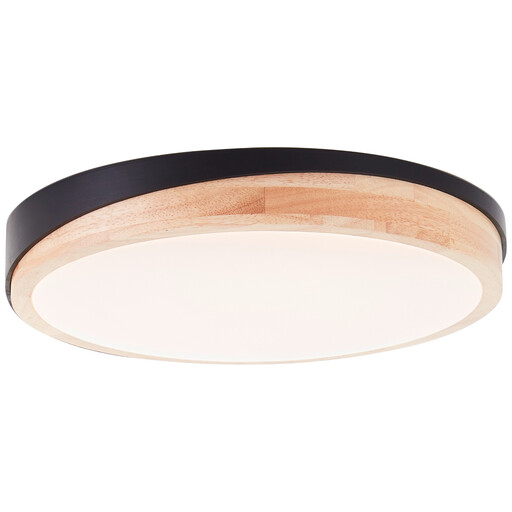
Why this product suits the profile: The combination of 2,400 lumens, 3,000 kelvin, a wood-effect finish and three-stage dimming works well in living rooms, bedrooms, dining rooms and hallways.
The product data specifies luminous flux, colour temperature, dimming levels, dimensions and energy efficiency class F. This allows you to compare key buying criteria in advance.
Integrated LED, 2,400 lumens, 24 watts, 35 cm diameter, 3,000 kelvin and memory function.
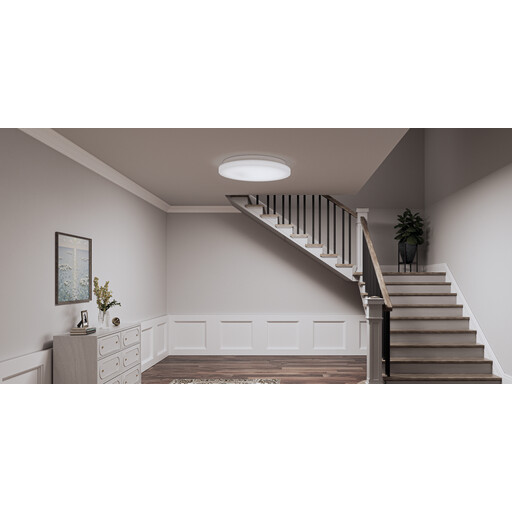
Why this product suits the profile: Presence detection is useful for hallways, entrance areas or rooms where the light should often be activated automatically.
The sensor function is designed to make operation more convenient. Even so, check the detection range, installation height, settings and preferred manual control method before buying.
Model with presence detection and documented manufacturer and EU responsible-person details.
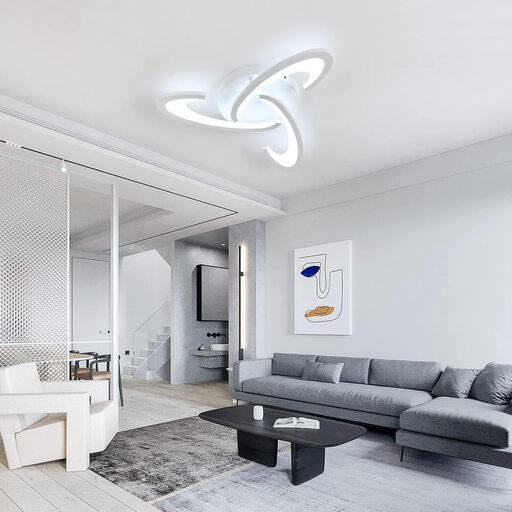
Why this product suits the profile: The combination of a remote control, stepless brightness adjustment and adjustable colour temperature is designed for rooms with changing lighting requirements.
The product details specify a range of 3,000 to 6,500 kelvin and brightness adjustment from 5 to 100 per cent. This makes the available controls clear before purchase.
30 watts, remote control, stepless dimming, 3,000–6,500 kelvin and memory function.
We have put together a complete, regularly updated list of products that fully meet these strict selection criteria and the safety regulations applicable in the EU.
Before ordering a ceiling light, compare the following points:
A broad, warm white ceiling light can be a sensible choice for a living room. In the kitchen, even illumination and a suitable colour temperature are important. A bedroom ceiling light should offer sufficient dimming, while a ceiling light with a motion sensor can reduce the need for manual operation in hallways or entrance areas. For garages and other specialist areas, you should also take the surroundings, moisture and IP rating into account.
This depends on the room size, ceiling height, wall colours and intended use. When choosing, compare the manufacturer’s recommended coverage area with the stated luminous flux in lumens. Work areas often benefit from higher brightness than a bedroom ceiling light intended to create a relaxed atmosphere.
The actual service life depends on factors including operating time, heat dissipation, electronics and build quality. Check the service life stated by the manufacturer and the warranty conditions. With integrated LEDs, replacing the bulb is generally not предусмотрed; with a traditional fitting, the bulb can be replaced separately.
Running costs depend on power consumption, daily usage and your electricity tariff. A simple calculation is: Wattage ÷ 1,000 × operating hours × electricity price per kilowatt-hour. When comparing products, consider power consumption alongside the required brightness in lumens rather than focusing only on a low wattage.