
Lieferung heute & morgen

Qualitätsgarantie

Willkommens-Angebote freischalten: KOSTENLOSE Lieferung | Bis zu 80 % RABATT | Kostenlose 30-Tage-JoyPlus-Testphase
App herunterladen
An LED ceiling light can illuminate rooms evenly, save space and reduce electricity consumption compared with older light sources. However, some common marketing claims can lead to poor purchasing decisions. For example, a high lumen figure does not automatically mean pleasant light. “Dimmable” is only practical when the right dimmer is used.
Before choosing, you should therefore watch out for three common pitfalls:
Lumens indicate how much visible light a light produces. As a general guide, living rooms and bedrooms can often manage with around 100 to 150 lumens per square metre. Work areas, kitchens or rooms with dark surfaces may need more light, depending on how they are used.
A wide beam spreads light more evenly. With a flat LED ceiling light, it is also important to check whether the cover diffuses the light evenly. A high luminous flux alone will not prevent unwanted shadows or glare.
With LED ceiling spotlights and LED recessed spotlights, you should also check the number of lights, beam angle and arrangement. Several spotlights are suitable for targeted lighting, while a central LED ceiling lamp often creates more even general illumination.
Colour temperature is measured in Kelvin:
A warm-white LED ceiling light creates a more understated atmosphere. A neutral-white LED ceiling light can help with tasks where outlines and colours need to be clearly visible. Models with switchable colour temperature offer greater flexibility, but they do not replace checking the other technical specifications.
With low ceilings or suspended structures, a flat LED ceiling light with a low profile can be a sensible choice. Recessed spotlights, on the other hand, require a suitable ceiling cut-out. Before buying, check:
For a bathroom ceiling light, the IP rating must be suitable for the installation position. IP44 protects against solid foreign objects measuring 1 mm or more, as well as splashing water from different directions. This does not mean that the light is suitable for direct water jets or immersion. In the kitchen, the light should likewise not be exposed directly and without protection to steam, splashing water or heat sources.
The following products differ in design, light colour, brightness and control options. The details refer to the respective product information.
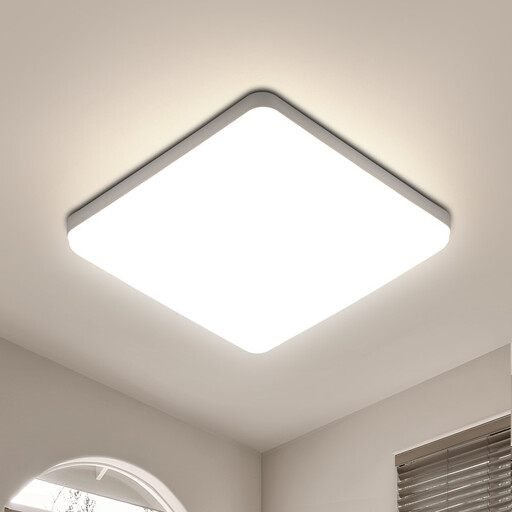
Why this product suits the profile: The square surface-mounted light provides 3300 lm at 4500 K and, according to the product information, is intended for rooms of approximately 15 to 20 m². This makes it suitable for straightforward general lighting in hallways, kitchens, bedrooms or living rooms.
The specifications clearly state the luminous flux, colour temperature and dimensions. Dimming is not assumed. However, the IP rating is not specified, so a separate check is required before using it in the bathroom.
3300 lm, neutral-white 4500 K and a slim design measuring approximately 3.5 cm. The stated CRI value is above 80.
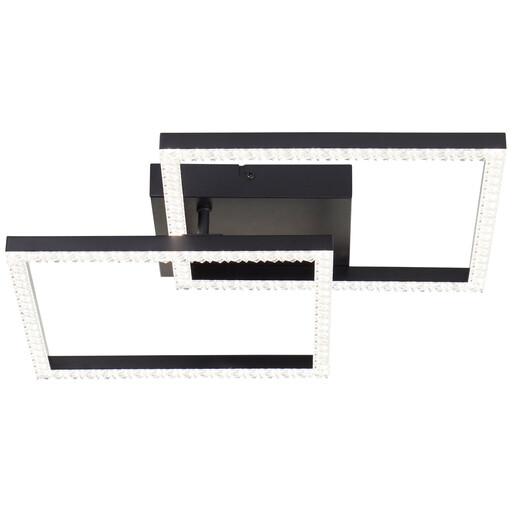
Why this product suits the profile: Measuring 41 × 41 cm, this light combines an integrated LED with 2700 lm and neutral-white 4000 K. A swivelling element allows limited adjustment of the light direction.
The product data specifies the wattage, luminous flux, colour temperature, energy efficiency class D and IP20. This makes it easier to identify the light as suitable for a dry indoor space, rather than mistaking its appearance for suitability in damp areas.
2700 lm at 20 W, 4000 K and a swivelling element. The integrated LED is designed to provide even ceiling illumination.
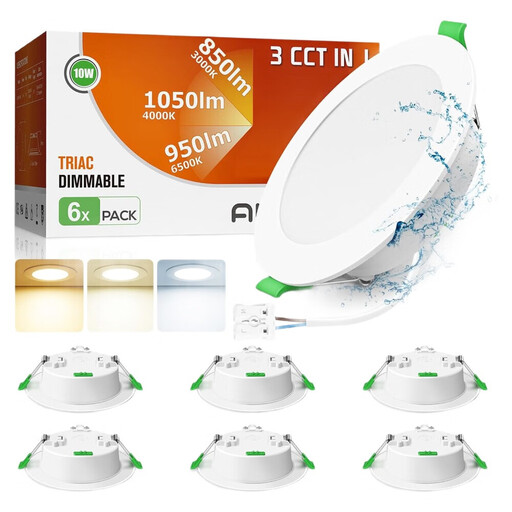
Why this product suits the profile: The set of six recessed spotlights offers selectable 3000, 4000 or 6500 K, 1050 lm per light and dimming from 10 to 100 per cent with a compatible trailing-edge dimmer. The installation depth is 34 mm.
The dimming requirement is stated explicitly. The colour temperature, 90–100 mm cut-out and IP44 rating are also specified. Direct water jets should still be avoided.
Three colour temperatures, dimmable from 10 to 100 per cent and IP44 protection. It connects directly to 220–240 V without a transformer.
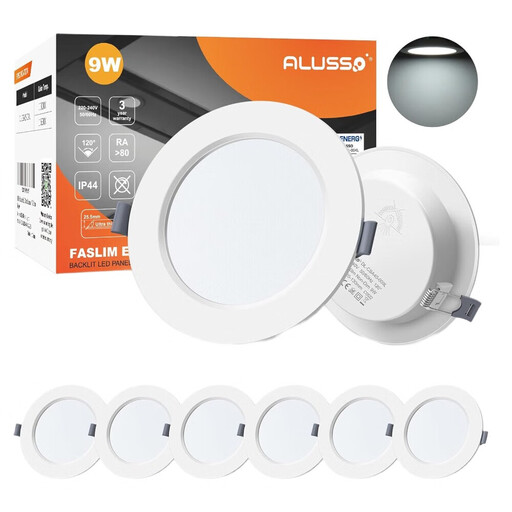
Why this product suits the profile: According to the product data, these recessed lights require an installation depth of just 25.5 mm and a ceiling cut-out of 115–135 mm. They are intended for indoor spaces and each produces 720 lm at 6500 K.
The shallow installation depth and required cut-out are clearly specified. It is also explicitly stated that the set is not dimmable. This makes it easier to coordinate the electrical planning before purchase.
25.5 mm installation depth, IP44 protection and direct connection to 220–240 V without a transformer. The set includes six lights.
We have put together a complete, regularly updated list of products that fully meet these strict selection criteria and the safety regulations applicable in the EU.
A permanently connected LED ceiling light should generally be installed by a suitably qualified electrician. Before carrying out any work on the ceiling, the power supply must be switched off and secured against being switched on again. With recessed spotlights in particular, you must take the ceiling cut-out, cable routing and heat dissipation into account.
Running costs can be calculated simply:
Power in kW × operating hours × electricity price = electricity costs
A 20 W light uses 20 kWh over 1,000 operating hours. The actual cost depends on your personal electricity tariff. The energy efficiency class on the EU energy label allows comparisons within the product data provided for each item. Figures such as “30,000 hours’ service life” are manufacturer specifications and are not a guarantee for every installation situation.
As a rough guide, around 100 to 150 lm per square metre is suitable for general residential lighting. Kitchens, studies and rooms with dark surfaces may need more light. Room height, beam angle and the number of existing light sources are also important factors.
Pay attention to the IP rating required for the installation location. IP44 can protect against splashing water in certain areas, but it is not designed for direct water jets or immersion. Distances from the shower and bath, as well as the applicable installation regulations, must be taken into account.
Many product data sheets state an average service life, such as 30,000 hours. This figure depends on operating time, heat dissipation, mains quality and ambient temperature. Good ventilation and installation in accordance with the instructions help support the intended operation.