
Lieferung heute & morgen

Qualitätsgarantie

Willkommens-Angebote freischalten: KOSTENLOSE Lieferung | Bis zu 80 % RABATT | Kostenlose 30-Tage-JoyPlus-Testphase
App herunterladen
Modern LED ceiling lights should do more than simply brighten a room: they need to suit the size of the room, provide an appropriate colour temperature and blend harmoniously with your décor. At the same time, unclear lumen specifications, unsuitable colour temperatures and incompatible dimmers often lead to disappointing purchases.
If you are looking for a new LED ceiling light for your living room, bedroom, kitchen, hallway or home office, you should not base your decision solely on shape and price. The key factors are the technical specifications, installation requirements and intended use.
Wattage describes power consumption, not brightness directly. For comparison, luminous flux in lumens is more meaningful. A light with 2,400 lumens will generally produce more light than a model with 1,200 lumens, regardless of how the wattage is marketed.
The following ranges can serve as a rough guide:
The right choice also depends on ceiling height, wall colour, furnishings and the desired lighting effect.
A ceiling light with warm white light of around 2,700 to 3,300 Kelvin usually creates a cosy atmosphere and is suitable for bedrooms, living rooms and dining areas. Neutral white light of around 4,000 Kelvin can be practical in kitchens, hallways or home offices. Cool white light of around 6,000 to 6,500 Kelvin has a distinctly functional feel and can be chosen for work or reading areas.
A bright LED ceiling light with a colour temperature of 6,500 Kelvin is therefore not automatically suitable for every room. It may feel too harsh in a bedroom, while supporting clear illumination in a home office.
“Dimmable” can refer to different systems. Some lights have an integrated multi-stage dimmer, while others require a compatible wall dimmer. Before buying, you should check:
Working on an electrical installation carries a risk of electric shock. The connection should be carried out in accordance with the manufacturer’s instructions by a suitably qualified professional.
Start by comparing the luminous flux in lumens, followed by the power consumption in watts. The kWh/1,000 hours figure can help you assess the running costs of different models. With comparable brightness, lower power consumption generally means lower electricity usage.
The energy efficiency class should also be taken into account. According to the product information, the Brilliant Baarlo model has a power rating of 24 watts, 2,400 lumens, energy efficiency class F and a consumption figure of 21 kWh/1,000 hours. This provides specific comparison figures that go beyond simple advertising claims.
For rooms with changing requirements, a dimmable ceiling light can be a practical choice. Bright light supports activities such as food preparation in the kitchen, while a lower setting may be more pleasant during dinner or in the living room.
It is important to distinguish between brightness and colour temperature: dimming changes the amount of light, but not necessarily the colour temperature. If you need different lighting moods, look specifically for a light with an adjustable colour temperature. The colour temperatures specified for the products featured here are fixed.
A flush ceiling light is particularly suitable for rooms with low ceilings. Pendant lights, on the other hand, require sufficient clearance above furniture and should be installed over dining tables or kitchen islands so that they do not obstruct your view or restrict movement.
A wooden ceiling light can add natural accents. According to the product information, the Baarlo model combines wood, plastic and metal; an FSC feature is also listed. The IP rating must be checked for damp rooms. The Baarlo light is rated IP20 and is therefore intended for dry indoor areas, not for direct use in damp or weather-exposed locations.

Why this product suits the profile: Its compact dimensions, warm white 3,000 Kelvin light and integrated three-stage dimmer make it suitable for smaller living spaces, bedrooms and hallways.
The lumens, Kelvin, wattage and energy efficiency class are all clearly specified. This makes it easier to compare the light objectively with other models.
2,400 lumens, 35 cm diameter, three-stage dimmer with memory function and a wood component according to the product information.
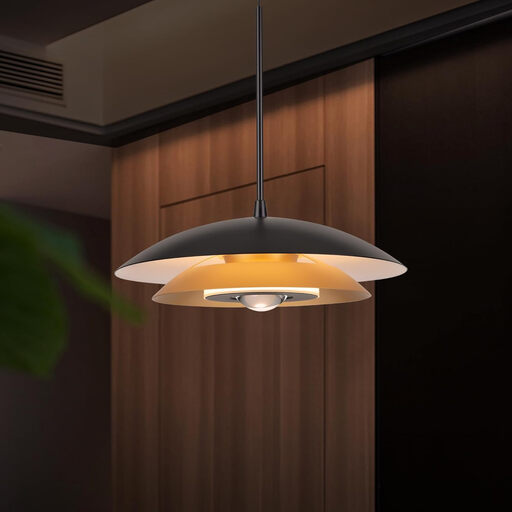
Why this product suits the profile: The adjustable suspension and double-layer metal shade are designed for use above a kitchen island or dining table.
The recommended use, colour temperature, power rating and dimmer compatibility are clearly stated. Even so, you should check the existing dimmer before installation.
Integrated 12 W LED module, 3,000 Kelvin, height-adjustable cable and metal construction according to the product description.
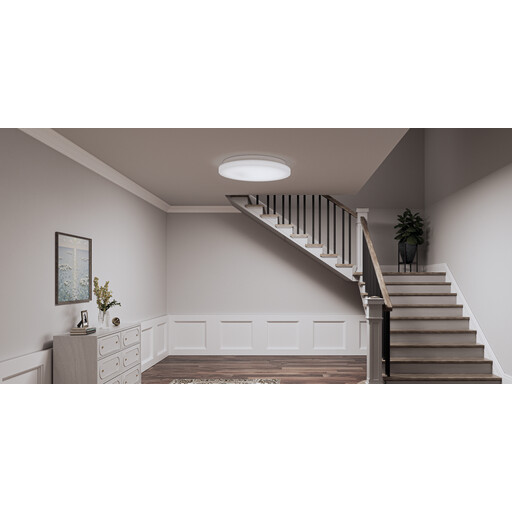
Why this product suits the profile: The sensor function is ideal for households where automatic lighting control in a hallway, entrance area or utility room could be useful.
The presence or sensor function is clearly identified as a key feature. Before buying, you should check the detection range and the switching logic you require.
Sensor ceiling light with presence detection; the available product information focuses on manufacturer and responsible-party details.
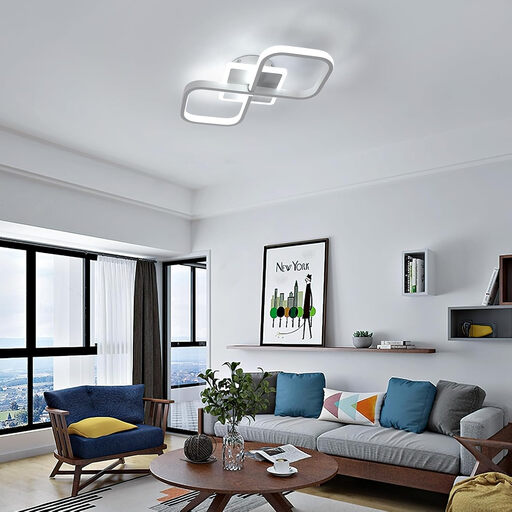
Why this product suits the profile: Its stated brightness and cool white colour temperature are well suited to home offices, reading areas and rooms where clear visibility is important.
The choice is based on measurable specifications rather than the word “bright”: 4,000 lumens, 36 watts and 6,500 Kelvin are clearly stated.
Geometric acrylic shade, integrated LED technology and a stated lifespan of 50,000 hours according to the product description.
Before installation, check the drilling points, ceiling supports and existing connection. With integrated LEDs, it is also important to remember that the light source cannot be replaced like a conventional bulb. Depending on the design, the entire light may need to be replaced if a fault occurs.
Several factors therefore contribute to energy-efficient LED lighting:
A sensor ceiling light can reduce unnecessary on-times in passageways. However, the actual saving depends on usage duration, switching behaviour and the electricity tariff.
We have put together a complete, regularly updated list of products that fully meet these strict selection criteria and the safety regulations applicable in the EU.
For a medium-sized living room, around 2,000 to 3,500 lumens are often suitable as general lighting. With dark walls, a high ceiling or several activity zones, an additional floor, wall or table lamp may be useful.
Lifespan depends on product quality, operating time, heat dissipation and usage. The white acrylic ceiling light is stated as having a lifespan of 50,000 hours according to the product information. This should be understood as manufacturer or product information and does not guarantee a specific actual service life in an individual household.
You can estimate the cost using this formula:
Power in watts ÷ 1,000 × operating hours × electricity price per kilowatt-hour
A 24-watt light operated for three hours a day uses 0.072 kWh per day in theory. For a realistic comparison, you should also take the dimming level, switching times and use of additional light sources into account.