
Lieferung heute & morgen

Qualitätsgarantie

Willkommens-Angebote freischalten: KOSTENLOSE Lieferung | Bis zu 80 % RABATT | Kostenlose 30-Tage-JoyPlus-Testphase
App herunterladen
A suitable LED ceiling light should illuminate the room evenly, suit the ceiling height and work reliably every day. However, choosing the right light involves more than just wattage and design. Unclear brightness specifications, an unsuitable IP rating or an installation depth that does not fit can mean that the light cannot be used in the intended location after purchase.
Power consumption in watts describes electricity usage, not brightness directly. For comparison, the luminous flux in lumens is the key factor. A 9-watt LED can produce different numbers of lumens depending on its design and lighting technology. If you only look at wattage, you risk choosing lighting that is either too dim or unnecessarily bright.
A light with IP20 is intended for dry indoor areas. For bathrooms, kitchens and other areas with increased moisture, products with IP44 or IP65 may be suitable, depending on the installation location. The IP rating alone is no substitute for proper planning: direct water jets, splash zones and the applicable installation zones must also be taken into account.
With LED recessed spotlights, the outer diameter, ceiling cut-out and installation depth must match. A cut-out that is too large prevents the light from being held securely, while a light that is too deep may not fit in low ceilings or suspended constructions. A dimmable LED ceiling light will not automatically work with every wall dimmer, either. Specifications such as “dimmable from 10 to 100 per cent” only apply when using a compatible dimmer, such as a suitable trailing-edge dimmer.
Colour temperature is measured in kelvins:
A 3CCT LED spotlight allows you to choose between several colour temperatures. Some products are adjusted using a switch on the light fitting. It is important to check your preferred colour temperature before installation, as the switch may be difficult to reach once the light has been fitted.
As a general guide, living rooms and bedrooms can be planned with around 100 to 150 lumens per square metre. Kitchens, worktops and bathrooms often need more light. Actual planning also depends on ceiling height, wall colour, spacing between lights and the desired lighting scheme.
Several LED ceiling spotlights often distribute light more evenly than a single fitting. By contrast, a ceiling light with 2300 to 2700 lumens may provide sufficient general lighting for medium-sized rooms. Work surfaces may benefit from additional directional lighting, such as an LED kitchen pendant light above an island or dining table.
Many recessed spotlights for direct connection operate at 220 to 240 V and do not require a separate transformer. Compact 12- to 24-volt lights, on the other hand, require a suitable power supply or transformer, which often has to be purchased separately.
Before ordering, you should note down these measurements:
An ultra-flat LED ceiling light can be practical for low ceilings. Even so, the installation height specified by the manufacturer must be observed. In Germany, the electrical connection should be carried out by a suitably qualified person in accordance with the applicable regulations.
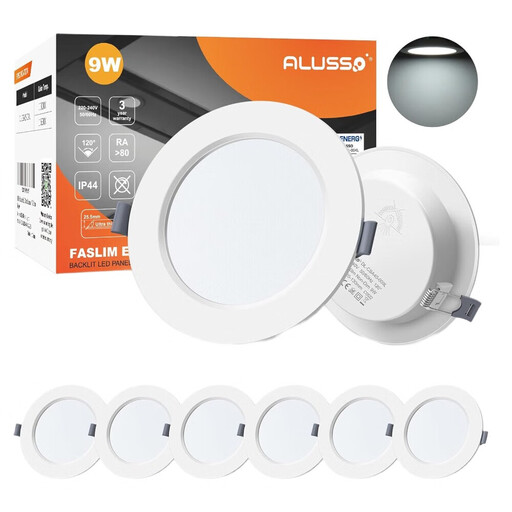
Why this product suits this profile: This set of 6 is ideal for buyers who want to equip several recessed points in the bathroom, kitchen, hallway or living room and need a slim design.
The installation depth is 25.5 mm, while the ceiling cut-out and 230-volt connection are also clearly specified. However, this model is not dimmable and is available exclusively in 6500 K.
9 W, 720 lm, IP44, 25.5 mm installation depth and direct connection without a transformer.
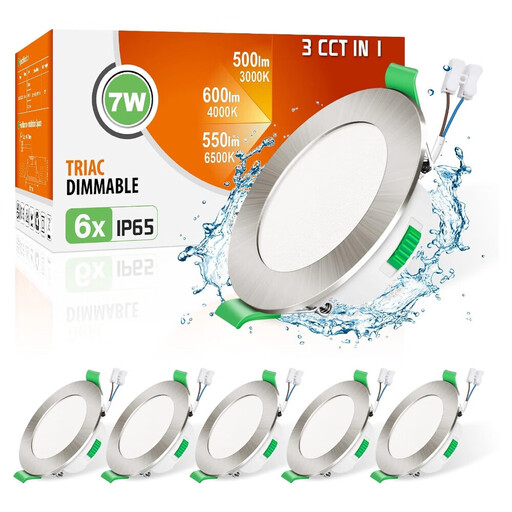
Why this product suits this profile: If you want to adjust colour temperature and brightness flexibly, this dimmable set offers three selectable colour temperatures and a higher IP rating.
IP65 and the direct 230-volt design are clearly specified. A compatible trailing-edge dimmer is required for the dimming function, and installation should be carried out professionally.
3CCT with 3000, 4000 and 6500 K, dimming from 10 to 100 per cent, 29 mm installation depth and IP65.
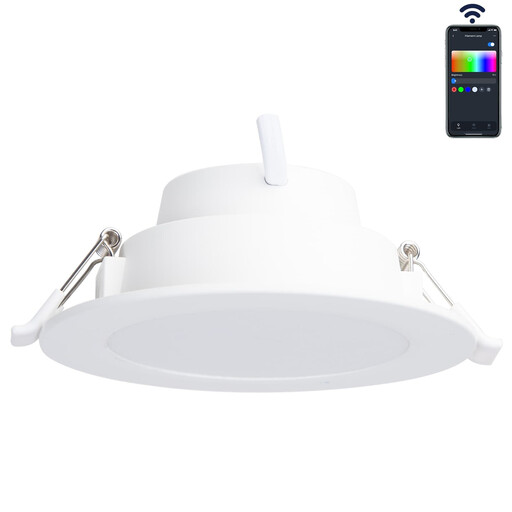
Why this product suits this profile: For hallways, living spaces and users who want to adjust their lighting via app or voice control, this model offers smart control without an external wall dimmer.
The control method is clear: dimming takes place via the app rather than an external wall dimmer. With IP20, this model is intended exclusively for dry indoor areas.
RGB and CCT selection from 2700 to 6500 K, Bluetooth Mesh, app control and 780 lm at 9 W.

Why this product suits this profile: This fixed LED ceiling light is designed for living rooms, bedrooms and dining areas where a central light with warm white illumination and a decorative wood effect is desired.
The colour temperature is specified as 3000 K, as is the three-stage internal dimming function. With IP20, the light is not intended for damp areas.
2400 lm, 3000 K, 35 cm diameter, three-stage dimmer with memory function and wood effect.
We have put together a complete, regularly updated list of products that fully meet these strict selection criteria and the safety regulations applicable in the EU.
Before installation, switch off the circuit and the fuse. A qualified electrician should be involved when installing 230-volt lights. For recessed spotlights in the bathroom, the position in the room and distance from water sources are just as important as IP44 LED recessed spotlights or an IP65 LED spotlight.
You should also check the following:
A stated service life of, for example, 30,000 hours is a manufacturer’s estimate, not a guarantee of a specific operating period in every household. Heat, frequent switching, voltage fluctuations and the installation conditions can affect the actual service life.
For many bathrooms, neutral white at around 4000 K is a practical choice because it creates a clear, functional impression. Warm white can be used for cosy general lighting. When installing a light in areas exposed to moisture, the specific model’s IP rating must be suitable for the intended location.
An LED ceiling light with a motion sensor can be suitable for hallways, utility rooms or cellars when light is only needed while someone is present. Check the detection angle, run-on time, installation height and whether the sensor can be deactivated. In living rooms or bedrooms, permanent manual control may be more convenient.
Running costs depend on power, daily usage time and the electricity tariff. The calculation is: wattage divided by 1000, multiplied by operating hours and the electricity price. A 24-watt light uses 2.4 kilowatt hours over 100 operating hours. Actual consumption may vary depending on the dimming level and standby function.