
Lieferung heute & morgen

Qualitätsgarantie

Willkommens-Angebote freischalten: KOSTENLOSE Lieferung | Bis zu 80 % RABATT | Kostenlose 30-Tage-JoyPlus-Testphase
App herunterladen
LED ceiling lights differ not only in shape and price. Colour temperature, brightness, protection rating, recessed depth and connection type all determine whether a light truly suits a room in everyday use. This applies equally to private individuals, renovators, DIY enthusiasts and those fitting out offices or retail spaces.
The wattage describes power consumption, not directly the brightness. For comparison, the luminous flux in lumens is what matters. An LED light with 720 lumens can use significantly less power than a conventional 72-watt halogen fitting. However, the right brightness also depends on room size, ceiling height, wall colours and the desired light distribution.
An LED ceiling light for the bathroom rated IP44 or IP65 is not automatically suitable for every spot in the bathroom. The protection rating describes the level of protection against the ingress of solid objects and water. In addition, wet areas have specific requirements regarding installation location, distance from water sources and electrical installation. The actual suitability should be checked against the installation instructions and, if in doubt, by a qualified electrician.
With a dimmable ceiling light, you need to clarify how the brightness is controlled. Some models require a suitable trailing-edge dimmer, while others are controlled exclusively by remote control or app. A smart model with Bluetooth Mesh, for example, may support app and voice control but not work with a conventional wall dimmer.
Colour temperature is given in Kelvin:
A warm white ceiling light at 3000 K creates a different room atmosphere than a 6500 K LED ceiling spotlight. If you want flexibility, you can choose a light with CCT selection. With RGB+CCT ceiling lights, you can also set coloured light scenes. For a consistently pleasant background light, the colour choice should still suit the purpose of the room.
For LED recessed downlights, LED ceiling spotlights and recessed ceiling spots, three measurements are crucial:
A shallow model can be an advantage with suspended ceilings or limited installation height. The measurements must be checked against the existing opening before purchase. A cut-out that is too large cannot always be neatly covered; a cut-out that is too small will prevent installation.
An LED ceiling light 230 V is usually connected directly to the mains electricity supply in Germany. This does not mean that installation should be carried out by yourself. Work on the fixed electrical installation may only be carried out in accordance with the applicable regulations and by a suitably qualified person. Before any maintenance, the power supply must be switched off at the fuse box.
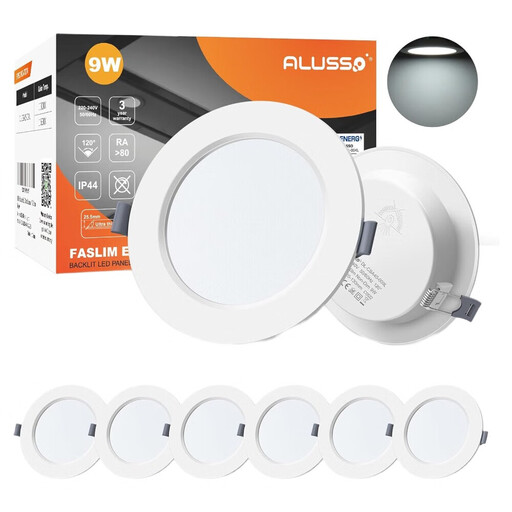
Why this product fits the profile: The 6-pack offers a consistent solution for multiple recessed openings and, with a 25.5 mm recessed depth, is designed for shallow ceiling constructions.
The specifications state the cut-out range, recessed depth, 230 V connection and explicitly "not dimmable". This allows installation and control requirements to be checked in advance.
720 lumens, 6500 Kelvin, IP44, 9 watts and a set of six lights.
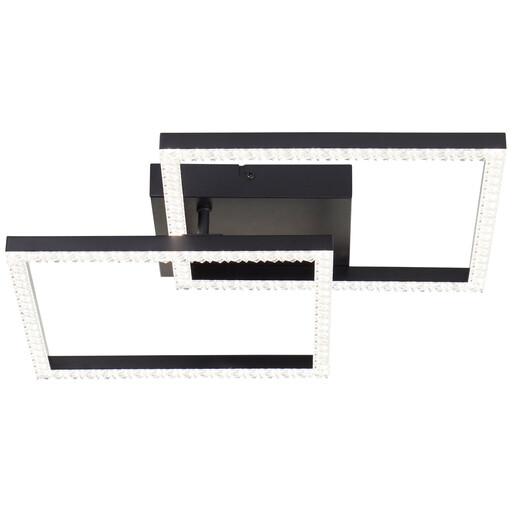
Why this product fits the profile: The integrated light combines a clearly defined light output with a decorative black design and a swivelling element.
The product data states 2700 lumens, 4000 Kelvin, 20 watts, energy efficiency class D and IP20. This clearly categorises the light for dry indoor spaces.
41 × 41 cm, 2700 lumens and a swivelling frame element for targeted direction.
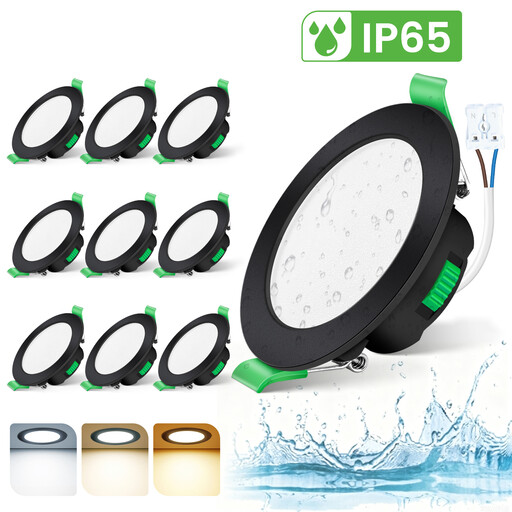
Why this product fits the profile: The combination of IP65, 3CCT selection, dimmability and direct 230 V connection is aimed at users with changing requirements in bathrooms, kitchens or covered outdoor areas.
The specifications make it clear that a suitable trailing-edge dimmer is required. In addition, the cut-out dimensions of 67–75 mm and the IP65 rating must be checked before installation.
3000, 4000 or 6500 Kelvin, dimmable from 10 to 100 per cent, 600 lumens and 7 watts.
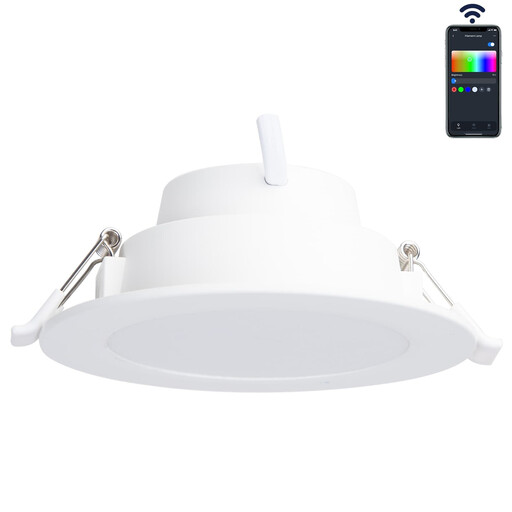
Why this product fits the profile: Bluetooth Mesh, app control, voice control as well as RGB and CCT settings enable flexible lighting planning in dry indoor spaces.
With IP20, the model is clearly intended for dry indoor areas. Control is via the app and not through an external wall dimmer.
780 lumens, 2700 to 6500 Kelvin, RGB colours, 120° beam angle and 9 watts.
We have put together a complete, regularly updated list of products that fully meet these strict selection criteria and the safety regulations in force in the EU.
That depends on room size and use. For a small hallway, a lower light output may be sufficient, while kitchens, studies or larger living spaces need more lumens. Several LED recessed downlights often distribute the light more evenly than a single point source.
Product specifications often state an average lifespan, for example 30,000 hours. This value is a manufacturer or supplier parameter and depends, among other things, on operating time, heat dissipation and ambient temperature. With integrated LEDs, the entire light is usually replaced when the light module fails.
The running costs can be estimated using the formula wattage × operating hours ÷ 1000 × electricity price. A 7-watt light uses 7 kWh over 1,000 operating hours. For a realistic comparison, you should also consider luminous flux, usage duration and the energy efficiency class.