
Lieferung heute & morgen

Qualitätsgarantie

Willkommens-Angebote freischalten: KOSTENLOSE Lieferung | Bis zu 80 % RABATT | Kostenlose 30-Tage-JoyPlus-Testphase
App herunterladen
An LED desk lamp should illuminate your work area evenly, take up little space and adapt to different activities. However, students, people working from home, schoolchildren, readers and creative users do not all prioritise the same features. A clip-on lamp may be more practical on a small desk than one with a wide base, while a rechargeable desk lamp is useful when there is no socket nearby.
It is worth taking a close look at the technical specifications before buying. Marketing terms such as “easy on the eyes”, “full spectrum” or “modern light” are no substitute for specific data.
Buying a dimmable desk lamp does not automatically mean that it is suitable for every situation. What matters is how far the brightness can be adjusted and whether the controls work precisely. Concentrated work usually requires a different brightness level from reading at the bedside.
You should therefore look for:
“Natural light” is not a technical unit. A lamp with an adjustable colour temperature should specify concrete Kelvin values. Warm white light around 3000 K generally feels more cosy, while more neutral values around 4000 K are often used for desks and reading. Higher values can create a cooler impression of colour.
Colour temperature describes the colour of the light, not automatically its quality or any health benefit.
A large base can be an inconvenience on a narrow desk. A folding LED lamp can be stored more compactly when not in use. A clip-on lamp, on the other hand, uses the edge of the desk and frees up additional space. Before buying, compare the maximum clip width, the dimensions of the base and the movement range of the lamp arm.
With flexible models, it is also important to check whether the gooseneck or articulated arm holds its position reliably. A lamp head that gradually drops down changes the illumination and can be irritating in everyday use.
Lumens indicate luminous flux, meaning the amount of visible light emitted. Watts describe energy consumption. A higher wattage does not automatically mean more even illumination. For a desk, it is also important to consider how widely and glare-free the light is distributed.
Broad, diffuse coverage is often more practical for work surfaces than a very small, bright beam of light. Reflective desk surfaces can intensify glare. Position the lamp to the side of your dominant hand so that writing creates as little shadow as possible.
For colour rendering, the CRI or Ra value is a useful point of comparison. A higher value can make colours appear more natural under the lamp. This information is particularly useful for drawing, crafting or product photography. However, it should be stated directly in the product specifications rather than inferred from advertising claims.
The term “eye-friendly desk lamp” should be treated with caution. Low-flicker, even illumination and suitable brightness can support visual comfort in everyday use. No medical or therapeutic effect can be inferred from this.
A desk lamp with a USB charging port can charge your smartphone or headphones directly at your workstation. Check whether it has USB-A, USB-C or both connections, and whether the charging power is specified. A USB port is not automatically compatible with every fast-charging protocol.
A rechargeable desk lamp offers greater flexibility but needs regular charging. Relevant factors include battery capacity, charging time, stated operating time and whether the lamp can be used while charging. For mains-powered products, EU plugs, an instruction manual, manufacturer information and the required conformity details should be provided.
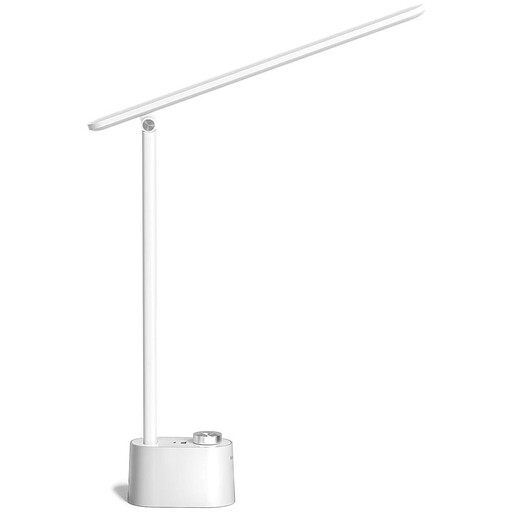
Why this product suits this profile: This folding model combines a space-saving design with dimming, three stated colour temperatures and USB-A and USB-C charging ports.
The stated adjustment range of 15 to 100 per cent and the values 3000 K, 4000 K and 5500 K are more specific than a purely promotional claim of “adjustable light”.
500 lumens, 10 watts, folding design, USB-A and USB-C ports, plus a stated CRI value of 95.
Why this product suits this profile: For working from home, studying and creative activities, the documented light parameters and adjustable light direction are particularly relevant.
The product data specifies luminous flux, colour temperatures, CRI and a stated service life of 30,000 hours. These details make an objective assessment easier.
Three colour temperature levels, 15 to 100 per cent dimming and a reinforced lamp shaft according to the product description.

Why this product suits this profile: The clip mount, flexible silicone arm and integrated battery are suitable for small desks, shelves or mobile reading areas.
The product data specifies a 1200 mAh battery capacity, three brightness levels, 160 lumens and a maximum clip width of 74 mm.
Battery operation, 4000 K neutral white light, 2.5 watts, a 120-degree beam angle and a flexible lamp arm.
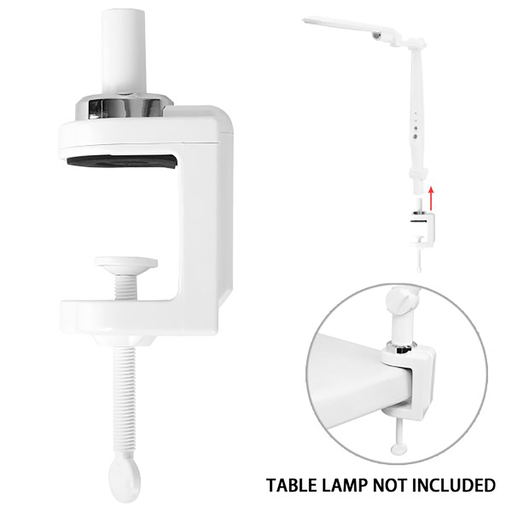
Why this product suits this profile: If you do not want to give up any desk space, a clip-on design for a desk, workbench or craft table could be a practical choice.
The stated clip width of up to 74 mm helps you check whether the desk edge is actually suitable. According to the description, the clamping surface is designed to resist slipping and scratching.
Space-saving installation, polycarbonate construction and intended use indoors.
For the Yeelight LED Folding Desk Lamp Z1 Pro, the available product information mainly confirms its folding design and white colour. You should check the product page directly for details of lumens, dimming, colour temperature and battery before buying: Yeelight LED Folding Desk Lamp Z1 Pro.
We have put together a complete, regularly updated list of products that fully meet these strict selection criteria and the safety regulations applicable in the EU.
Place the lamp to the side of your writing hand and direct the lamp head towards the work surface, not straight at your eyes. The screen should not reflect the lamp wherever possible. If you use a height-adjustable desk, you should also take your new sitting or standing position into account.
The lifespan depends on the LED module, heat dissipation, electronics and how long it is used. Manufacturer specifications such as 20,000 or 30,000 hours are comparative figures, not a guarantee of an identical service life. With models featuring permanently installed LEDs, you should also check whether the light source can be replaced.
Running costs are calculated based on power consumption, daily usage time and the electricity price. A 10-watt lamp used for five hours a day consumes around 0.05 kWh per day. For a precise estimate, multiply this consumption by your current price per kilowatt-hour. Disclosure: Actual consumption may vary depending on the dimming level.