
Lieferung heute & morgen

Qualitätsgarantie

Willkommens-Angebote freischalten: KOSTENLOSE Lieferung | Bis zu 80 % RABATT | Kostenlose 30-Tage-JoyPlus-Testphase
App herunterladen
An LED desk lamp should light your workspace evenly, take up little room and adapt to different tasks. But problems often only become apparent after a few weeks: the lamp doesn’t adjust far enough, the clamp doesn’t fit your desk or the stated battery life only applies at the lowest brightness setting.
This guide explains which details matter before you buy and which design best suits your desk, bedside table, reading nook or craft area. Our selection takes account of clearly stated specifications, such as power, luminous flux, battery capacity, dimensions and controls.
The wattage mainly indicates energy consumption. On its own, it doesn’t tell you how much light reaches the work surface. Luminous flux, measured in lumens, is a more useful guide. A USB desk lamp with low power consumption may provide enough light for reading at close range, while a larger work surface needs a wider spread of light.
The colour temperature should also suit how you plan to use the lamp. Warm white light often works well for a clip-on reading lamp by the bed. Neutral white light can be more practical for focused work or crafts. Your personal preference and the room’s lighting also matter.
With a dimmable desk lamp, brightness may be adjusted in steps or continuously, depending on the model. Before buying, check how many settings there are and whether the lamp is operated by a switch, touch sensor or remote control. With touch lamps, it’s also important that the sensor is easy to reach and won’t be accidentally covered by other objects.
A gooseneck or movable lamp arm is only useful if it stays in position. With an LED clamp lamp, you also need to consider the desk thickness, clamping force and surface protection. A clamp that’s too small may slip, while tightening it too much could damage a delicate tabletop.
A low luminous flux is often enough for a small reading area, provided the lamp is close to the page or work surface. For a desk, the beam should reach the area you need without causing excessive glare. Figures such as 400 lm or 160 lm make for a useful comparison, but you’ll also need to consider distance, beam angle and the brightness of the room.
A mains-powered lamp is a good choice for a permanent workspace. Models with a USB port can also charge mobile devices, provided the port is designed for this purpose. A rechargeable reading lamp gives you more freedom to move it around, but needs regular charging. For battery-powered models, always check the stated operating time alongside the brightness setting it applies to.
A compact desk lamp is a sensible choice if you have a small desk. A clamp saves space, but you’ll need a suitable desk edge. Before buying, check:

Why it suits this need: This mains-powered desk lamp is designed for desks, bedrooms and living spaces. It offers 8 W of power, around 400 lm, warm white light and touch controls with a dimming function.
The stated 400 lm and 8 W make it easier to compare light output and energy consumption than a general marketing claim would. Brightness is adjusted using the touch control.
Warm white light, touch dimming and a USB charging port; operates on 220–240 V.
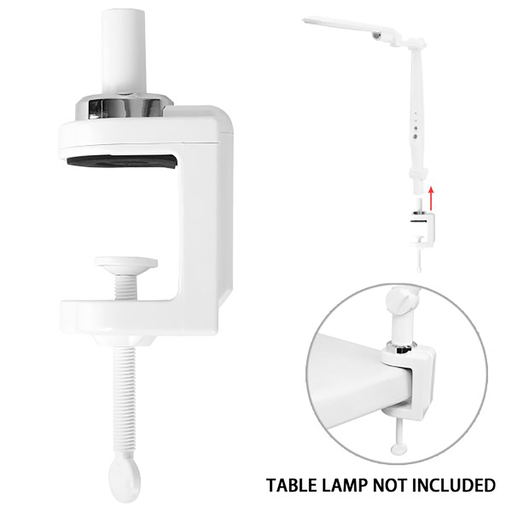
Why it suits this need: The separate clamp is designed for desk edges up to 74 mm thick. It’s a good fit for workspaces, workbenches and craft tables where saving space is a priority.
The maximum clamp thickness is clearly stated. Its non-slip, scratch-resistant design helps reduce the risk of slipping and surface damage.
PC construction, dimensions of 58 × 74 × 169 mm and suitable for edges up to 74 mm thick.

Why it suits this need: This cordless LED lamp has a 1200-mAh battery and can be attached in different places, with its flexible neck letting you direct the light where you need it. It’s suitable for work surfaces, reading areas and crafts.
Three brightness settings and a clearly stated output of 160 lm make it easier to choose the right setting. The stated operating times of 3, 7 or 30 hours depend on the setting selected.
2.5 W, 4000 K neutral white light, a 1200-mAh battery and a 120° beam angle.

Why it suits this need: This compact clip-on reading lamp can stand on its own or attach to a book. Weighing 37 g, with warm white light and USB charging, it’s a handy choice for bedtime, travel and short reading sessions.
The specifications are clearly stated: 16 lm, two brightness settings, around 1.5 hours to charge and up to 8 hours of use.
350° rotation, 45° tilt, 3000 K warm white light and a lightweight 37 g design.
For mains-powered lamps, make sure the voltage and intended setting match the product description. The Aigostar LIGHT08 is specified for 220–240 V, 50/60 Hz and indoor use. Don’t use battery-powered lamps if the casing or charging cable is damaged, and keep them away from moisture. A CE mark is a legal indication of conformity, but it doesn’t replace comparing light output, controls and construction.
Electricity costs depend on wattage, daily usage and the current price of electricity. A 8 W lamp used for five hours a day consumes around 40 Wh per day. With battery-powered lamps, the electricity is used by the charger instead; the actual cost depends on charging losses and how often you use the lamp.
We’ve put together a complete, regularly updated list of products that meet these strict selection criteria and fully comply with the safety regulations in force in the EU.
It depends on the distance, the room’s lighting and how much of the area you want to illuminate. A low luminous flux may be enough for a small reading area if the lamp is close by. For larger desks, light distribution and positioning to avoid glare are also important. Always consider lumen figures alongside the beam angle and distance from the lamp.
A dimmable lamp can be useful when daylight and room lighting change. With touch lamps, make sure the controls are easy to reach. For video calls, avoid pointing the lamp directly at the camera or into your eyes.
Operating time depends on battery capacity, brightness setting and charge level. Manufacturer claims such as “up to 8 hours” usually apply to a specific setting. When choosing a lamp, consider the maximum runtime, charging time and whether it can be charged via USB.