
Lieferung heute & morgen

Qualitätsgarantie

Willkommens-Angebote freischalten: KOSTENLOSE Lieferung | Bis zu 80 % RABATT | Kostenlose 30-Tage-JoyPlus-Testphase
App herunterladen
An LED desk lamp should illuminate your workspace evenly, use little electricity and adapt to different activities. For working from home, studying, doing homework or reading in the evening, design and brightness are not the only considerations. Unclear technical specifications, unsuitable power supplies or a light-emitting surface that is too small can mean that a lamp does not suit your desk in everyday use.
A high lumen rating describes the total luminous flux, but on its own says little about how much light actually reaches the work surface. Beam angle, lamp height and distance from the desktop are also crucial. Despite a high lumen rating, a compact lamp with a tightly focused beam can create a small, bright area with dark zones around the edges.
That is why a broad, as-even-as-possible light distribution is advisable for a desk. With a reading lamp for your desk, the lamp head should be adjustable so that your hand or book does not cast distracting shadows.
The term eye-friendly desk lamp is not automatically a uniformly tested standard in retail. Instead, look for clear information such as low-flicker light, glare reduction, colour temperature and colour rendering index (CRI). Claims such as ‘flicker-free’ or ‘blue-light-free’ should be linked to a specific product data sheet or certification.
A daylight lamp is not equally suitable for every situation either. Cooler light can feel clearer during tasks requiring concentration, while warm light is often more pleasant in the evening. An adjustable colour temperature is therefore more useful than a blanket recommendation.
A desk lamp with a USB connection can be practical, but depending on the model, the connection may only be intended for charging and not for powering the lamp. Also check the mains plug, input voltage and supplied power adapter. The specification 110 volts is particularly relevant for German households when buying internationally: operation on the usual 230-volt mains is only permitted if a suitable version or an appropriate, safe voltage converter is provided.
For concentrated work, luminous flux in lumens is not the only important factor. Illuminance is measured in lux and describes how much light reaches a specific area. The following questions can help in everyday use:
A dimmable desk lamp is particularly practical if it is used both for writing and reading, or for subtle lighting in the evening.
Colour temperature is specified in Kelvin (K). Warm white light is typically at the lower end of the range, neutral white light in the middle and cool white light at the higher end. A lamp with adjustable colour temperature offers greater flexibility than one with just a single fixed light tone.
The CRI value describes how naturally colours appear under the light. A high CRI can be important for drawing, product photography or tasks involving colour recognition. The specification should be listed directly in the technical data, rather than described only with general marketing terms such as ‘natural’.
Touch controls, a memory function and automatic brightness adjustment can make everyday use easier. With a desk lamp with touch controls, the sensor area should be easy to reach and not activated accidentally by nearby objects.
Compared with traditional incandescent bulbs, LED lights are often considered more energy efficient. However, actual running costs depend on power consumption in watts, daily usage time and electricity tariff. A 9-watt lamp switched on for four hours a day uses significantly less energy in theory than a 100-watt light used for the same amount of time. Brightness and illumination must still be suitable for the intended use.
The following selection categorises specific models according to their features and typical uses. Technical specifications are taken from the respective product information. For certification- or health-related claims, you should check the manufacturer’s information and the documents supplied with the product.
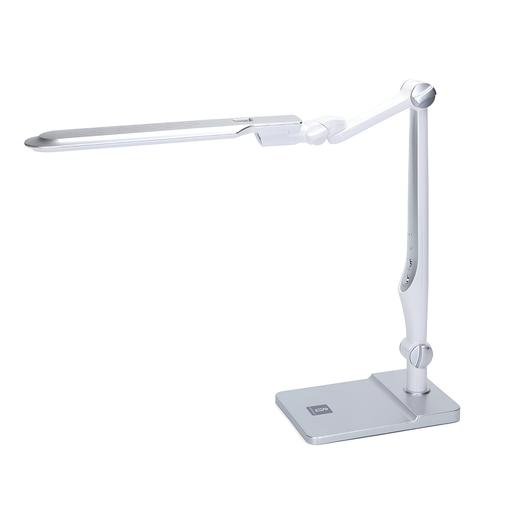
Why this product suits the profile: The 9-watt LED, touch controls and flexible colour temperature are suitable for a simple workspace, bedside table or occasional reading.
The key technical specifications state the power consumption, colour temperature range and dimming function. Nevertheless, check the power adapter and connection type before buying for use in Germany.
9 W power consumption, touch controls, flexible colour temperature from 3000 to 6500 K and adjustable lamp arm.
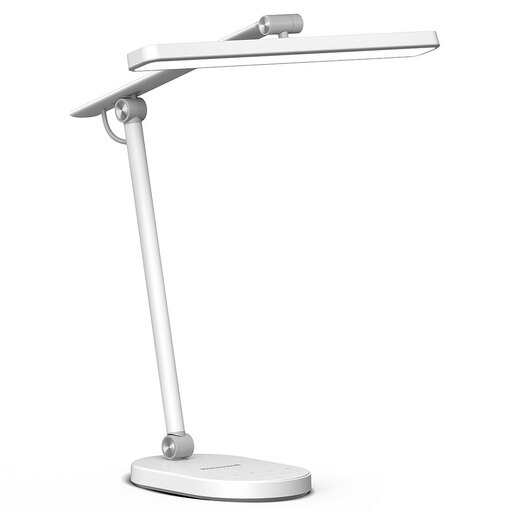
Why this product suits the profile: For long periods of work or study, an adjustable arm, several colour temperatures and automatic brightness adjustment are useful features.
The lamp provides specific details of 700 lumens, 14 watts, three colour temperatures and five brightness levels, rather than making only a general ‘eye protection’ claim.
CRI 97 according to the product information, 3000–5000 K, ambient light sensor, timer, memory function and adjustable lamp head.

Why this product suits the profile: This 40 cm-high modern table lamp combines use at a desk, bedside table or in the living area with a USB charging connection and several light modes.
Choosing between three colour modes and stepless dimming means the lamp is not limited to just one situation. For precise desk work, you should check the actual brightness on the work surface.
Touch sensor, three colour temperature modes, stepless dimming, integrated USB connection and metal construction.
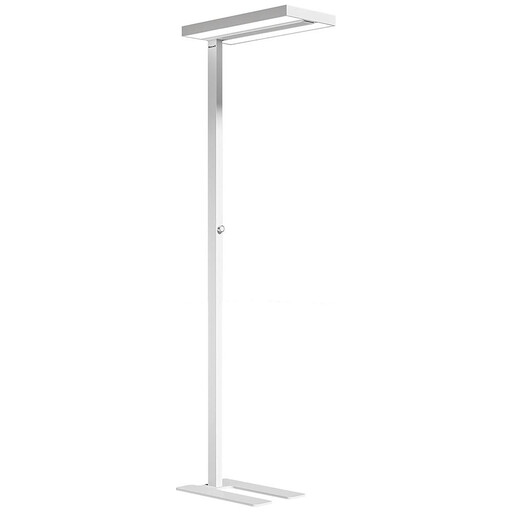
Why this product suits the profile: This floor lamp is designed for areas where several people or a large space need to be illuminated at the same time.
The broad beam reduces reliance on a small pool of light. Important: the product data specifies 110 volts; before buying, you must clarify whether it is suitable for the German 230-volt mains.
Luminous flux of 10,400 lumens according to the product information, dimming from 10 to 100 per cent, 4000 K and CRI 97.
We have put together a complete, regularly updated list of products that fully meet these strict selection criteria and the safety regulations applicable in the EU.
Place the lamp to the side of your preferred writing hand so that your hand casts as little shadow as possible on the paper. Right-handed people often place the lamp on the left, while left-handed people often place it on the right. When using a screen, the lamp head should not point directly at the display. A matt desk surface and indirect ambient light can also help to reduce harsh contrasts.
Make sure the base is stable, there is sufficient distance from liquids and the cable is routed without creating a trip hazard. For children or pets, tip-resistant designs and low heat generation are important selection criteria.
Consumption depends on the wattage and how long the lamp is used. A 9-watt lamp used for four hours a day consumes 0.036 kWh per day in theory. To calculate your individual costs, multiply this figure by your electricity price. Depending on the model, dimming levels can reduce actual consumption.
Neutral white light in the mid-range Kelvin spectrum is often chosen for reading and tasks requiring concentration. Warm white light can be suitable for more relaxed evening lighting, while cooler settings may be preferred for certain work tasks. A dimmable desk lamp with several colour temperatures leaves the choice open.
The lifespan is usually given in hours in the product data. It depends on the LED module, heat dissipation, power adapter and daily use. With permanently integrated LEDs, it is also important to check whether the manufacturer provides replacement or servicing information. A stated lifespan should therefore be understood as the manufacturer’s specification, not as a guaranteed operating life under all conditions.