
Lieferung heute & morgen

Qualitätsgarantie

Willkommens-Angebote freischalten: KOSTENLOSE Lieferung | Bis zu 80 % RABATT | Kostenlose 30-Tage-JoyPlus-Testphase
App herunterladen
An LED desk lamp with eye protection should illuminate your workspace evenly, without distracting reflections or visible flicker. In practice, however, many shoppers focus primarily on design, maximum lumen values or terms like "daylight." This can mean important details get overlooked: a light panel that is too small creates harsh shadows, an unsuitable colour temperature feels wrong for the task at hand, and a power supply that hasn't been tested can cause problems in the UK.
This buying guide highlights which specifications matter before you purchase, and which models suit different usage scenarios.
A very bright lamp can feel unpleasant on a small desk if the light shines directly into your eyes or reflects off white surfaces. What really matters is not just the luminous flux in lumens, but also the light distribution, the size of the light panel and the ability to dim.
A dimmable LED desk lamp can be adjusted to suit the time of day, the room's ambient brightness and the task at hand. Concentrated work usually requires a different setting than relaxed evening reading.
Colour temperature is measured in Kelvin. Warm white light around 2700 to 3000 Kelvin is often perceived as cosy. 4000 Kelvin feels neutral and works well for many workplaces. Cool white light up to around 6500 Kelvin can be useful for detail-oriented tasks, but may feel too clinical in a bedroom.
An LED lamp with adjustable colour temperature therefore offers more flexibility than a model with only a single fixed setting.
Before buying, you should check whether the product is suitable for the UK mains supply. The UK typically uses 230 volts at 50 hertz. Imported lamps may require different voltage ratings, plugs or adapters.
Also, a USB port isn't automatically a high-power USB charging port. Information about USB-A or USB-C, output power and whether a power supply is included will give you better guidance.
A matte or diffusing cover can reduce harsh points of light. With a glare-free lamp, you should also consider the position of the light source. The lamp head should be adjustable so that the LEDs are not directly in your line of sight.
"Flicker-free" shouldn't just be taken as a marketing word. More reliable are concrete details about the LED technology, the power supply and, where applicable, any certification. A blanket statement about health effects cannot be inferred from this.
A good desk lamp should offer at least several brightness levels or stepless adjustment. Touch controls, a memory function and automatic adjustment to ambient light are practical features.
For a desk lamp for reading and studying, three colour temperatures can be sufficient. If you carry out a variety of tasks, you'll benefit from a wider range, for example from warm white to daylight-like.
The CRI value describes how naturally colours appear under the light. A CRI of 90 or higher is interesting for creative tasks, drawing, photography and material selection. However, a lamp with a high CRI is not automatically brighter or more energy-efficient.
For running costs, the key factors are wattage, daily usage time and your electricity tariff. An energy-saving LED lamp typically uses less power than a comparable incandescent bulb. Manufacturer claims about lifespan, such as 30,000 or 50,000 hours, should be understood as technical guidelines.
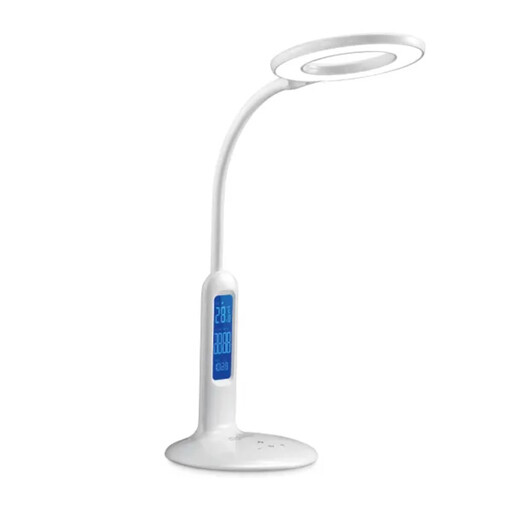
Why this product fits the profile: This compact desk lamp combines basic task lighting with display and timer functions. It is suitable for school pupils, students and small desks.
Brightness is steplessly adjustable via touch control, while the colour temperature ranges from 2700 to 6500 Kelvin. This means the lamp is not limited to a single light colour.
7 watts, 360 lumens, adjustable arm plus calendar, clock and timer display according to product specifications.
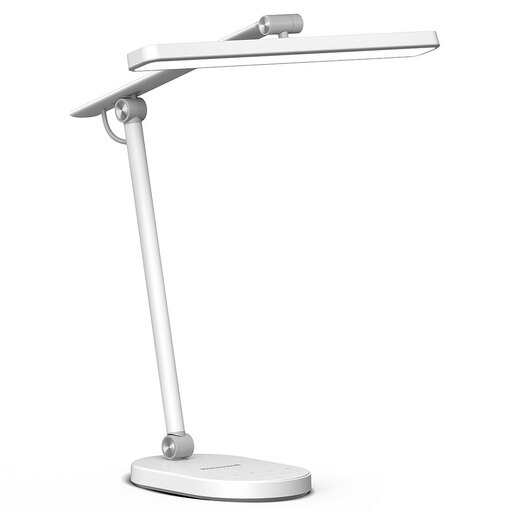
Why this product fits the profile: This model is aimed at people who need different lighting moods at their workspace and value automatic adjustment as well as flexible positioning.
The built-in ambient light sensor can adjust the brightness to the room lighting. In addition, three colour temperatures and five brightness levels are available.
700 lumens, 14 watts, CRI 97 according to product specifications, RG0 rating, 60-minute timer and memory function.
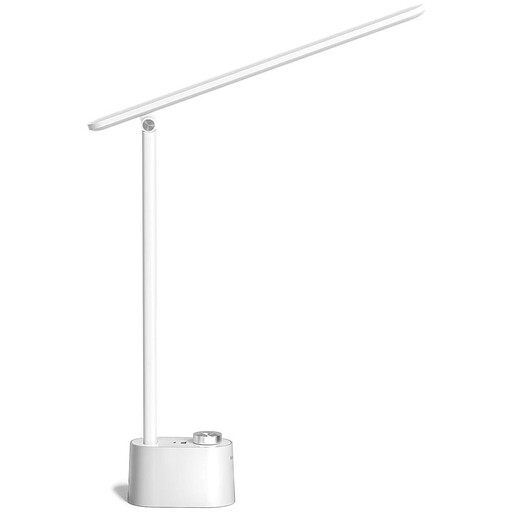
Why this product fits the profile: The foldable design is suitable for small work surfaces, mobile workstations and bedside tables. Two charging ports can help reduce the number of additional power supplies.
The lamp head can be angled and the brightness adjusted from 15 to 100 per cent. Three colour temperatures help you adapt to different tasks.
500 lumens, 10 watts, 3000/4000/5500 Kelvin plus USB-A and USB-C ports according to product specifications.
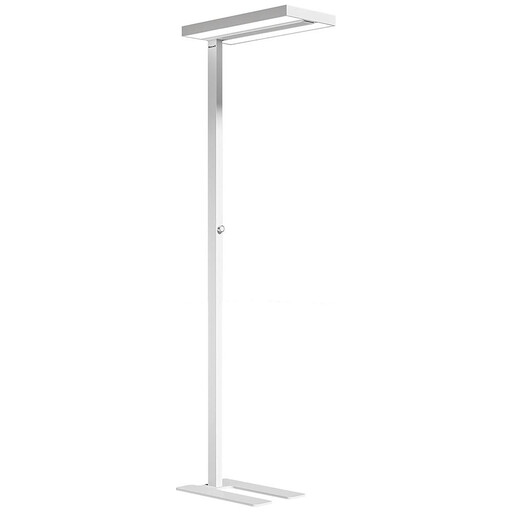
Why this product fits the profile: This floor lamp is designed for large-area illumination and can provide light for several workstations in a living area, office or studio.
The large light panel, which emits light upwards and downwards, distributes the light over a wider area. The U-shaped base is designed for stable placement. Before purchasing, the stated mains voltage of 110 volts must be checked for planned use in the UK.
10,400 lumens total luminous flux, 4000 Kelvin, CRI 97, dimming from 10 to 100 per cent and 100 watts according to product specifications.
We have compiled a complete, regularly updated list of products that fully meet these strict selection criteria and the safety regulations in force in the EU.
A sunset lamp can be interesting for decorative evening lighting, but it does not replace a dedicated task light. Similarly, a modern LED floor lamp is better suited to room lighting than to precise tasks at a desk.
For many workplaces, a neutral setting around 4000 Kelvin is a practical starting point. For reading in the evening, warm white light can feel more pleasant. Your personal perception, room colour and screen brightness should all be taken into account when adjusting.
The lifespan depends on the LED module, heat dissipation, power supply and operating conditions. Manufacturers often quote values between 30,000 and 50,000 hours. This figure describes a technical guideline and does not necessarily mean the lamp will fail immediately after that point.
You can estimate the cost using this formula: wattage ÷ 1000 × hours of use × electricity rate. A 10-watt lamp running for five hours a day uses 0.05 kilowatt-hours per day. For an accurate calculation, your current tariff and the actual brightness level used are the key factors.