
Lieferung heute & morgen

Qualitätsgarantie

Willkommens-Angebote freischalten: KOSTENLOSE Lieferung | Bis zu 80 % RABATT | Kostenlose 30-Tage-JoyPlus-Testphase
App herunterladen
An outdoor LED floodlight can light up a courtyard, make your front entrance safer or provide reliable light during renovation work. In practice, however, poor buying decisions are often caused not by the LED technology itself, but by unsuitable power ratings, an insufficient IP rating or an unsuitable mounting position.
A higher wattage does not automatically mean greater usable brightness. The key factors are lumen output, beam angle and light distribution. An LED floodlight with a wide 120° beam illuminates a larger area, while a narrower LED spotlight focuses the light more tightly.
For work areas, garages or building sites, the stated light output should be suited to the area. A compact LED spotlight may be enough for a small entrance; for a workshop or building-site lighting, an LED work light with a tripod and wider coverage may be more suitable.
The rating IP65 means protection against dust and water jets. An IP66 floodlight also offers protection against powerful water jets. However, this does not mean the light can be used under water for extended periods. The cable entry, plug connection and mounting position also affect safety outdoors.
An IP65 outdoor light is suitable, for example, for walls, paths and covered areas. For freestanding work lights exposed to changing weather, IP66 may be a more suitable choice.
An LED spotlight with a motion sensor is useful for a courtyard, garage or front entrance. Before buying, check the detection range, timer and adjustment options. It is also worth noting that some models are supplied without a plug and with a short connection cable, and are intended for permanent connection. Mains electrical work should be carried out by a qualified electrician.
Look at lumens, not just watts. A wide beam angle spreads light more evenly, while adjustable lights can be directed at specific areas. Cool white light between around 6000 and 6500 K is often chosen for workshop lighting and repair work. It gives a clear, high-contrast effect. Warm white light between around 2800 and 3500 K is better suited to patios, gardens and decorative outdoor LED lighting.
An RGB LED floodlight is mainly suited to decorative use. For precision work or areas where safety is important, white light and a clearly stated lumen output are usually more practical.
Mains-powered LED work lights provide consistent brightness, but need a socket or permanent connection. A folding stand makes transport and storage easier. An LED spotlight with a tripod also gives you adjustable working height and can illuminate several areas.
An outdoor solar light with a motion sensor works without a mains connection. Its actual running time depends on direct sunlight, the time of year, the position of the solar panel and battery capacity. It is useful for paths and entrances; for long periods of bright working light, a mains-powered model is usually more suitable.
Aluminium housings help dissipate heat. Covers made from toughened glass are a robust design choice for work and outdoor lights. Also check whether the light head or sensor can be turned far enough. Even a light with the right output can be impractical if it is rigid and difficult to position.
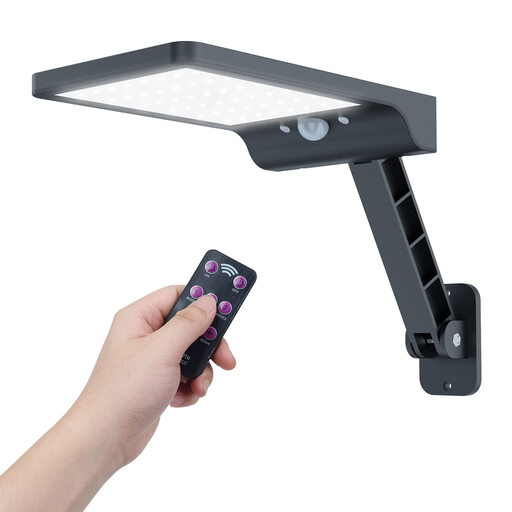
Why it suits this type of user: This solar-powered wall light does not need a mains connection and offers three operating modes and a remote control. It is suitable for paths, doorways, fences and smaller outdoor areas.
The product details specify IP65, a 120° sensor range and a charging time of 6–8 hours in direct sunlight. This makes it easier to assess whether it will suit your needs before buying.
2200-mAh battery, three modes and motion detection from 1–5 m away, according to the product description.
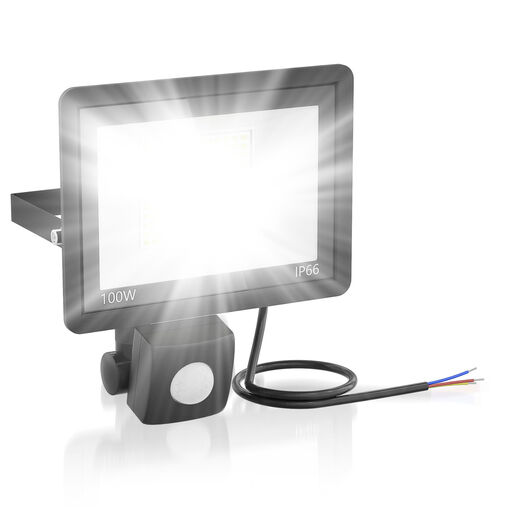
Why it suits this type of user: This outdoor LED floodlight is designed for garages, gardens, courtyards and driveways, combining 3500 lm output with an adjustable motion sensor.
According to the product description, the detection range can be adjusted from 2–8 m, the timer from 10 seconds to 6 minutes, and the LUX setting can also be adjusted.
IP66, 120° beam angle, aluminium housing and two selectable light colours: cool white or warm white.
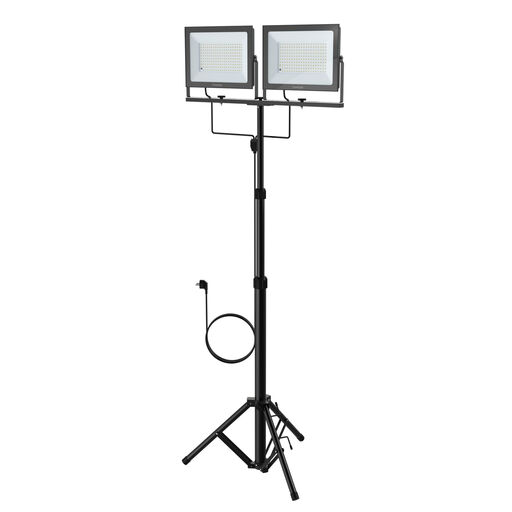
Why it suits this type of user: Two LED lights on a height-adjustable tripod are suitable for renovation work, workshops, garages and building sites where the lighting needs to be positioned flexibly.
According to the product details, the tripod height adjusts from 100 to 172 cm, and the light heads can be moved to direct the light.
IP66, 6500 K, 3-m cable with EU plug, and a remote control with timer and dimming functions, according to the product description.
Position an LED wall light so the sensor does not point directly at busy roads or moving branches. Solar panels should be placed where they receive as much unshaded sunlight as possible. Mains-powered lights with a plug need a socket suitable for outdoor use and a protected cable route.
Models without a plug that are connected directly to the mains, such as some LED floodlights for garages or façades, must be installed correctly by a qualified electrician. Clean the glass and housing with a soft cloth, and check the brackets, seals and cables from time to time.
We’ve put together a complete, regularly updated list of products that meet these strict selection criteria and fully comply with the safety regulations applicable in the EU.
Paths and small entrances often need a lower light output. Courtyards, garages and work areas need more lumens, depending on their size and how evenly you want them lit. Compare the beam angle and mounting height too, not just the wattage.
IP65 means complete protection against dust and protection against water jets. This makes the light suitable for many outdoor areas, but not for immersion in water. Connections must also be suitable for the environment in which they are used.
Many product listings state a lifespan of up to around 50,000 hours. Actual lifespan depends on factors including operating time, heat dissipation, mains quality, moisture and mechanical stress. For solar lights, the battery is also a separate wear part.