
Lieferung heute & morgen

Qualitätsgarantie

Willkommens-Angebote freischalten: KOSTENLOSE Lieferung | Bis zu 80 % RABATT | Kostenlose 30-Tage-JoyPlus-Testphase
App herunterladen
An LED ceiling light can illuminate a room evenly, take up very little space and reduce energy consumption compared with traditional light bulbs. However, a cheap offer won’t always be the right choice. Buyers often focus only on wattage, appearance or an apparent discount. More important factors include light output, colour temperature, IP rating, room size and installation requirements.
With LEDs, wattage mainly indicates energy consumption. Luminous flux, measured in lumens, is a better guide to brightness. An LED ceiling light with a lower wattage may be bright enough, while a larger fitting with poor light distribution can leave some areas in shadow.
So be sure to check:
An IP44 ceiling light is protected against solid objects larger than 1 mm and water splashes from different directions. This makes it suitable for many bathrooms, kitchens and other damp areas. However, it is not designed to withstand a direct jet of water or continuous damp, or to be installed inside a shower without proper planning.
Also check which bathroom zone the light will be installed in. If you’re unsure, have the electrical connection fitted by a qualified electrician.
Warm white and cool white light can significantly change the feel of a room. Warm white, at around 2700 to 3200 Kelvin, creates a softer ambience and is often used in bedrooms and living rooms. Cool white, at around 6000 to 6500 Kelvin, looks bright and clear, making it a popular choice for hallways, cellars, home offices and kitchens.
A dimmable LED ceiling light is only practical if its dimming function, remote control and colour temperatures suit the way you plan to use it. For lights with fixed wiring, you should also check that they are compatible with your existing wall switch and installation.
A flat LED ceiling light is a good choice for low ceilings, narrow hallways and rooms where a large fitting would get in the way. Round models often distribute light evenly. A round LED ceiling light with a diameter of around 28 to 30 centimetres may suit smaller rooms. For larger living areas, consider models measuring 40 to 60 centimetres across or rectangular LED panels.
As a general guide:
The CRI value indicates how naturally colours appear under a light. Many lights designed for living spaces have a CRI above 80 Ra, which may be sufficient for everyday use. However, this rating doesn’t replace checking how the light actually looks in your room.
Integrated LEDs require little maintenance, but if they fail, they often can’t be replaced like a traditional light bulb. Stated lifespans, such as around 30,000 or 50,000 hours, are manufacturer or product specifications and depend on operating conditions, heat dissipation and usage.
Before buying, check your existing ceiling connection, the fixing method and the required installation depth. With LED recessed spotlights, you’ll also need to check the cut-out diameter, installation depth and whether a transformer is required.
A 12 to 24-volt recessed spotlight must not be connected directly to 230 volts. Models designed for 220 to 240 volts generally don’t need a separate transformer. Always switch off the power before installation. If you’re unsure about wiring, earth connections or damp areas, seek professional help.
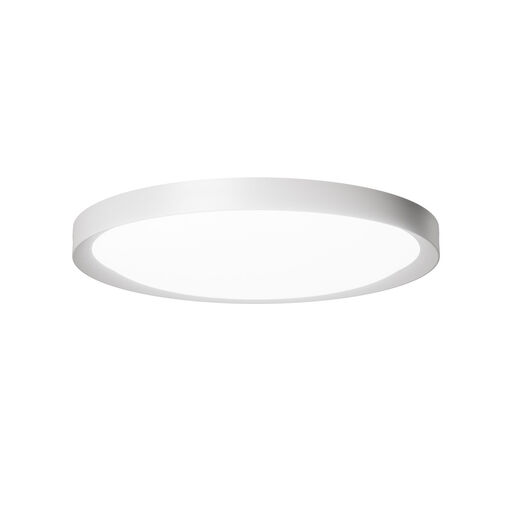
Why this product suits you: Its round, flat design and choice of wattages make it a straightforward option for anyone looking for general lighting in a bedroom, hallway, home office or cellar.
Choosing between 36, 48 or 72 W means you don’t have to base your decision on a single wattage. The product specifications state that the casing is rated IP44.
Round panel design, a choice of warm or cool white light, and a stated height of around 3 cm.
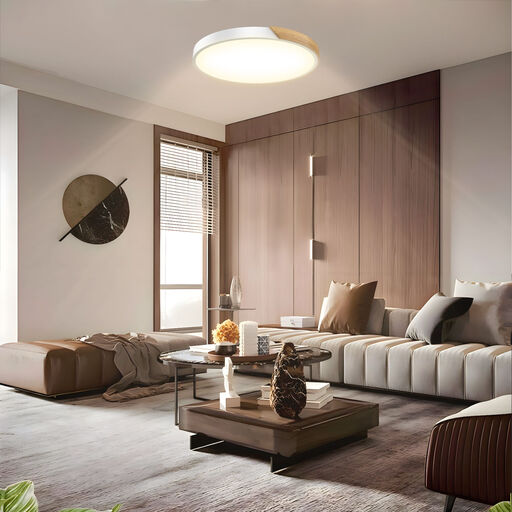
Why this product suits you: The combination of a metal frame, wood-effect finish and acrylic cover will appeal to buyers who want to consider the look of their living space as well as its lighting.
The specifications explicitly state that it is dimmable and offers several colour temperatures. That means you don’t have to choose between a decorative look and versatile lighting.
60 cm diameter, 120-degree beam angle and a stated output of 96 W. According to the product description, you can choose between warm and cool white light.

Why this product suits you: This set is a good option for renovations and larger areas where several slim recessed lights are needed in a suspended ceiling.
The product details list the installation depth, cut-out size and direct connection to 220 to 240 V. This makes it easier to check the installation requirements before you buy.
Pack of six lights, stated installation depth of 25.5 mm, 430 lumens per light and an IP44 rating.
We’ve put together a complete, regularly updated list of products that meet these strict selection criteria and the safety regulations in force in the EU.
A light with IP44 may be suitable for many areas of the bathroom, provided it is appropriate for the intended installation location. IP44 means protection against water splashes, not every direct jet of water. The light should be installed outside particularly high-risk areas. If you’re unsure, consult a qualified electrician.
That depends on the room size, how you use it, the ceiling height and any existing light sources. To make an informed choice, consider the stated light output in lumens, the beam angle and the floor area together. One very bright light isn’t always as comfortable as several evenly distributed light sources.
Depending on the model, manufacturers often state a lifespan of around 30,000 to 50,000 operating hours. These are product specifications, not a guarantee for every installation. Heat, frequent switching and operating time all affect the lifespan. Also bear in mind that with integrated LEDs, the light source usually can’t be replaced separately.