
Lieferung heute & morgen

Qualitätsgarantie
App herunterladen
Kategorien
Selecting an LED floor lamp requires an analysis of technical specifications and functional requirements. Modern LED technology offers advantages over traditional light sources in terms of energy efficiency, lifespan, and control options. This article analyses the key criteria for selection and presents specific models based on their technical features.
The decision for a specific model should be based on an objective evaluation of lighting parameters, control options, and material properties.
Operation is a key functional feature. Options range from simple mechanical switches to complex smart home integrations.
A modern floor lamp is often characterised by a minimalist design. Common materials include metals like aluminium or steel, which ensure durability and a stable base. A weighted base is an essential safety feature to prevent the lamp from tipping over. The height and orientation of the light source determine the light distribution in the room—uplighters produce indirect, diffused light, while downward-facing lamps provide direct illumination.
The following models have been selected based on their specific technical features and areas of application.
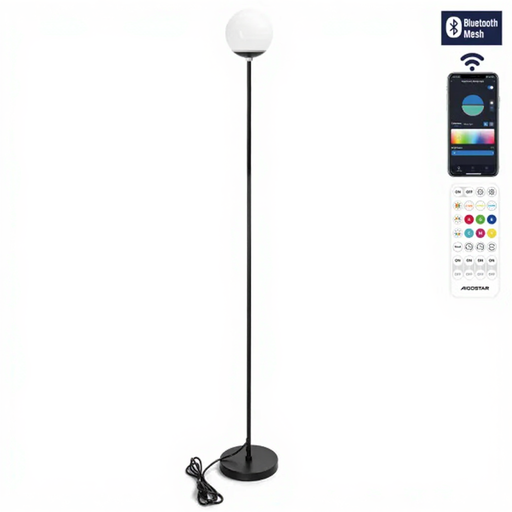
Product Feature Analysis: The Aigostar FL08 is distinguished by its dual-light design, which emits light both upwards and downwards. This construction allows for multi-layered and atmospheric room lighting. It is controlled via Bluetooth Mesh, enabling the networking of over 200 compatible devices. The lamp offers a wide spectrum of light settings, including RGB colours and an adjustable white light temperature from 2700 K to 6500 K. With a power consumption of 8 watts, it produces a luminous flux of 800 lumens, equivalent to the brightness of a traditional 60-watt incandescent bulb.
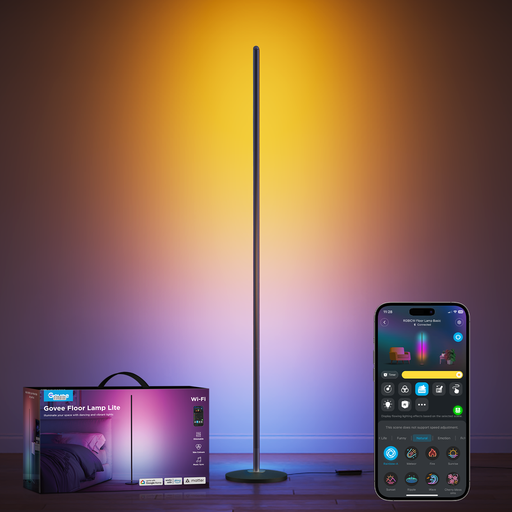
Product Feature Analysis: This model from Govee is a smart floor lamp with comprehensive connectivity via Wi-Fi and Bluetooth. It is compatible with Alexa and Google Assistant, allowing for voice control. Its standout feature is the RGBIC technology, which allows multiple colours to be displayed simultaneously on different segments of the light strip. With a luminous flux of 1,000 lumens at 24 watts of power consumption, it offers high brightness. Additional features like the music sync mode and 58 preset scene modes make it a versatile light source for entertainment areas.
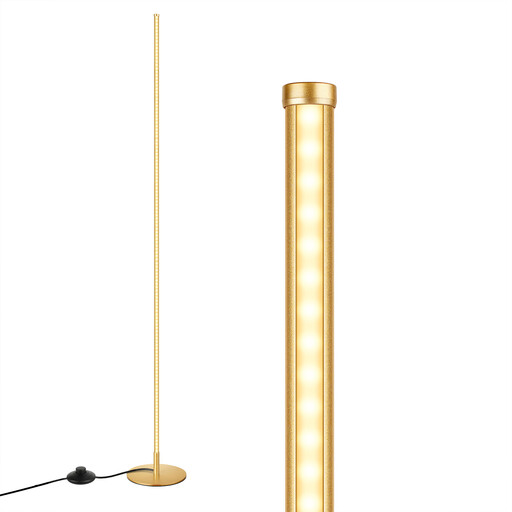
Product Feature Analysis: The Dewenwils Edishine focuses on core functions with simple and robust operation. This dimmable floor lamp is controlled via a foot switch, which allows for stepless brightness adjustment with a long press. The integrated memory function saves the last setting. The lamp produces a warm white light with a fixed colour temperature of 3000 K, creating a cosy atmosphere. The design is minimalist, and its height is adjustable thanks to the segmented pole.
The market for LED floor lamps offers a wide variety of designs, materials, and functional scopes. For a broader overview of models covering different aesthetic and technical requirements, you can consult our main category for Standard Lighting.
1. What does 'steplessly dimmable' mean for an LED floor lamp? A steplessly dimmable floor lamp allows for a smooth adjustment of brightness, typically via a long press of a switch or a slider in an app. In contrast, step-dimmable lamps offer only a few predefined brightness levels.
2. How many lumens should an LED floor lamp for the living room have? For general ambient lighting in an average-sized living room, a luminous flux of 800 to 1500 lumens is often a good guideline. If the lamp is intended primarily as a reading light or for accent lighting, models with 400 to 800 lumens can also be sufficient, provided the light is focused.