
Lieferung heute & morgen

Qualitätsgarantie

Willkommens-Angebote freischalten: KOSTENLOSE Lieferung | Bis zu 80 % RABATT | Kostenlose 30-Tage-JoyPlus-Testphase
App herunterladen
An LED floor lamp can be used as task lighting, a reading lamp or a decorative light source. However, before you buy, it’s worth taking a close look at the technical specifications. High lumen values, lots of colours or app control alone don’t tell you whether the lamp is actually suitable for your living room, home office or open-plan workspace.
As a Joybuy Product Recommendation Officer, I filter the most important details and categorise them by typical usage scenarios. This way, you can avoid common buying mistakes.
A high lumen figure may seem impressive at first. However, it only describes the total light output, not necessarily the brightness at a specific workstation. An office floor lamp needs even illumination across the work surface. A living room floor lamp, on the other hand, can often be less focused and more indirect.
So pay attention to whether the light is emitted directly, indirectly or as a combination. The beam angle and the position of the lamp also affect the actual lighting.
Some models only offer two or three brightness levels. Other lamps can be adjusted steplessly via a touch panel, remote control or app. If you want a dimmable floor lamp for reading, working and relaxing, you should check the specific control method.
A smart floor lamp with Wi-Fi, Bluetooth or voice control often requires a compatible app and a suitable network. With an RGB floor lamp, it’s also worth noting that coloured light isn’t automatically suitable for focused work. Check whether neutral white or warm white light is also available, and whether the lamp can still be operated without a smartphone.
Luminous flux is given in lumens (lm). For a decorative corner, lower values are often sufficient, whereas an office floor lamp or large-area indirect lighting needs significantly more light.
The colour temperature in Kelvin (K) helps you categorise the light:
The CRI or Ra value describes how naturally colours appear under the light. A value of 80 is common for many everyday lamps. For creative activities such as sewing, painting or crafting, a more realistic colour rendering may be more important.
For office workstations, the glare rating is relevant. A value of UGR < 19 is often used for screen-based workstations. It describes the standardised assessment of direct glare under specific conditions and is not a blanket quality judgement for every room.
A combination of direct and indirect lighting distributes light across the work surface and the ceiling. This can be practical for a floor lamp with a sensor in single or open-plan offices. In the living room, upward-facing light components create a softer, indirect lighting effect.
Before buying, you should check the height, footprint and cable length against your intended location. An adjustable floor lamp is flexible, but needs sturdy joints or a robust telescopic construction. For slim models, the base area is also crucial, especially on carpets or in walkways.
It’s also worth checking:
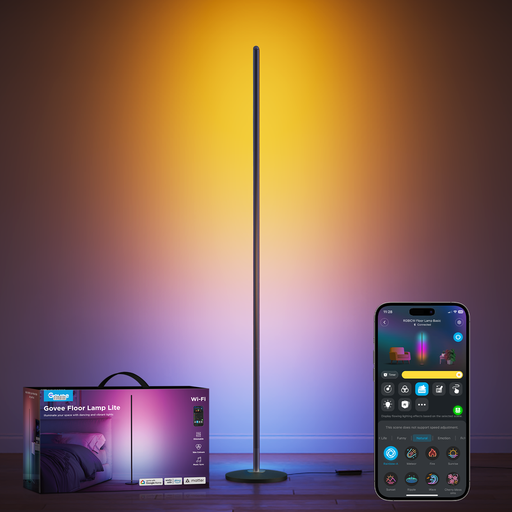
Why this product fits the profile: This lamp combines dimmable light with app, Wi-Fi, Bluetooth and voice control. With 1,000 lm, 24 W and a height of 136 cm, it’s suitable for living rooms, bedrooms and gaming spaces.
The specifications state luminous flux, power consumption and specific control methods. This makes it easier to assess whether the RGB features actually match your needs.
16 million colours, 58 scene modes and support for Alexa and Google Assistant.
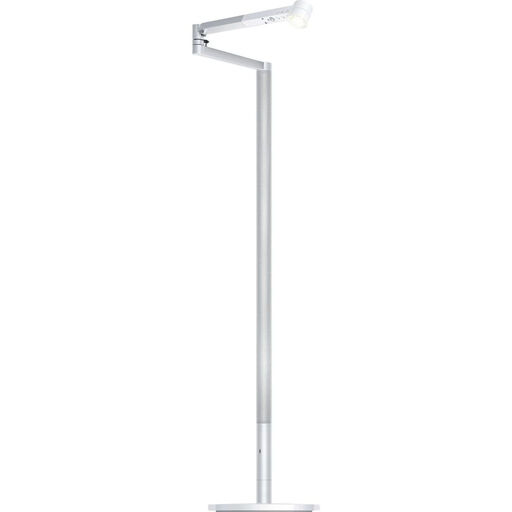
Why this product fits the profile: This lamp offers four lighting modes, colour temperature control and app connectivity. The stated range spans from 2,700 to 6,500 K depending on the operating mode.
The technical specifications distinguish between operation with and without a cable, and also state power consumption, standby usage and dimensions.
850 lm, 11.2 W power consumption, USB-C charging port and motion sensor.
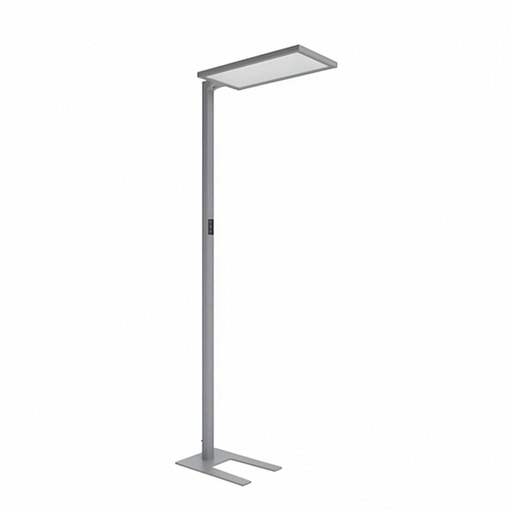
Why this product fits the profile: With up to 12,600 lm, 4,000 K and separately controllable direct and indirect light, this model is designed for single and open-plan offices.
The lamp states specific values for luminous flux, light distribution, UGR and cable length. This makes planning for a single or dual workstation much easier.
Up to 144 lm/W, UGR < 19, daylight and presence sensor, plus touch panel.
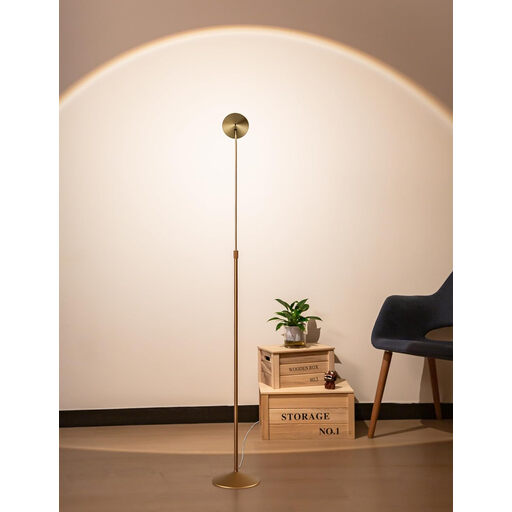
Why this product fits the profile: This height-adjustable floor lamp can be adapted to different positions for reading, sewing, crafting or working.
Instead of an inflexible light source, the lamp head offers 150-degree adjustment and three touch dimming levels.
Telescopic height adjustment, 150-degree lamp head and integrated LED.
Electricity costs depend on the power consumption in watts, the daily usage time and your electricity tariff. The simple calculation is:
Watts ÷ 1,000 × hours of operation × electricity price per kilowatt-hour = electricity costs
A lamp with 20 W that runs for four hours a day uses 0.08 kWh per day in theory. Sensors and automatic switch-off can reduce actual consumption, but that doesn’t replace checking the standby power.
We’ve put together a complete, regularly updated list of products that fully meet these strict selection criteria and the safety regulations in force in the EU.
That depends on the room size, ceiling lighting and intended use. For a reading corner, a lamp that can be directed precisely is a good idea. For general room lighting, the light distribution should be as broad or indirect as possible. So don’t just compare the lumen value, but also the beam angle and lamp position.
Neutral white around 4,000 K is often used for work areas. What’s also crucial is even illumination, suitable light distribution and as little direct glare as possible. A flexible lamp with adjustable colour temperature can cover different times of day and activities.
The manufacturer usually states the lifespan in hours of operation. Values such as L80/B10 describe the conditions under which a certain proportion of lamps still achieve a defined luminous flux. The actual service life depends on factors including operating time, heat dissipation and ambient temperature. Also check whether the LED module is replaceable or whether the entire lamp needs to be replaced.