
Lieferung heute & morgen

Qualitätsgarantie

Willkommens-Angebote freischalten: KOSTENLOSE Lieferung | Bis zu 80 % RABATT | Kostenlose 30-Tage-JoyPlus-Testphase
App herunterladen
An LED floor lamp can provide additional lighting in the living room, reading light in the bedroom or task lighting in a home office. The choice ranges from a simple LED floor-standing lamp and an arc lamp to a smart floor lamp with app control. However, differences in luminous flux, colour temperature, dimming technology and IP rating determine whether a model is suitable for its intended use.
When buying, three common marketing pitfalls in particular can lead to the wrong decision:
Luminous flux is specified in lumens (lm). A compact floor lamp for a bedroom or living room often needs less light than a task lamp for an office. For decorative ambient lighting, 340 to 1,000 lm may be sufficient. An office floor lamp with direct and indirect light distribution, on the other hand, reaches significantly higher levels.
The beam angle and direction are also important. An arc lamp often illuminates a seating area from above. A height-adjustable lamp with a swivelling head can direct the beam precisely onto a desk, book or work surface.
Colour temperature is specified in Kelvin (K):
A lamp with CCT functionality allows you to adjust the light between warm-white and cooler ranges. This is more practical than a lamp with just one fixed colour temperature. With an RGB lamp, you should also check whether neutral-white or warm-white light is available.
A dimmable floor lamp can be adjusted to suit different activities. A touch dimmer may be integrated into the lamp head or housing. Alternatively, a floor lamp with a remote control lets you operate it from further away, while a smart floor lamp can be controlled via an app, Bluetooth, Wi-Fi or voice assistant.
A motion sensor is useful in hallways, entrance areas or offices. For a living-room floor lamp, however, it may be unnecessary if you want to switch the lamp on and off manually. Also check whether the dimmer operates in steps or continuously, and whether a memory function is included.
The following selection matches specific models to different requirements. Technical details are based on the product data provided.
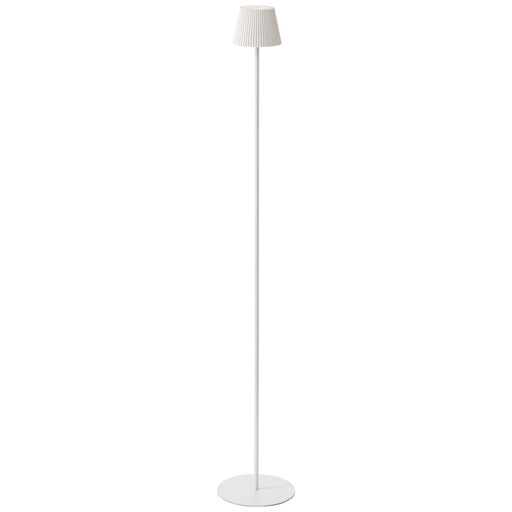
Why this product suits this profile: This cordless LED floor lamp can be recharged via USB and used flexibly indoors, on a balcony or on a patio. A three-stage touch dimmer is integrated.
The product data specifies both the luminous flux of 340 lm and the colour temperature of 3,000 K. The IP54 rating indicates protection against dust and splashing water.
Battery operation, 3.4 W LED output, three-stage touch control and 3,000 K warm-white light.
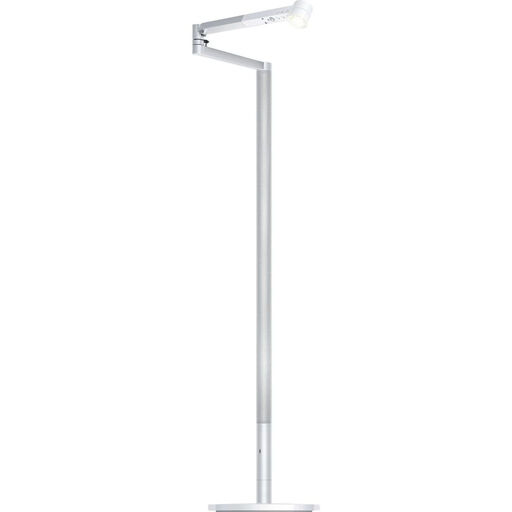
Why this product suits this profile: This model combines several lighting modes, app control and a motion sensor. According to the manufacturer, it offers four lighting modes and a USB-C port.
The functions are described in specific terms: 850 lm, 2,700–6,500 K, cordless operation, dimming and automatic shut-off after more than two minutes of absence, according to the product details.
Four selectable modes, app connectivity, motion sensor, 11.2 W power consumption and an integrated USB-C port.
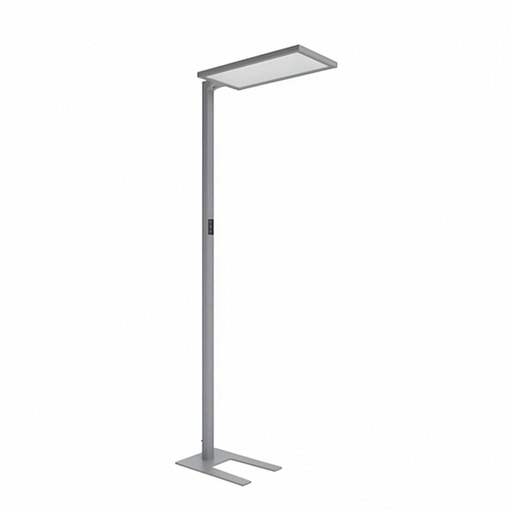
Why this product suits this profile: For offices and larger work areas, this LED floor-standing lamp provides direct and indirect lighting, a daylight and presence sensor, and touch controls.
Its suitability for workspaces is defined by specific figures: 4,000 K, UGR < 19, CRI 80, plus separate light components of up to 3,600 lm direct and 9,000 lm indirect.
Up to 12,600 lm, sensor control, 2,500 mm cable length and a stated L80/B10 lifespan of 75,000 hours according to the product data.
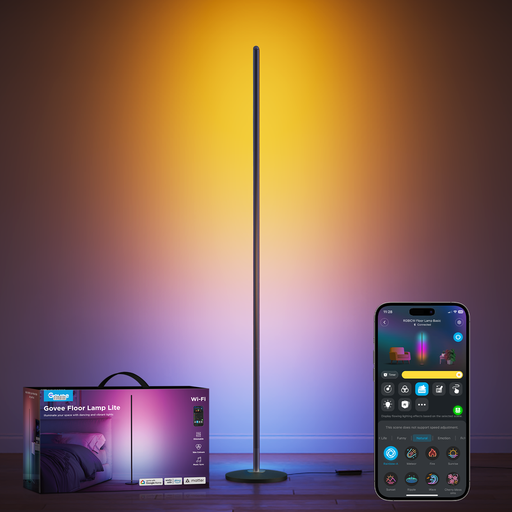
Why this product suits this profile: This RGBIC lamp is designed for scenes, music modes and app control. According to the product data, it supports Wi-Fi, Bluetooth, Alexa and Google Assistant.
The lamp is explicitly intended for indoor use and has an IP20 rating. This makes it clear that it is not designed for balconies, gardens or damp rooms.
1,000 lm, 24 W, 58 scene modes, 16 million stated colours, plus dimming and music synchronisation.
We have put together a complete, regularly updated list of products that fully meet these strict selection criteria and the safety regulations applicable in the EU.
Before installation, check the lamp’s base, cable length and position. A floor lamp must stand securely and must not obstruct escape routes. With integrated LEDs, the light source is often not replaceable by the user. It is therefore worth checking the warranty conditions, availability of spare parts and stated lifespan.
For outdoor areas, bear in mind that IP54 protects against dust and splashing water, but does not automatically replace a permanently protected outdoor connection. Models with IP20 belong exclusively in dry indoor spaces. Electrical work on the connection must only be carried out in accordance with the manufacturer’s instructions and by qualified persons.
That depends on how it will be used. A few hundred lumens may be enough for a decorative floor lamp in the living room. A reading lamp needs more targeted positioning. For office areas, significantly higher levels are advisable, particularly when direct and indirect lighting are combined.
The cost depends on power consumption, daily usage time and the electricity price. A lamp with 3.4 W uses less energy over the same operating period than a model with 24 W or 14 W. For an accurate estimate, you can use the formula Watts × operating hours ÷ 1,000 × electricity price per kWh.
RGB colours are mainly suited to ambience, gaming and decorative scenes. For reading, choose a model that also provides clear white or warm-white light with sufficient brightness and suitable positioning. Pay attention to lumens, colour temperature and dimmability rather than focusing solely on the number of colour effects.