
Lieferung heute & morgen

Qualitätsgarantie

Willkommens-Angebote freischalten: KOSTENLOSE Lieferung | Bis zu 80 % RABATT | Kostenlose 30-Tage-JoyPlus-Testphase
App herunterladen
LED garden lighting can mark pathways, highlight seating areas or create a decorative atmosphere. However, to ensure that lights remain suitable for their location over time, buyers should look beyond light colour and design. The power supply, IP rating and actual lighting duration often have a greater impact on everyday usability than advertising claims.
An IP44 outdoor light is protected against solid foreign objects above a certain size and against splashing water. However, it is not designed to be immersed in water. For permanently exposed areas, locations close to the ground or places where puddles may form, an IP67 recessed ground light may be more suitable. The IP rating should always match the specific installation location.
With solar garden lights, operating time depends on sunlight, the time of year, shade, battery capacity and temperature. A stated operating duration should therefore be understood as a product specification under certain conditions. In winter or on cloudy days, the usable lighting duration may be shorter.
Battery-powered models also require regular checks. Before buying, check whether batteries are included, which battery size is required and whether an automatic switch-off function is available.
An outdoor LED string light with many light points can have a decorative effect, but it does not necessarily replace lighting intended to help with orientation. For paths, steps and entrances, the beam angle, installation height and light distribution are crucial. An LED garden light in warm white at around 2700 to 3000 Kelvin usually creates a more understated effect. An LED garden light in cool white at around 5000 to 6500 Kelvin looks more functional and can emphasise contours more strongly.
The IP code consists of two digits. The first describes protection against solid foreign objects, while the second indicates protection against water. IP44 is generally suitable for splashing water, for example on a covered patio. IP67 indicates a higher level of protection against temporary immersion, provided the manufacturer's specifications and installation instructions are followed.
An IP rating does not replace correct installation. Cable connections, chargers and solar panels may have their own limitations.
Warm white LEDs are often well suited to decorative garden lighting for seating areas, flower beds and balconies. Cool white can be useful for paths, driveways or clearly defined contours. Smart models with Bluetooth smart garden lighting offer additional settings such as colour changes, schedules, dimming or grouping. Check the required app, Bluetooth range and compatibility with your smartphone in advance.
With a cordless LED lamp, stability, the handle, charge level and controls are also important. Touch controls or memory functions can make operation easier, but are only useful if the light remains easily accessible in its intended location.
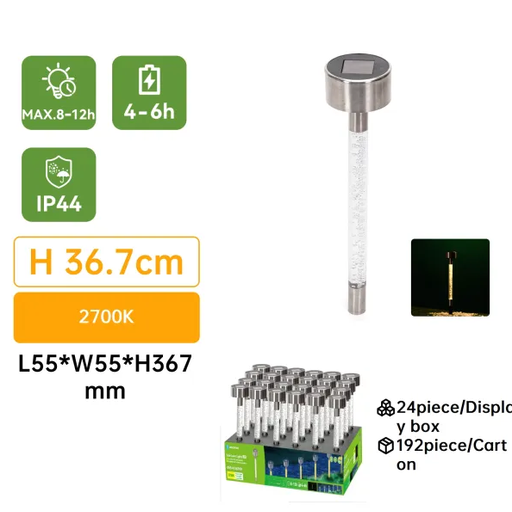
Why this product suits this profile: This solar light can be pushed into soft ground and does not require a direct power connection. With 2700 Kelvin light, it is ideal for decorative accents in flower beds, on lawns or along paths.
The specifications state IP44, a charging time of around 4 to 6 hours and a lighting duration of around 8 to 12 hours under suitable conditions. This makes it easier to assess how it will perform in real-world use.
2700-Kelvin light, integrated NiMH battery, automatic activation in darkness and compact ground installation.
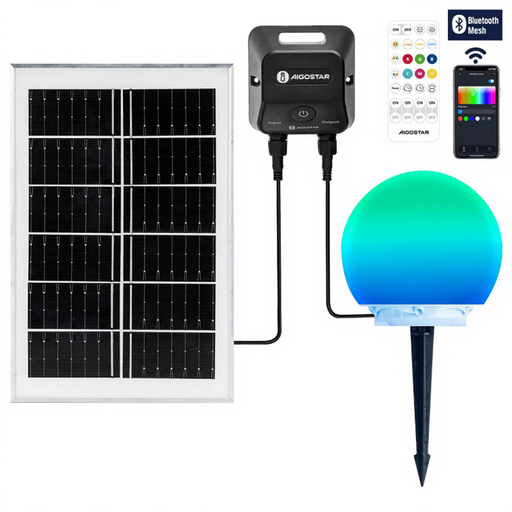
Why this product suits this profile: This solar recessed ground light combines RGB colours with adjustable white light from 2700 to 6500 Kelvin. Bluetooth Mesh allows several lights to be controlled through the compatible app.
The IP67 rating is more relevant for installation close to the ground than an IP44 rating alone. The separate solar panel also allows it to be positioned towards a sunnier location.
20 W, 4000-mAh lithium battery, RGB+CCT control and a stated lighting duration of up to 24 hours.

Why this product suits this profile: This cordless light is designed for dining tables, balconies, camping and indoor spaces. Four brightness levels and a rechargeable 4000-mAh battery provide flexible use.
The brightness can be adjusted, so the maximum operating time is not required for every use. IP44 also clearly indicates protection against splashing water, not suitability for immersion.
Up to 80 hours of operating time according to the product specification at the lowest brightness setting, USB charging, touch controls and 360-degree light distribution.

Why this product suits this profile: This battery-powered string light with 180 LEDs and a total length of around 14.7 metres is suitable for balconies, gardens, parties and outdoor Christmas decorations.
The total length, LED spacing of 8 cm, battery type and IP44 rating are clearly stated. Batteries are not included and need to be purchased separately.
180 cool white LEDs, eight functions with memory function, 14.7-metre length and battery-powered design without the need for a socket.
We have put together a complete, regularly updated list of products that fully meet these strict selection criteria and the safety regulations applicable in the EU.
Position solar lights so that the panel receives direct light for as long as possible. For ground lights, the surface should be stable and allow water to drain away. String lights must not rub against sharp edges; connections and battery compartments should remain protected in accordance with the manufacturer's instructions.
For entrances and paths, glare-free positioning is recommended. With decorative models such as fireworks or star lights, you should also check that the hanging fixture is securely attached. Battery-powered products should be switched off before longer periods of non-use and stored in a dry place where necessary.
Consumption depends on the power rating, operating time and energy source. Solar and rechargeable lights do not require a direct mains connection while in use. Battery-powered models incur ongoing costs when the batteries need replacing. A lower dimming level can extend the operating time.
IP44 is often specified for sheltered outdoor areas, provided the light is exposed only to splashing water. For installations close to the ground or in more exposed locations, a higher rating such as IP67 may be suitable. The installation and safety instructions for the individual product remain decisive.
Solar lights can also be used in winter, provided the panel receives enough daylight. Shorter days, cloudy weather, snow and shade reduce charging performance, however. For reliable lighting when there is little sunshine, rechargeable or mains-powered solutions are often easier to plan.