
Lieferung heute & morgen

Qualitätsgarantie

Willkommens-Angebote freischalten: KOSTENLOSE Lieferung | Bis zu 80 % RABATT | Kostenlose 30-Tage-JoyPlus-Testphase
App herunterladen
The right LED indoor lighting should reliably illuminate your rooms, complement your interior style and require as little day-to-day effort as possible. However, product descriptions do not always lead directly to the right buying decision. Terms such as “modern”, “bright” or “energy-efficient” alone reveal little about whether a light is suitable for the living room, hallway, bathroom or children’s room.
The wattage primarily describes power consumption, not actual brightness. For comparisons, the luminous flux in lumens is what matters. A 7 W LED can emit different amounts of light depending on its design and efficiency. If you only look at the wattage, you risk ending up with hallway lighting that is too dim or bedroom lighting that is unnecessarily bright.
Warm white LED light at around 2700 to 3000 Kelvin usually creates a pleasant atmosphere in living rooms and bedrooms. Neutral white light around 4000 Kelvin may be more suitable for kitchens, work areas or utility rooms. Cool white light at around 6000 to 6500 Kelvin is more functional and is often offered for orientation lighting.
A high Kelvin value does not automatically mean higher quality. It only describes the light colour. Brightness, colour rendering and the atmosphere you want to create are also important when choosing a light.
A light for the bathroom must not only look the part. The IP rating indicates how well it is protected against dust and water ingress. A model with IP20 is intended for dry indoor areas and should not be used in damp locations. For certain bathroom zones, lights with a higher rating such as IP44 or IP65 may be suitable. The specific installation must also comply with local regulations.
The type of installation is important too: an LED wall lamp or LED wall light requires suitable wall fixings and, where applicable, a mains connection. LED recessed spotlights, on the other hand, require suitable ceiling cut-outs and sufficient space for the connection and heat dissipation.
Start by checking the stated luminous flux in lumens. A lower amount of light may be sufficient for decorative LED wall lights, while a ceiling light should illuminate the entire room evenly. The CRI or Ra value describes how naturally colours appear under the light. A value of Ra 80 or higher is a common benchmark for many residential applications.
For flexible use, 3-way CCT can be useful. Depending on the model, you can switch between warm white, neutral white and cool white. This is particularly practical during renovations, when the room’s future use has not yet been finalised.
“Dimmable” does not mean that every light works with every dimmer. With dimmable LED recessed spotlights, you should check whether a compatible trailing-edge dimmer is required. The dimmer’s minimum load may also be relevant.
With integrated LED lights, it is also worth noting that the LED module is not always replaceable. Technical details covering service life, warranty and the availability of spare parts should therefore be checked before purchase.
A plug-in night light with a dusk sensor switches on as ambient light levels fall. A night light with a motion sensor also responds to movement and switches off again after a set period. In hallways and stairwells, this can eliminate the need to operate a manual switch.
When choosing sensor lights, check the range, detection angle, switch-off time and sensor position. A covered sensor may affect operation. For bathrooms or other damp areas, the stated IP rating is essential.
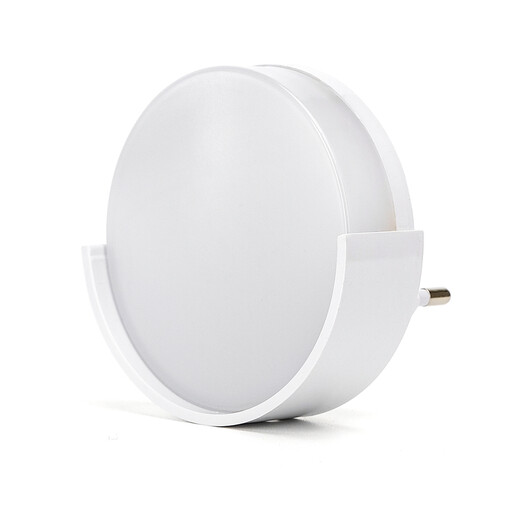
Why this product suits this profile: This compact plug-in night light works without batteries and switches on automatically when light levels fall below 20 lux. It is suitable for hallways, children’s rooms and stairwells.
The technical specifications state 1 W, 40 lm, 6500 K, IP20 and automatic switching. This makes it easier to assess where the light can be used before buying.
1 W power consumption, a stated service life of 25,000 hours and CE/RoHS marking.
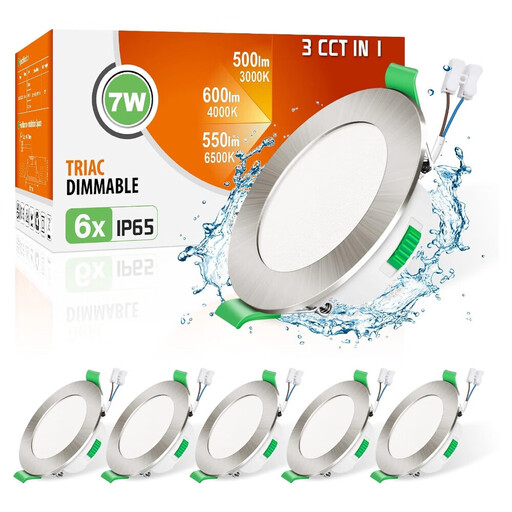
Why this product suits this profile: These recessed spotlights offer 3-way CCT, a stated dimming range of 10 to 100 per cent and IP65 protection. This makes them suitable for planned renovations in dry or moisture-prone indoor areas.
The required installation opening of 67 to 75 mm, installation depth of 29 mm and connection to 230 V must all be taken into account. Installation should be carried out by a qualified person.
7 W per spotlight, 500/550/600 lm according to the product details, 3000/4000/6500 K and IP65.
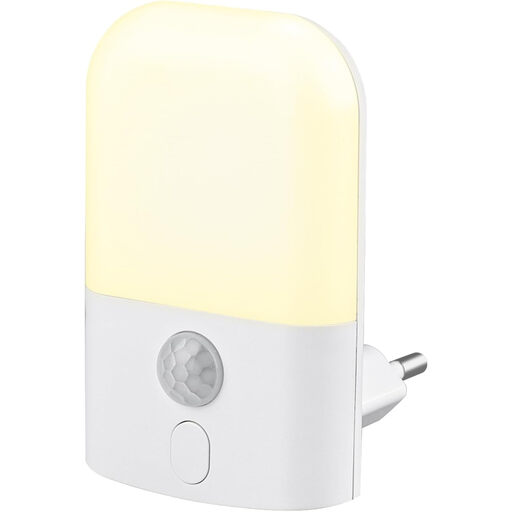
Why this product suits this profile: For families, hallways, steps and getting around at night, this model offers five brightness levels, warm white light at 2700 K and motion detection up to 3 m across 120 degrees.
The automatic switch-off after 60 seconds reduces continuous operation. At the same time, the brightness can be adjusted for a children’s room, bathroom or stairwell.
0.5 W power consumption, five brightness levels and sensor range of up to 3 m according to the product details.
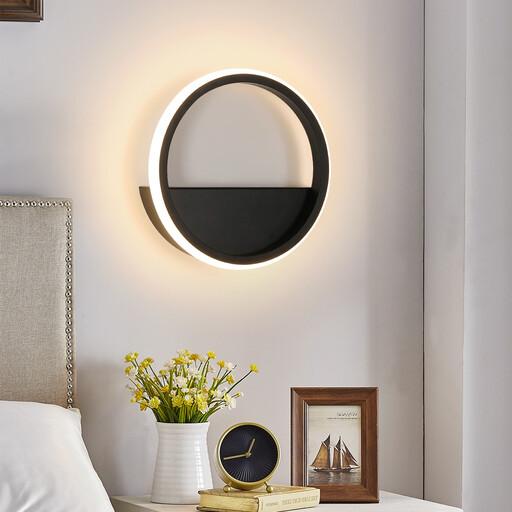
Why this product suits this profile: With its round aluminium design and 3000 K light, this fitting is suitable as primary or supplementary hallway lighting, bedroom lighting, and for living areas and stairwells.
The fixed colour temperature of 3000 K is clearly specified. This avoids having to choose between multiple modes, although you should check the existing mains connection before installation.
12 W power, round design with a diameter of 20 cm and aluminium housing according to the product details.
We have put together a complete, regularly updated list of products that fully meet these strict selection criteria and the safety regulations applicable in the EU.
Before installation, check the existing connection type, the ceiling cut-out and the installation depth. With 230 V lights, the work must be carried out with the power disconnected and in accordance with the applicable safety regulations. For 12 to 24 V recessed spotlights, a suitable transformer is required; this is not included with every product.
For bathroom lighting, only lights with an IP rating suitable for the installation location may be used. An IP20 night light does not belong in a damp area. With an LED ceiling light, you should also take the size of the room into account to prevent dark areas. Several lights, or a combination of ceiling and wall lighting, can provide more even illumination.
Consumption depends on the power rating and operating time. A 12 W light used for five hours a day consumes a calculated 0.06 kWh per day. Night lights rated at 0.5 to 1 W may be designed for longer operation, provided their technical specifications and heat dissipation are taken into account.
For a homely atmosphere, warm white LED light at 2700 to 3000 K is often chosen. Warm white light can also work well in hallways. For work areas or kitchens, some households prefer neutral white light around 4000 K. The key factors are how the space is used, its interior design and personal perception.
The manufacturer specifies service life in operating hours, and it depends on factors including heat generation, switching cycles and usage. With integrated LED lights, you should also check whether the module is replaceable and what warranty conditions apply. Technical specifications such as 25,000 hours should be understood as manufacturer information, not as a blanket guarantee for every installation situation.