
Lieferung heute & morgen

Qualitätsgarantie

Willkommens-Angebote freischalten: KOSTENLOSE Lieferung | Bis zu 80 % RABATT | Kostenlose 30-Tage-JoyPlus-Testphase
App herunterladen
LED lamps differ not only in shape and colour. What really matters are luminous flux, colour temperature, power supply, mounting type and suitability for the room in question. A decorative table lamp might look nice on a sideboard, but it won't replace a focused LED desk lamp. Similarly, a portable LED light isn't automatically suitable for the bathroom.
Wattage describes energy consumption, not directly the brightness. For comparison, the luminous flux in lumens (lm) is much more meaningful. A light with 160 lm, for example, is better suited to a confined area. For even room lighting, much higher values are needed depending on the size of the room.
3000 Kelvin produces warm white light, often used in living or sleeping areas. 4000 Kelvin appears more neutral and is suitable for a desk, kitchen or reading spot. 6500 Kelvin corresponds to a cooler white tone. A lamp with multiple colour temperatures offers more flexibility, but it isn't automatically equipped with every dimming function you might want.
With dimmable LED recessed spotlights, you also need to check whether your existing dimmer is compatible. A light may technically be dimmable, but with an unsuitable wall dimmer it could flicker or fail to reach the full brightness range.
A battery-powered table lamp is flexible, but it needs regular charging. With a USB LED lamp, you should pay attention to the connection and the cable supplied. Mains-powered lights, on the other hand, need a socket and are ideal for fixed positions.
For damp rooms, the IP rating is important. IP20 is intended for dry indoor spaces. IP44 offers protection against splashing water and, subject to the manufacturer's specifications, can be suitable for bathrooms or kitchen areas. Even with IP44 lights, direct water jets should be avoided.
Pay attention to the stated luminous flux in lumens and the beam angle. A wider beam angle distributes the light more broadly, while a focused light source can illuminate a workstation or a book precisely. For an LED reading lamp, an adjustable head is also practical.
The colour rendering index Ra or CRI describes how naturally colours appear under the light. A value of Ra 80 or above is a common benchmark for many domestic and work lights. For photography, video or content creation, higher values such as CRI 95+ may be of interest, provided this information is clearly stated in the product data.
A lamp with a touch switch can be turned on and off quickly. Depending on the model, you may also be able to select brightness levels or colour temperatures via a touch panel. Check whether the light has a memory function and whether the controls work reliably even when dimmed.
A LED clip lamp saves space and is ideal for shelves, bed frames or desk tops. Before buying, check the maximum clamp opening and the stability of the mounting surface.
Measure the intended space before you buy. For recessed spotlights, the ceiling cut-out, installation depth and connection type are particularly important. The flat model featured here requires a cut-out of 90 to 100 mm and has an installation depth of 34 mm, according to the product specifications.
For a LED floor lamp, consider the base area, cable length and the maximum wattage of the bulb used. With lights that have a replaceable E27 socket, check whether the bulb is included in the delivery.
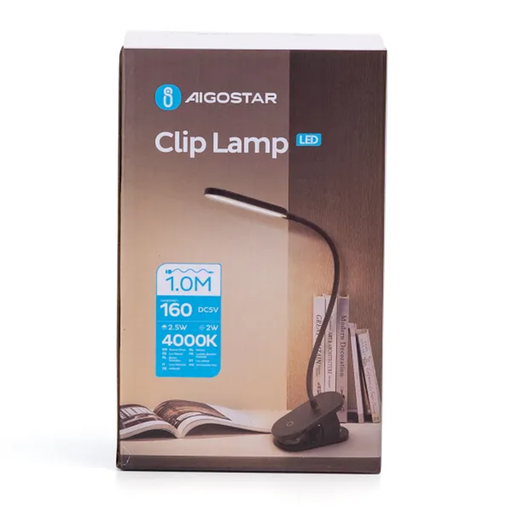
Why this product fits the profile: This compact LED clip lamp can be attached to a desk, shelf or bed and, thanks to its built-in battery, doesn't need to be permanently plugged into a socket.
The product data states 160 lm, 4000 K, three brightness levels and a battery capacity of 1200 mAh. This means the key buying criteria are transparently provided.
Adjustable silicone arm, USB charging, three operating levels and a stated runtime of 3 to 30 hours depending on the mode.
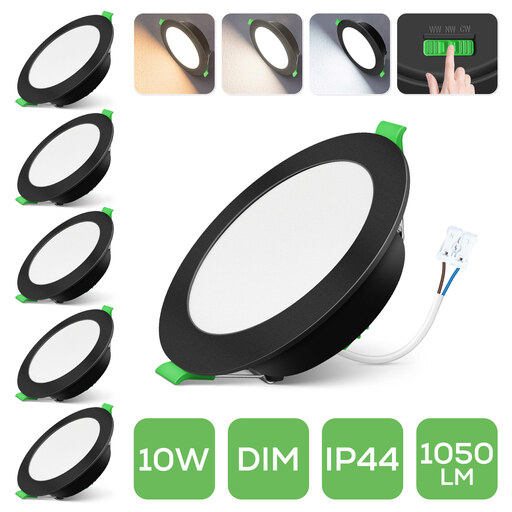
Why this product fits the profile: This flat recessed panel is designed for planned lighting in the kitchen, bathroom or living area and offers three selectable colour temperatures.
The specifications state 1050 lm, 10 W, 3000/4000/6500 K, a 10–100 % dimming range and IP44. Before installation, you should check compatibility with your dimmer.
Aluminium and polycarbonate construction, direct connection to 220–240 V and installation in 90–100 mm ceiling cut-outs.
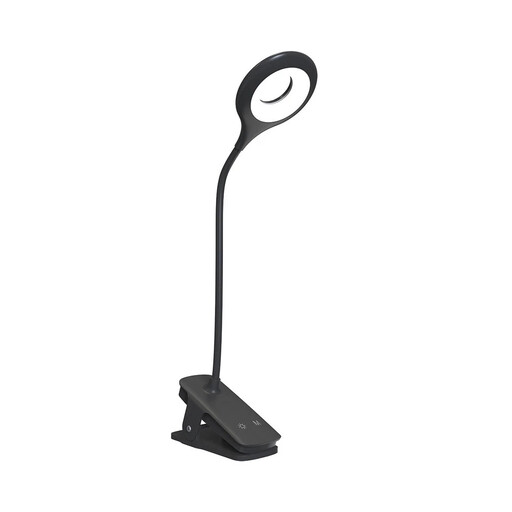
Why this product fits the profile: For readers, students and anyone who works from different spots, this LED reading lamp combines a clip-on design, battery power and adjustable light modes.
Rather than listing just a single brightness figure, the product specifies five brightness levels and five mixed light modes between 3000 and 6500 K.
1800 mAh battery, USB-C port, memory function and a stated operating time of 4 to 32 hours depending on the setting.

Why this product fits the profile: This RGB LED video light is designed for mobile recording, streaming, photography and video calls, where colour and positioning need to be adjusted flexibly.
The controls distinguish between CCT, RGB and scene modes. The included diffuser can soften the light distribution; the light is noted as not being waterproof.
360-degree colour selection, CCT and scene modes, plus mounting options via cold shoe adapter and tripod accessories.
We've put together a full, regularly updated list of products that fully meet these strict selection criteria and the safety regulations in force in the EU.
That depends on the work surface, distance and desired light distribution. For a small, targeted area, a lower luminous flux may be sufficient. For larger desks or broader illumination, higher lumen values make sense. It's also important whether the light is glare-free and adjustable onto the surface.
The lifespan is stated by the manufacturer in operating hours and depends on factors such as heat dissipation, usage duration and electronics. For the Aigostar clip lamp, for example, 20,000 hours are specified, and for the flat recessed spotlight, 30,000 hours. These values are technical specifications and not a guarantee of identical service life in every household.
In many applications, LED lamps operate with a lower power consumption than comparable conventional bulbs. For running costs, the wattage, daily usage time and electricity tariff all matter. A 10 W light running for several hours a day will naturally consume more than a 2.5 W clip lamp used for the same amount of time.