
Lieferung heute & morgen

Qualitätsgarantie

Willkommens-Angebote freischalten: KOSTENLOSE Lieferung | Bis zu 80 % RABATT | Kostenlose 30-Tage-JoyPlus-Testphase
App herunterladen
The right lighting is about more than just design. An LED ceiling light may seem too dim in the living room, while a cool-white LED ceiling light can feel too stark in the bedroom. Decorative LED lamps also usually serve a different purpose from a central ceiling light.
Before buying, households should therefore avoid three common pitfalls:
Luminous flux is measured in lumens (lm). A higher lumen value generally means more light output. However, the brightness you need depends on the size of the room, ceiling height, wall colour and intended use.
An LED living room lamp should usually provide even general lighting. An additional directional light can be useful for a reading chair or desk. In a hallway, a less powerful solution is often sufficient, provided that no dark areas are left.
Power consumption in watts (W) shows how much electrical energy the light uses during operation. A 24-watt light with 2,300 lumens may therefore be sufficient for many everyday situations, while a 36-watt light with 4,000 lumens will illuminate a space much more brightly. These values should always be considered together.
Colour temperature is measured in Kelvin (K):
A warm-white LED ceiling light can create a calm, understated atmosphere in the bedroom or living room. By contrast, a cool-white LED ceiling light with 6,500 K is designed to provide good visibility and a more functional lighting effect. Personal perception is also influenced by furniture, wall colours and existing lighting.
Before ordering, compare the diameter, height and installation method with the space available. For rooms with low ceilings, slim ceiling lights are often more practical than models with a longer suspension. In rented properties, it may also be important to check whether the light can use existing drill holes or requires additional fixings.
You should also check:
Permanently wired ceiling lights should be installed in accordance with the applicable safety requirements. In Germany, work on electrical installations may require a qualified electrician.
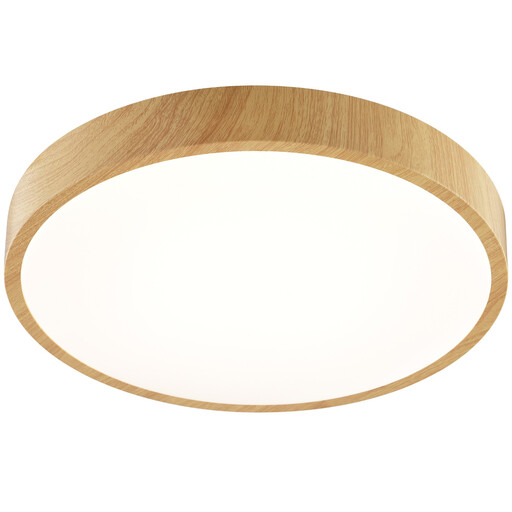
Why this product suits this profile: The round design with a wood-effect finish works well in living rooms, bedrooms, hallways or dining areas, and there is no need to order a separate bulb.
The specifications state the luminous flux, power consumption and colour temperature, and clearly indicate that there is no dimmer. This makes it easier to assess how suitable it will be before buying.
24 W, 2,300 lm, 3,000 K warm white; diameter 38.5 cm; plastic wood-effect finish.
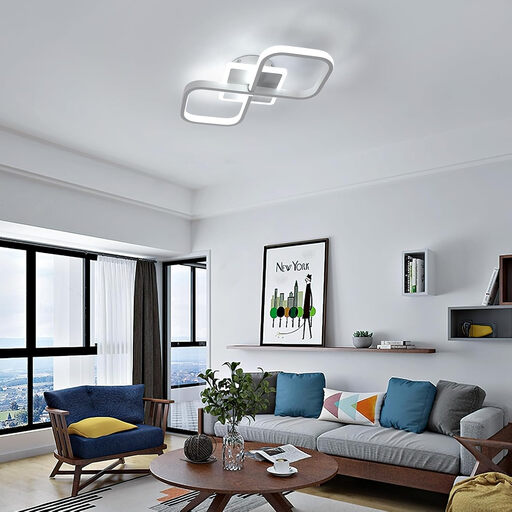
Why this product suits this profile: The combination of geometric styling, high light output and an acrylic cover is aimed at households looking for clear, modern ceiling lighting for larger or multifunctional rooms.
The product specifications clearly state 4,000 lm and 6,500 K. This makes it easy to distinguish its bright, cooler light from warm-white bedroom lighting.
36 W, 4,000 lm, 6,500 K; integrated LED technology; stated product lifespan of 50,000 hours.
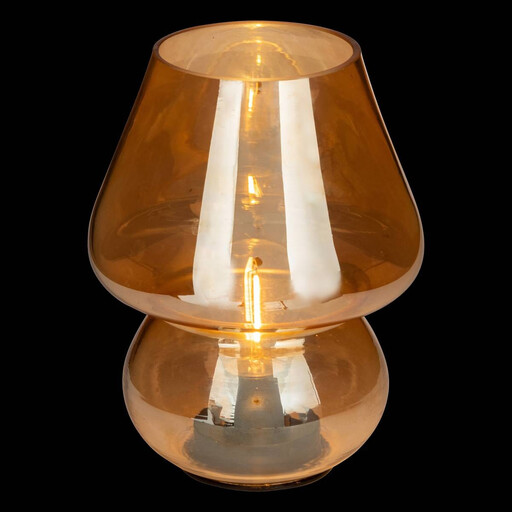
Why this product suits this profile: This compact table lamp works as a decorative LED lamp on a side table, coffee table or sideboard when permanent ceiling installation is not wanted.
The low light output of 30 lm is stated transparently. This makes clear that the lamp is intended as accent lighting, not as a replacement for central room lighting.
Height 19 cm; iridescent glass effect; bulb included; according to the product description, up to 48 hours of battery life with two batteries.
Ceiling lights are usually the obvious choice for even general illumination. An LED bedroom lamp with 3,000 K can create a warmer atmosphere, while a 6,500 K light is more suited to providing clear visibility. In a home office, you should also check whether reflections appear on the screen.
A rechargeable table lamp is particularly flexible if you want to move the light regularly. According to the product specifications, however, the Cara lamp is battery-operated. Before buying, you should therefore decide whether you prefer batteries or a rechargeable battery.
A simple calculation can help estimate running costs: Power in watts × hours of use per day × electricity price. A low wattage can reduce consumption, but actual usage time and lumen output are also important. The energy efficiency class should be checked directly in the relevant product data sheet; the Teranon light is listed as class F.
We have put together a complete, regularly updated list of products that fully meet these strict selection criteria and the safety regulations applicable in the EU.
This depends on the size and use of the room. For a small area, a light with around 2,000 to 2,500 lumens may be sufficient. In larger or frequently used rooms, a higher value may be more suitable. Several light sources provide more even distribution than one very bright lamp.
Warm-white light of around 2,700 to 3,000 K is often perceived as more subdued. A cool-white LED ceiling light with 6,500 K creates a noticeably cooler lighting effect, so it should be chosen to suit how you want to use the room.
Lifespan depends on the product and should be stated in the technical specifications. The white acrylic ceiling light is listed as having a lifespan of 50,000 hours according to the product description. This is a manufacturer’s specification, not a guarantee of identical operating life under all conditions. Installation, heat generation and daily use can affect the actual lifespan.