
Lieferung heute & morgen

Qualitätsgarantie

Willkommens-Angebote freischalten: KOSTENLOSE Lieferung | Bis zu 80 % RABATT | Kostenlose 30-Tage-JoyPlus-Testphase
App herunterladen
The right lighting isn’t just about a lamp’s shape or price. For home office, study, reading and creative tasks, what really matters is the amount of light, how it’s distributed, how the lamp is operated and how stable it is. If you only focus on a high lumen count or a modern design, you could end up buying a lamp that dazzles in daily use, doesn’t illuminate enough surface area, or becomes impractical after a short time.
A high luminous flux describes how much light a fixture emits overall. However, it says little about whether the light actually reaches your work surface. An LED floor lamp that shines mostly upwards can brighten a room while your desk remains too dark.
For a workspace, light distribution is therefore crucial. Direct light supports tasks on the desk, while indirect light can reduce harsh contrasts in the room. For a living room lamp, a broad and pleasantly distributed illumination is often more sensible than a tightly focused beam of light.
Labels such as eye-friendly lighting, eye-care or flicker-free light should not be taken as a fixed standard without scrutiny. Look for concrete specifications like flicker behaviour, glare limitation, colour rendering and light stability. Medical claims cannot be derived from such marketing terms.
For screen work, a monitor light bar can be interesting because it illuminates the workspace without shining directly onto the monitor. What matters is that no reflections appear on the screen.
A simple on/off switch offers no adaptation to different tasks. A dimmable lamp with a touch dimmer, foot switch or remote control can be more practical. However, check whether the brightness is steplessly adjustable or only in a few steps, and whether the last setting is saved.
Luminous flux is given in lumens (lm). A small reading lamp needs less light than a large office light. With a floor lamp, you should also check whether the light is emitted directly, indirectly, or in both directions.
Position the lamp so that your hand or head doesn’t cast an annoying shadow on the work surface. Right-handed people often place a task lamp on the left, left-handed people on the right.
Colour temperature is given in Kelvin (K):
The CRI or Ra value describes colour rendering. A higher value can be useful for drawing, sewing, model making or other colour-critical tasks. For these activities, a lamp with a verifiable CRI specification is more sensible than a pure advertising claim.
Check before buying:
With a height-adjustable lamp, the construction should remain stable after adjustment. For floor lamps, a stable base and safe cable routing are especially important. The IP rating indicates how well a product is protected against the ingress of foreign objects and water. For dry indoor spaces, a low protection rating is often sufficient; the manufacturer’s specific details remain decisive.
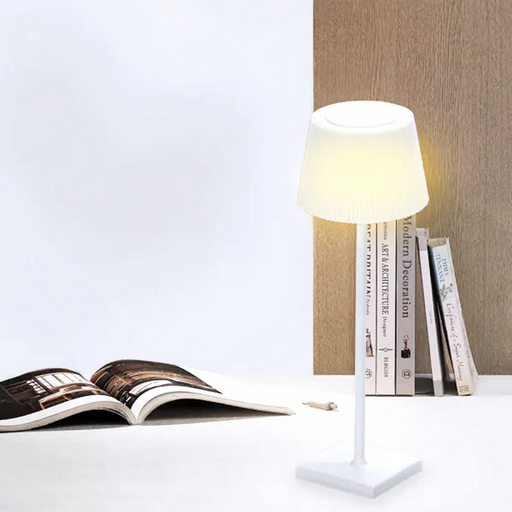
Why this product fits the profile: This compact LED desk lamp is suitable for reading, studying and flexible workspaces. The built-in battery allows operation without a permanently connected cable.
The product description states 400 lm, three colour temperatures from 3,000 to 5,000 K and touch dimming instead of a vague comfort claim.
Battery with 2 × 1,800 mAh, flexible lamp neck and 4 W power consumption according to product data.
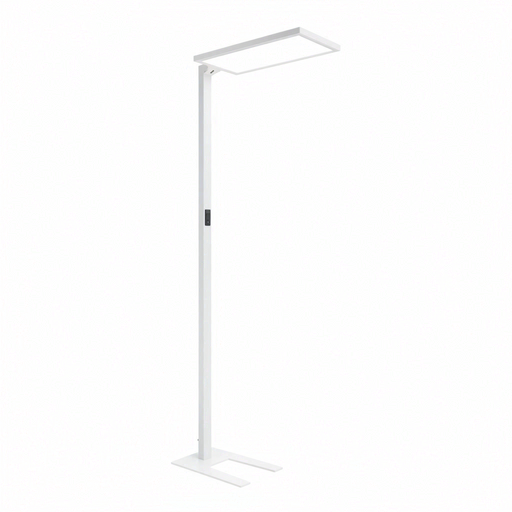
Why this product fits the profile: This lamp is aimed at home office workspaces and offices where a large area needs to be evenly illuminated.
Instead of only stating a total value, the product description lists direct and indirect light components separately. The stated UGR value is below 19.
Up to 12,600 lm, 4,000 K, touch control panel as well as daylight and motion sensor according to manufacturer specifications.
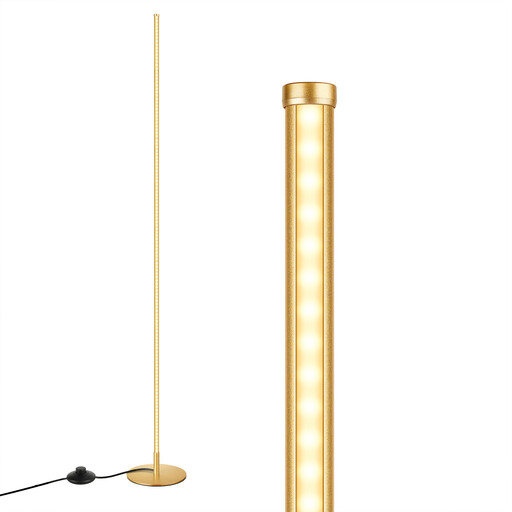
Why this product fits the profile: This slim LED floor lamp is designed for living rooms, bedrooms, reading and working next to the desk.
The lamp offers a specific light colour of 3,000 K, a foot switch with stepless dimming and a memory function.
Height-adjustable construction, warm white light and integrated LED source; energy efficiency class F is stated.
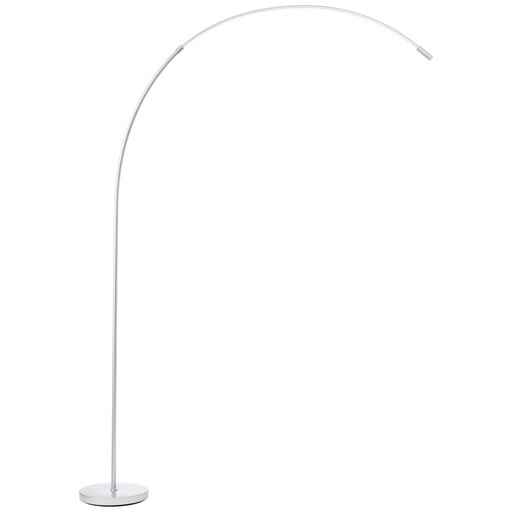
Why this product fits the profile: As a living room lamp, this curved model combines room lighting with an adjustable light mood and also works well as a reading lamp next to a sofa or armchair.
The specifications don’t just say “dimmable” – they mention a touch dimmer, 1,300 lm and a CCT range of 3,000 to 6,500 K.
179 cm height, 14 W power consumption, stepless dimming and 2.28 m cable according to the product description.
We’ve put together a complete, regularly updated list of products that fully meet these strict selection criteria and the safety regulations in force in the EU.
A fixed number doesn’t suit every workspace. What matters are desk size, distance, beam angle and personal visual habits. Always compare lumens together with light distribution and dimmability.
LED technology can have a lower power consumption for a comparable amount of light. However, for running costs, what counts are the wattage, daily operating hours and electricity tariff. The energy efficiency class and stated consumption should be checked before buying.
The lifespan is usually given by the manufacturer in hours. It depends on factors including heat dissipation, operating time and component quality. With permanently integrated LEDs, you should also clarify whether the entire product needs to be replaced if it fails.