
Lieferung heute & morgen

Qualitätsgarantie

Willkommens-Angebote freischalten: KOSTENLOSE Lieferung | Bis zu 80 % RABATT | Kostenlose 30-Tage-JoyPlus-Testphase
App herunterladen
LED ball string lights can add decorative lighting to your balcony, patio, living room or garden. Before you buy, though, it’s worth checking the technical details carefully. Product images often show an even, bright glow, but in everyday use, the length, power supply and weather protection are what matter most.
An IP44 string light is generally protected against solid objects and splashes of water from different directions. However, this doesn’t mean that every component should be exposed to heavy rain, snow or standing water for long periods. With many models, the protection applies mainly to the string lights, while the power supply, battery compartment or controller needs to stay dry.
IP44 may be suitable for a covered patio or balcony. For exposed locations, check whether a higher protection rating is specified and which components are actually weather-protected.
String lights for indoor and outdoor use are often advertised by their total cable length. This may include a lead cable and the distance to the power supply. When planning your set-up, check these three measurements:
A short string with closely spaced LEDs may look more evenly lit on a small balcony than a longer model with larger gaps. For a garden fence or patio, however, 10, 20 or 30 metres is often more practical.
A string light with 8 modes usually offers a combination of steady light, flashing, wave and fade effects. This choice can be useful for parties or Christmas decorations. In everyday use, though, warm white steady light is often all you need. A memory function is handy if the lights keep your last chosen setting after being switched off.
Warm white string lights tend to create a subtle look in living rooms, on balconies and at weddings. The colour temperature can vary from one model to another. A rating such as 2700 K indicates a warmer light. The number of LEDs alone, meanwhile, doesn’t tell you much about the actual brightness. The size of the balls, their spacing, the material and the way the light is distributed all affect the overall look.
Clear balls often create a more focused, pinpoint effect. Plastic balls or those with a decorative finish can diffuse the light more softly. For even garden lighting, it’s worth considering the spacing between the lights as well as the number of LEDs.
A timer can automate switching the lights on and off each day. Check whether it offers set cycles such as 3, 5 or 8 hours. For outdoor installations, it’s also important to check whether the controls need to be kept in a sheltered place. A flexible cable makes installation easier, but it shouldn’t be sharply bent or subjected to constant mechanical strain.
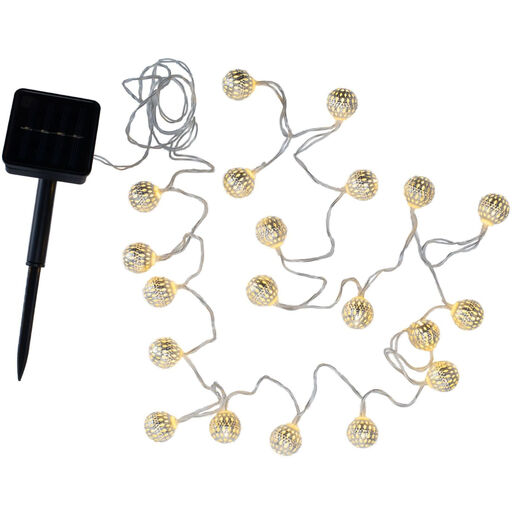
Why this product suits this profile: This model is well suited to small gardens, balconies and patios without a nearby socket. The warm white balls provide decorative ambient lighting.
The product details specify a length of 5 m, 20 lights and solar power. This makes it easier to work out whether it will cover the area you need, rather than relying on the product image alone.
Solar panel, 2700 K light colour and four lighting modes; how long the lights stay on depends on the weather and charging conditions.
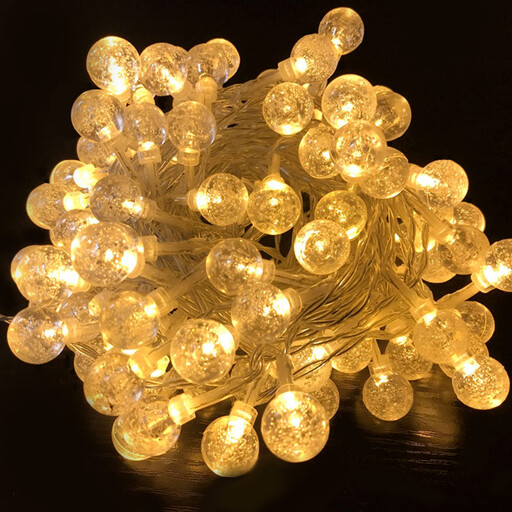
Why this product suits this profile: With a length of 10 m, 80 LEDs, eight modes and a memory function, this model is a good choice for buyers comparing technical details and looking for flexible indoor and outdoor use.
The product details distinguish between the string lights’ IP44 protection and the need to keep the controller dry. This helps avoid mistakes when planning an outdoor installation.
31 V low voltage, flexible PVC cable and a memory function; cable is available in clear or dark green, depending on the version.
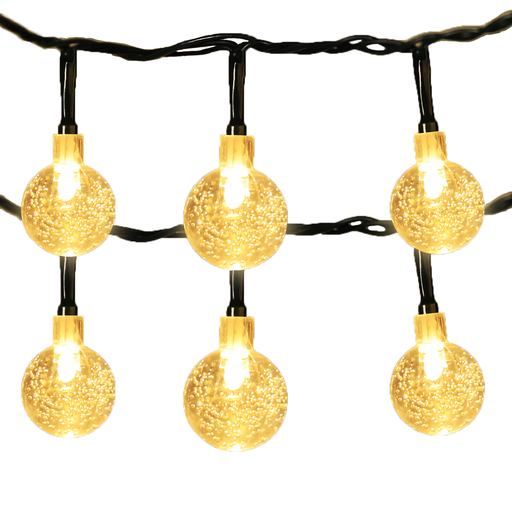
Why this product suits this profile: The 10 m version is ideal for longer railings, trees, marquees, patios and decorative displays at weddings or parties.
The product details list eight modes, a memory function and IP44 protection. Bear in mind, though, that the solar panel needs to be positioned in a sunny spot to charge effectively.
40 crystal balls, solar power and automatic dusk control; these string lights are designed for decorative outdoor use.
We’ve put together a complete, regularly updated list of products that meet these strict selection criteria and fully comply with the safety regulations in force in the EU.
Before installation, measure the planned route and decide where to position the power supply or solar panel. Don’t run cables over sharp edges. For outdoor installations, keep the battery compartment, adapter and controller protected from direct moisture, in line with the manufacturer’s instructions.
A soft, dry cloth is usually all you need for cleaning. Regularly remove dust and leaves from the solar panel. Before each use, check for damaged cables, cracks or loose sockets. Don’t continue using the string lights if you find any damage.
Compact solar- or battery-powered models are handy for balconies, provided there’s enough daylight or a dry place for the battery compartment. If you have a socket, a longer IP44 string light may also be suitable. The key things to consider are the width of the railing, the lead cable and protection for the controller.
Energy use depends on the number of LEDs, their power rating and how long the lights are on each day. Solar- and battery-powered models don’t use mains electricity at the point of use. For mains-powered lights, you can estimate energy use from the stated wattage and how long you use them. A timer can help avoid unnecessary running time.
Lifespan depends on factors including operating hours, heat, moisture, storage and the quality of the electrical components. A general advertising claim won’t necessarily apply to every product. Storing the lights in a dry place, avoiding kinks in the cable and following the protection instructions can help reduce typical wear and tear.